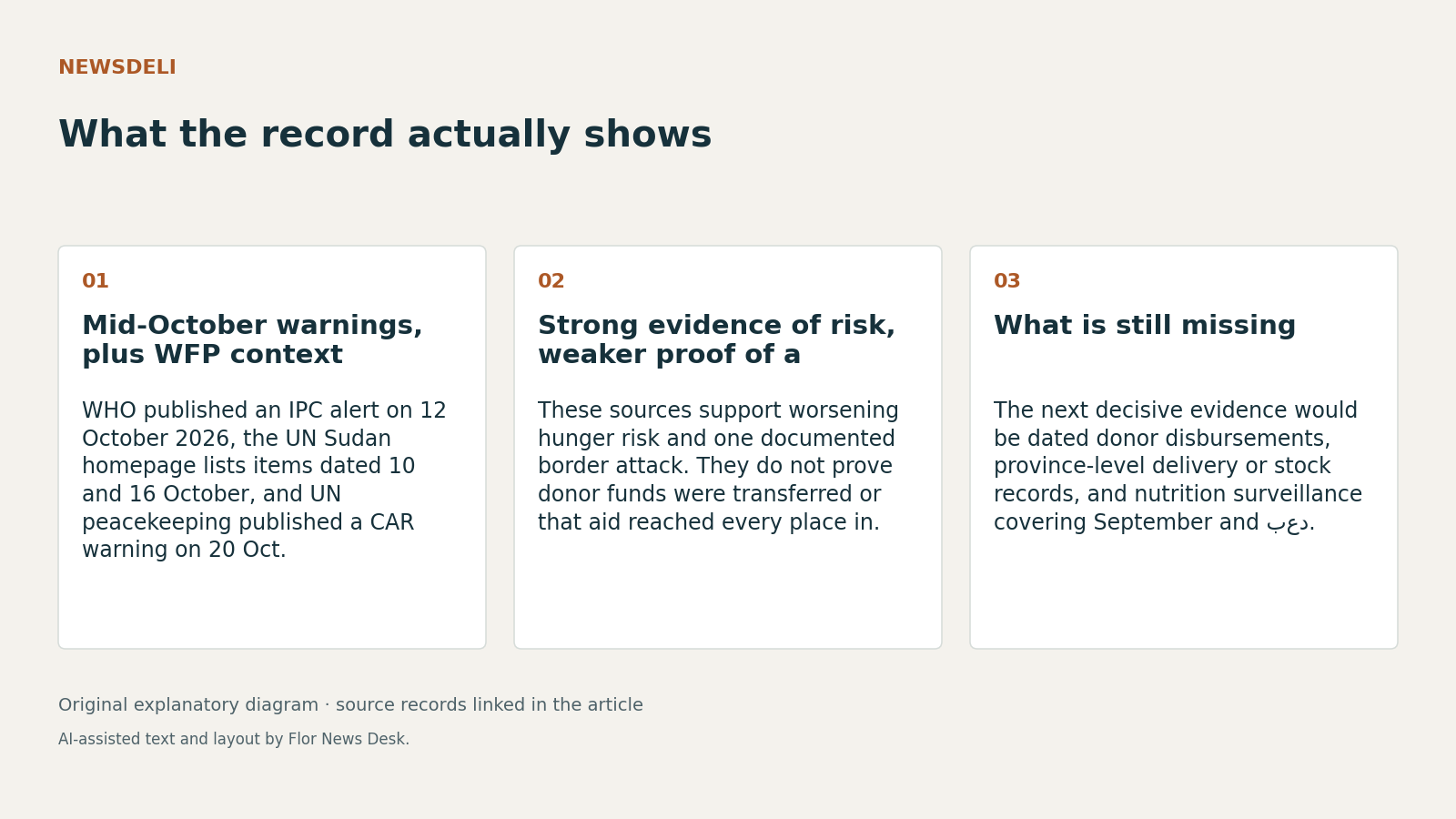
The clearest new warning in the public record came from the UN system in mid-October, but not every source in this package was published then. On 12 October 2026, WHO said the Integrated Food Security Phase Classification issued a Food Insecurity and Malnutrition Alert for Sudan. The United Nations in Sudan homepage also shows a 10 October 2026 statement by Resident and Humanitarian Coordinator Denise Brown and a 16 October 2026 item titled “Severe rainfall deficits in Sudan,” though the homepage text alone does not verify their full contents. WFP adds context through an undated Sudan emergency page, retrieved on 21 October 2026, and a 22 September 2026 WFP story. That timing matters, because it means the record supports a cluster of UN warnings in October plus WFP background, not a claim that WFP published a new warning in the 10-20 October window.
Taken together, those sources describe a fast-worsening hunger emergency. WHO said the IPC was warning of a growing famine risk across parts of Greater Darfur and Greater Kordofan, driven by conflict, mass displacement, severe drought and inadequate humanitarian funding. WHO also said an El Niño-induced drought was affecting roughly half of Sudan and that health care and clean water were increasingly scarce.
What that WHO page proves is limited but important. It reports that WHO supported all 161 operational nutrition stabilization centres in Sudan in 2026 and helped treat more than 26,000 children with severe acute malnutrition and medical complications between January and August. It also says 37 percent of Sudan’s health facilities had stopped functioning by 2026, and that only 23 percent of WHO’s US$97.7 million humanitarian appeal had been funded. Those are institutional claims about need and response. They do not show what happened in September or October, or provide independent verification for every locality.
WFP’s public numbers point the same way, with similar limits. Its Sudan emergency page says 19 million-plus people are facing acute hunger, almost 19.5 million face crisis levels of hunger, 825,000 children under 5 are expected to suffer severe acute malnutrition in 2026, and 9 million people have been forced from their homes by the conflict. WFP also says disruptions in the Red Sea are delaying imports and raising the cost of food, fuel and fertilizer. But the same page is undated, and its statement that WFP urgently needs US$579 million for operations “to October 2026” does not show whether cash arrived later in the month.
The stronger operational detail comes from WFP’s 22 September story. In that piece, WFP said funding shortfalls were forcing further ration cuts for 950,000 displaced people in Tawila, North Darfur, even as it was reaching more than 4 million hungry people a month in recent months. The same article said up to 3,000 refugees and returnees were arriving weekly in South Sudan from Sudan, while WFP in Chad had prioritized newly arrived refugees because of resource pressure.
The regional spillover case is clearest in the 20 October 2026 UN peacekeeping report on the Central African Republic. It said Special Representative Valentine Rugwabiza told the Security Council that a 30 June attack on Am-Dafock, on the Sudan border, killed civilians and members of national security forces, displaced 17,000 civilians and injured six UN peacekeepers before the attackers retreated into Sudan. That is concrete evidence of cross-border destabilisation. It is not a full regional count.
So the useful distinction for readers is simple. By 21 October 2026, the public record strongly supports rising famine risk and regional strain tied to Sudan’s war. It is much thinner on whether donor pledges became disbursements, which provinces actually received food or medical stocks, and whether nutrition outcomes improved after August. An older UN Sudan Annual Results Report 2025, published on 14 July 2026, helps explain why that gap matters: it said the 2025 humanitarian plan received only 40 percent of requested funds while malnutrition rose and the health system was overwhelmed.