Finding a vacancy online and sustaining a job are different achievements. A digital service designed around the first task can appear successful while leaving the second largely unmeasured.
The ILO’s September 9 account of a Berlin seminar discusses how digital innovation can support more inclusive employment pathways, including for people with disabilities. The event took place on September 1 and 2. Its discussion extended beyond job matching to continuing support, accommodation and progression. An account of a professional seminar is not, by itself, a controlled evaluation showing that a particular technology improved employment outcomes.
The pathway has more than one doorway
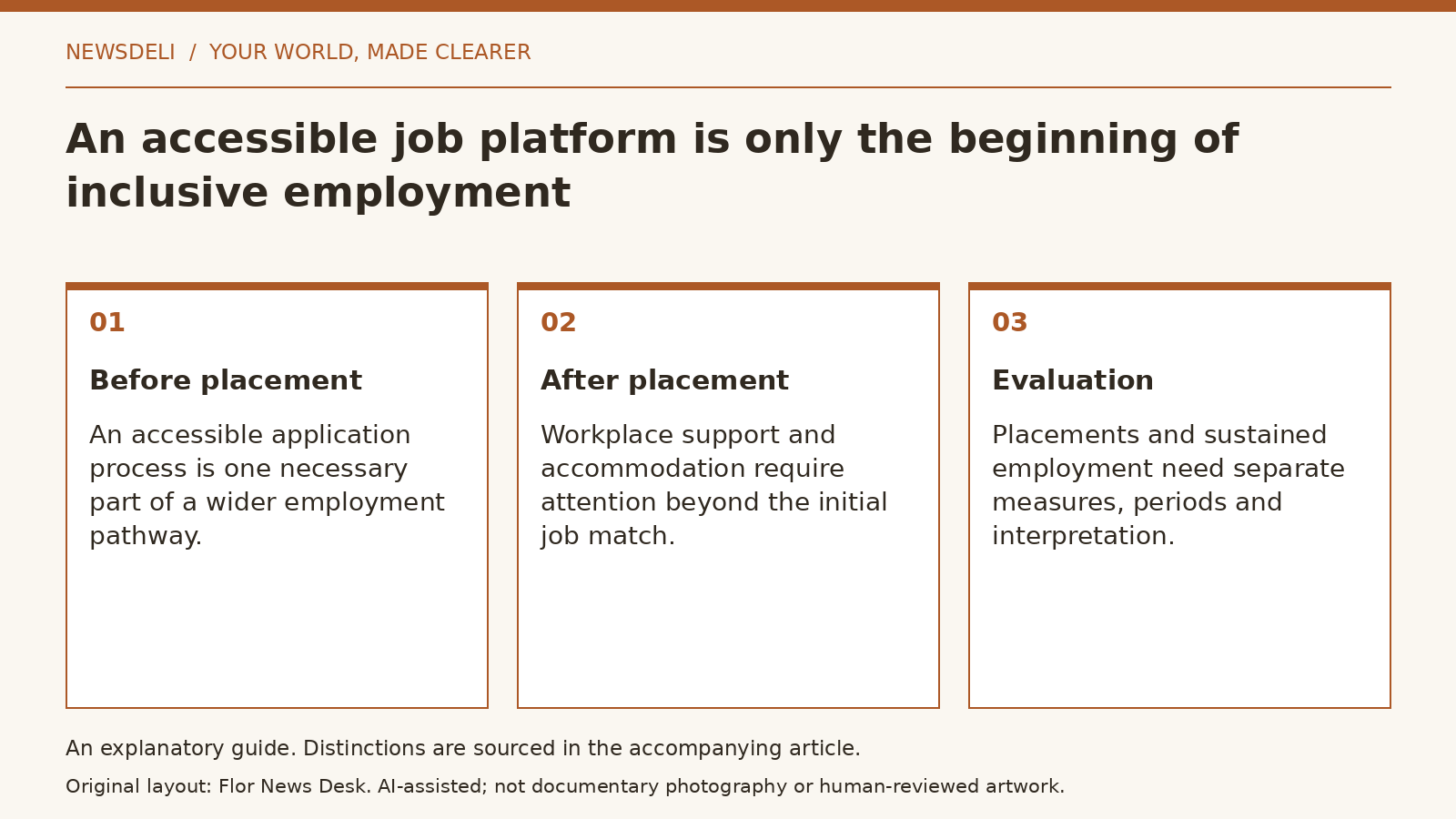
A useful way to examine an employment service is to follow a person’s hypothetical journey. Can the person access the platform, understand the vacancy, complete the application and communicate their requirements? After placement, is there a way to obtain support or resolve a problem? These questions describe design tests, not the experience of an identified participant.
Improving one doorway does not prove that all later ones are open. Conversely, a service may provide valuable support after placement that a simple count of applications fails to capture. The choice of measurement can therefore shape which parts of the experience are visible.
Inclusion is about work, not just software
The ILO’s disability-and-work overview treats equal opportunity and inclusion within the world of work as the broader objective. Reading the digital discussion alongside that objective prevents the platform itself from becoming the final measure of success.
For example, an accessible form could help someone submit an application while saying nothing about the accessibility of an interview or the support available in the workplace. The form matters, but its contribution should be described at the stage where it operates.
Measure continuity without erasing choice
An evaluation could distinguish completed applications, placements, sustained employment and changes in job quality. It would also need clear periods and definitions. Remaining in a job is not automatically a positive outcome under every circumstance, and leaving one is not automatically evidence that a support service failed. Understanding the person’s choices and conditions would be part of interpreting either result.
The practical lesson from this distinction is modest but important: technology should be assessed against the employment pathway it is meant to support. A compelling demonstration or a high placement total is insufficient evidence for claims about every later stage.
The seminar points toward a wider design question. Instead of asking only whether a digital system can connect people with vacancies, ask what happens after that connection, and what evidence the service gathers to find out.