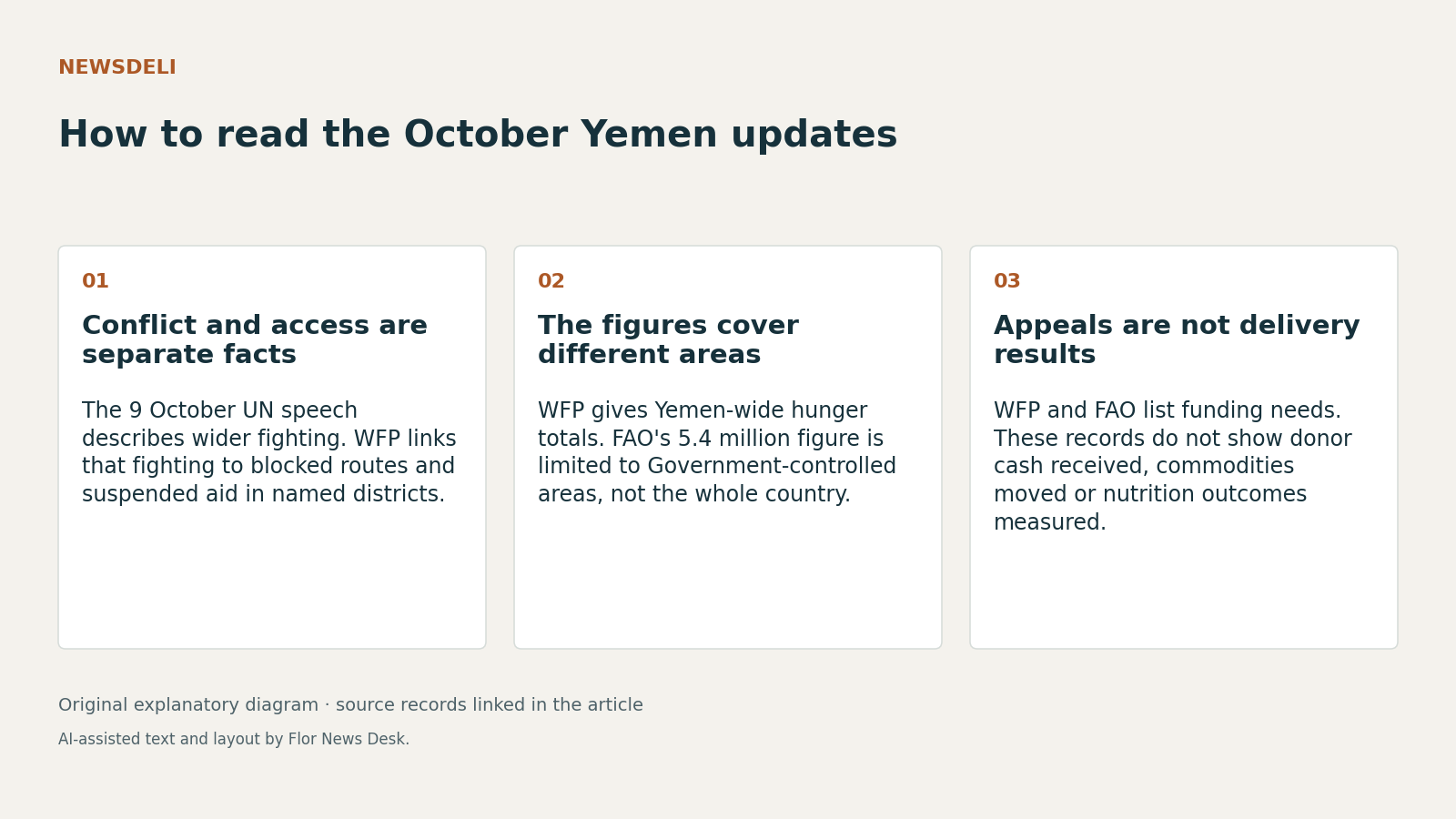
As of 17 October 2026, the strongest documented shift in Yemen is not a proven national nutrition outcome. It is a tightening link between renewed fighting and worsening humanitarian access. In records published between 2 and 16 October, the World Food Programme said conflict had displaced more people, cut off more communities and forced it to reshuffle planned assistance, while the UN Special Envoy told the Security Council on 9 October that the country had slipped back into full-scale war over the previous weeks WFP, 2 October Special Envoy remarks, 9 October WFP, 16 October.
The conflict record matters because it explains why the food story is moving. On 9 October, Hans Grundberg said the Government of Yemen had launched a counter-offensive earlier that week and had reported retaking areas around the Bab al-Mandab, while the humanitarian situation in Taiz was deteriorating rapidly Special Envoy remarks, 9 October. WFP’s updates then attached operational numbers to that picture. On 2 October, WFP said more than 150,000 people had been displaced in recent weeks and that conflict had blocked access to 350,000 people in parts of Taiz and Hodeidah WFP, 2 October. By 16 October, WFP said displacement had passed 200,000 and access cuts had widened to nearly 800,000 people across multiple districts in Al-Mokha, Turbah and Taiz WFP, 16 October.
The hunger totals need careful reading because the agencies are not all measuring the same geography. WFP’s October updates describe a Yemen-wide emergency, putting severe hunger or acute food insecurity at just over 18 million people nationally and acute malnutrition among children under 5 at 2.2 million on 2 October, with more than 2 million young children on 16 October WFP, 2 October WFP, 16 October. FAO’s Yemen emergency page adds useful scale, but it is narrower and less clearly dated: it lists 5.4 million people facing high acute food insecurity and 4.8 million internally displaced people in areas controlled by the Government of Yemen, alongside an aim to assist 9.1 million people FAO Yemen page. That means FAO’s figure cannot be treated as a smaller national total or as a direct update to WFP’s national estimate.
The funding figures also answer a different question from the hunger figures. On 2 October, WFP said it had reallocated resources from food assistance planned for November and needed US$109 million for emergency food and nutrition support for up to 1.5 million people affected by the escalation, plus US$158 million to sustain regular operations for 2.4 million people through March 2027 WFP, 2 October. On 16 October, WFP said it needed US$268 million to sustain emergency food assistance, nutrition programmes, school meals, resilience activities and logistics services through 2027 WFP, 16 October. FAO’s page separately lists a 2026 requirement of US$86.6 million FAO Yemen page. Those are appeals and programme requirements, not evidence that money has been paid in, allocated inside Yemen or turned into deliveries.
What the October record does not establish is just as important. None of these documents confirms donor disbursements, post-16 October commodity movements, national distribution tallies or measured changes in malnutrition rates. WFP says it was supporting up to 2.4 million people in Government-controlled areas and had scaled up aid to more than 120,000 people in two southern displacement hotspots, but those are agency statements rather than independently verified delivery logs WFP, 16 October. FAO’s overview page has no clear publication date for its headline statistics, so its figures should be treated as contextual rather than a precise 17 October status check FAO Yemen page.
So the October evidence supports a narrower but still important conclusion: renewed fighting since September 2026 appears to be worsening hunger risk mainly by displacing people and interrupting aid access, while UN agencies are publicly warning that existing resources are inadequate Special Envoy remarks, 9 October WFP, 16 October. It does not yet prove that new financing has arrived, that planned scale-ups reached their full targets or that national nutrition outcomes have already changed in measured data.