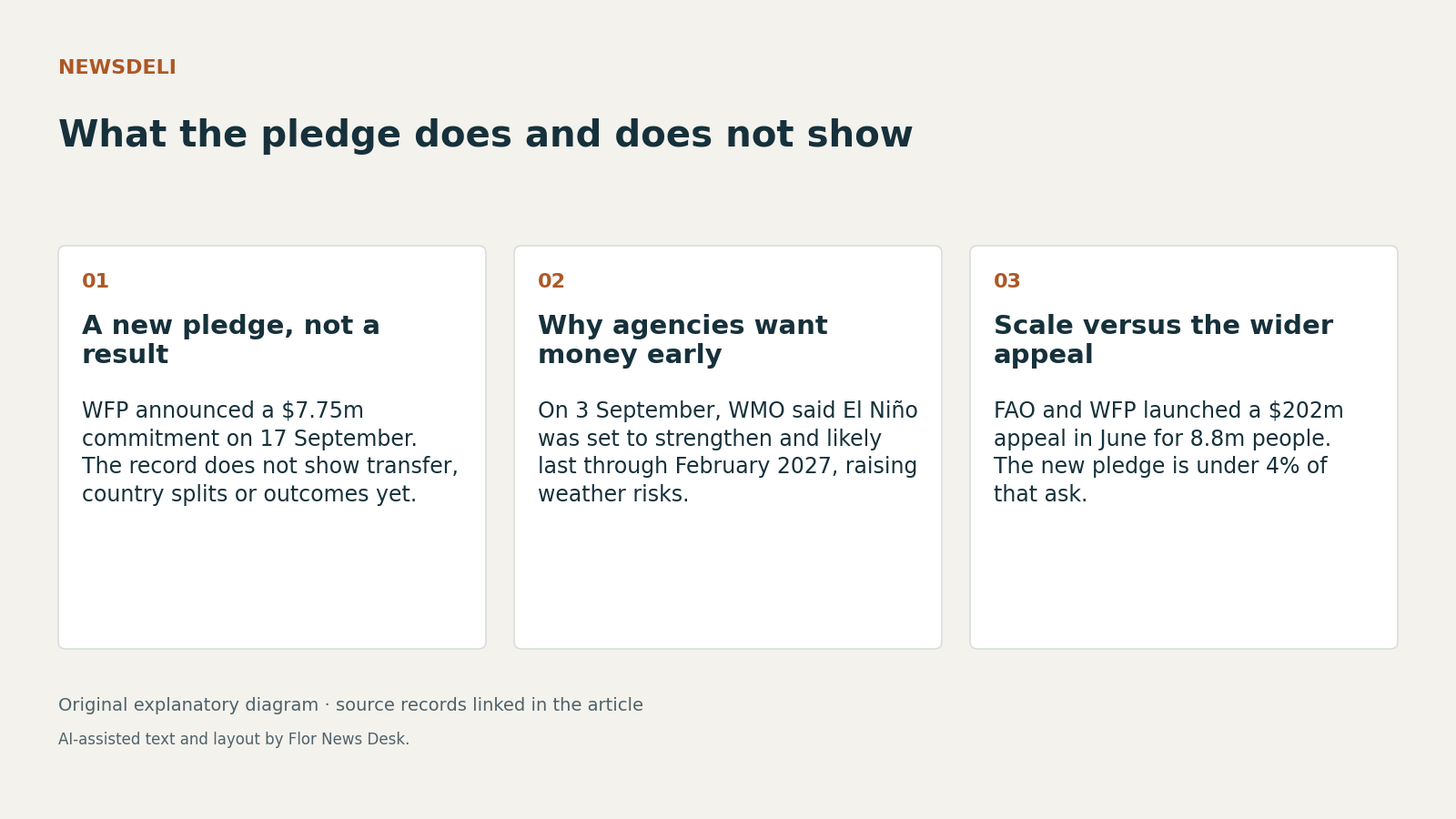
The World Food Programme’s 17 September 2026 announcement of a US$7.75 million commitment from the Novo Nordisk Foundation matters less as a fundraising headline than as a test of what “anticipatory action” can mean before El Niño worsens. WFP said the money is for action ahead of forecast weather shocks, including possible El Niño impacts, and described it as its largest private-sector investment for anticipatory action. It also said the funding could be allocated flexibly across 22 countries facing the highest risk of weather-related emergencies. WFP announcement
Why the timing matters is clearer than the likely outcome. On 3 September 2026, the World Meteorological Organization said El Niño was firmly established, expected to intensify to a very strong event in the coming months, and had an exceptionally high likelihood of persisting through February 2027. WMO also said climate impacts were expected to continue well into 2027, including risks linked to shifts in rainfall and temperature such as floods, drought and extreme heat. That is a forecast update, not evidence that any particular country has already suffered those effects or that any funded action has worked. WMO update
The new pledge fits into an older and much larger request. FAO and WFP said on 22 June 2026 that they had launched a joint El Niño 2026 Anticipatory Action Appeal seeking US$202 million to support 8.8 million people in 22 high-risk countries. In that Geneva briefing, FAO and WFP tied the appeal to worsening hunger hotspots and to the risk that emerging El Niño conditions could disrupt agricultural production across several regions. FAO-WFP appeal launch
That makes the Novo Nordisk Foundation commitment significant in one sense and limited in another. Measured against the joint appeal, US$7.75 million is about 3.8% of the US$202 million sought. The practical value, based on WFP’s description, is not that it closes the funding gap, but that it adds money WFP says can move across 22 countries as forecasts and operational needs change. If a weather risk sharpens in one place and eases in another, flexible funding is more adaptable than money fixed to one location before the hazard picture is clear. That is analysis from the structure of the announcement, not proof of implementation.
The same sources also show why readers should resist treating the pledge as evidence of readiness. WFP said possible uses include anticipatory cash transfers, support for early warning systems and predictive analytics, but it did not identify the 22 countries, provide a disbursement timetable, break down spending by activity, or confirm that the money had already been transferred. WFP announcement So the record supports a narrower claim: a major private commitment was announced for early action, with broad intended uses, but the article trail needed to judge delivery is still missing.
Scale is the other caution. WFP said its own analysis projects that El Niño effects could push 49 million people into acute food insecurity by the end of 2027. WFP announcement That figure and the 8.8 million people targeted by the FAO-WFP appeal are not directly interchangeable: one is a projected impact number, the other is a planned coverage number. Still, placed side by side, they show that even full funding of the current appeal would address only part of the broader risk picture that WFP is describing.
The June briefing helps explain why this kind of money attracts attention. FAO and WFP’s summary said WFP’s Richard Choularton identified timely and flexible financing as the main constraint to scaling anticipatory action, rather than technical capacity. FAO-WFP appeal launch The new pledge therefore looks important less because it settles the preparedness problem, and more because it partially addresses the specific bottleneck the agencies themselves highlighted.
What to watch next is straightforward. The public record still needs country allocations, transfer and disbursement dates, the forecast thresholds used to release funds, and later monitoring that shows whether early cash, warning systems or other measures reduced harm when shocks arrived. Until those records appear, the announced US$7.75 million is best understood as new capacity to act early, not as proof that communities are already protected.