On 30 October 2026, the World Health Organization said Barbados had eliminated mother-to-child transmission of HIV as a public health problem. That is an important result, but it is also a tightly defined one. It does not mean HIV has disappeared from Barbados, and it does not prove future infant infections are impossible.
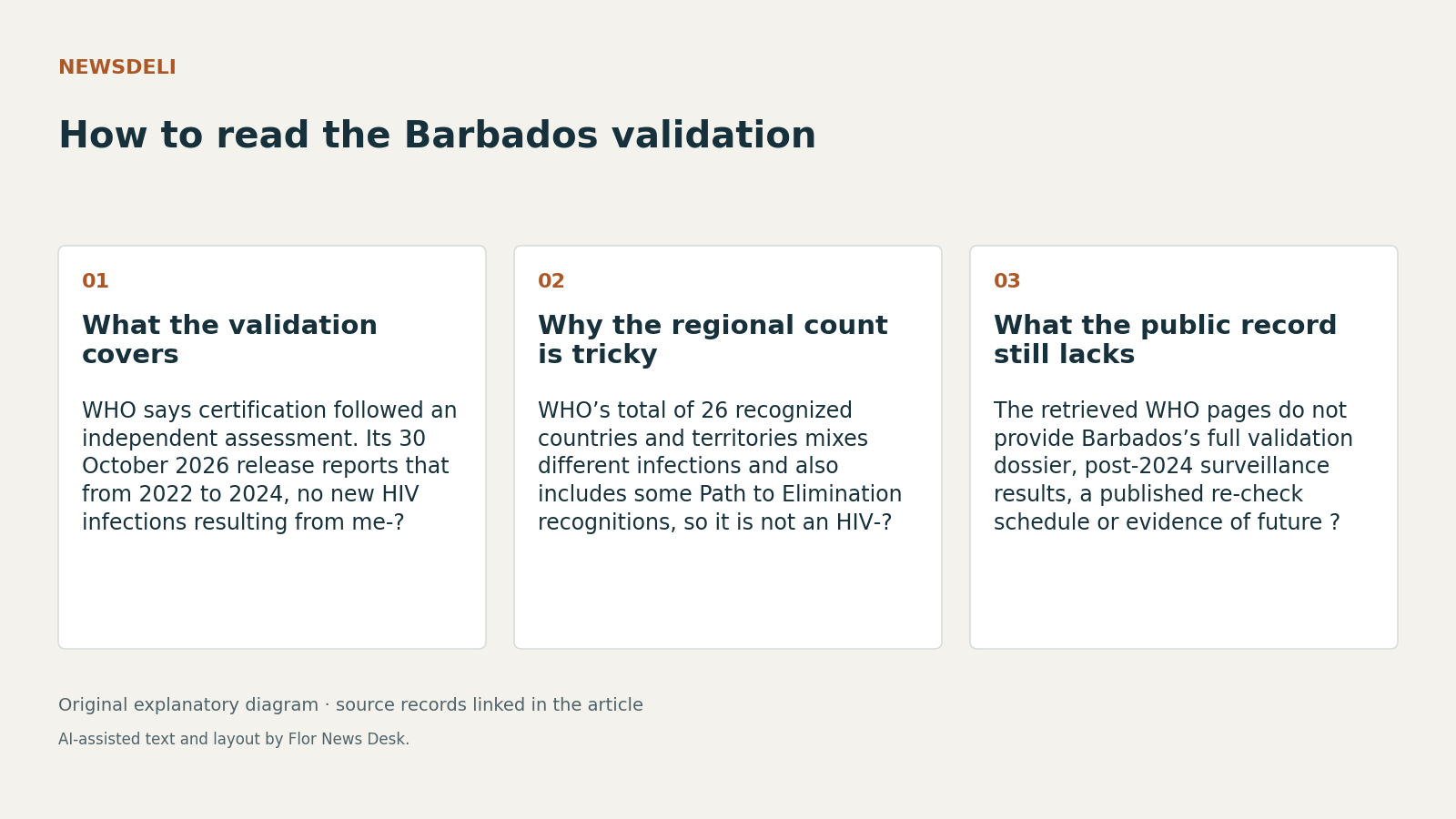
The public evidence WHO has made easy to inspect is narrower than that. In the 30 October release, WHO says its certification followed an independent assessment confirming Barbados met the global targets. The same release says that from 2022 to 2024, no new HIV infections resulting from mother-to-child transmission were reported among infants born in Barbados. It also reports three service-coverage figures for that same three-year period: 98% of pregnant women received antenatal care, 98% were tested for HIV, and 98% of pregnant women living with HIV received antiretroviral treatment. Those dates matter. The measured window described in the release ends in 2024, even though the announcement came in 2026. (WHO news release)
WHO’s broader validation overview helps explain what readers should, and should not, take from that. WHO says the term validation is used to attest that a country has met the criteria for eliminating mother-to-child transmission of HIV, syphilis or hepatitis B. Countries have been able to apply since 2015. In 2017, WHO added a separate Path to Elimination category for countries with higher maternal prevalence. In other words, this is a technical judgement against published standards, not a blanket declaration that risk is gone for good. WHO’s framework page also says maintaining validation requires sustained programme efforts.
That matters when readers see the regional comparison. In the 30 October release, WHO says Barbados joins 26 countries and territories worldwide recognized for eliminating mother-to-child transmission of HIV, syphilis or hepatitis B, or for being on track to do so, and that 15 of those are in the Americas. That is useful context, but it is not a like-for-like HIV league table. WHO’s overview page shows the list mixes HIV-only validations, syphilis-only validations, joint HIV-and-syphilis cases, at least one HIV-and-hepatitis-B case, and Path to Elimination recognitions. (WHO news release, WHO validation overview)
The limits of the source record matter too. As of 9 November 2026, the retrieved public material here is limited to two WHO pages. Those pages do not provide Barbados’s underlying validation dossier, post-2024 surveillance results, a published re-check schedule, or evidence that broader HIV indicators in Barbados are now improving or worsening. They also do not establish future financing.
WHO’s editor’s note adds useful service context. It says Barbados has universal public health care, Queen Elizabeth Hospital accounts for about 93% of births, and HIV testing and treatment are free for all pregnant women regardless of nationality. The same note says that keeping elimination status will require continued investment, updated guidelines, stronger health information systems, expanded HIV-syphilis testing, and better follow-up for women and children. Those are described as requirements for maintaining the status, not outcomes already shown in the public record. (WHO news release)
So the clearest reading is the narrow one: WHO has documented a three-year prevention milestone in Barbados, and that is significant on its own terms. It should not be stretched into claims about the whole HIV epidemic, post-2024 performance, or permanent success that the retrieved public evidence does not yet prove.