WHO’s 11 November member-state briefing changed the story of the Democratic Republic of the Congo’s Bundibugyo Virus Disease outbreak not only because the totals rose again, but because WHO linked those numbers to a direct blow against the response. The WHO Director-General said the country had reported almost 11,000 confirmed cases, more than 5,300 deaths and almost 3,000 recoveries across eight provinces. He also said an attack on Cantine-Aloya in the previous week killed 66 civilians, including three health workers, and that three health facilities were looted and burned WHO Director-General remarks, 11 November 2026.
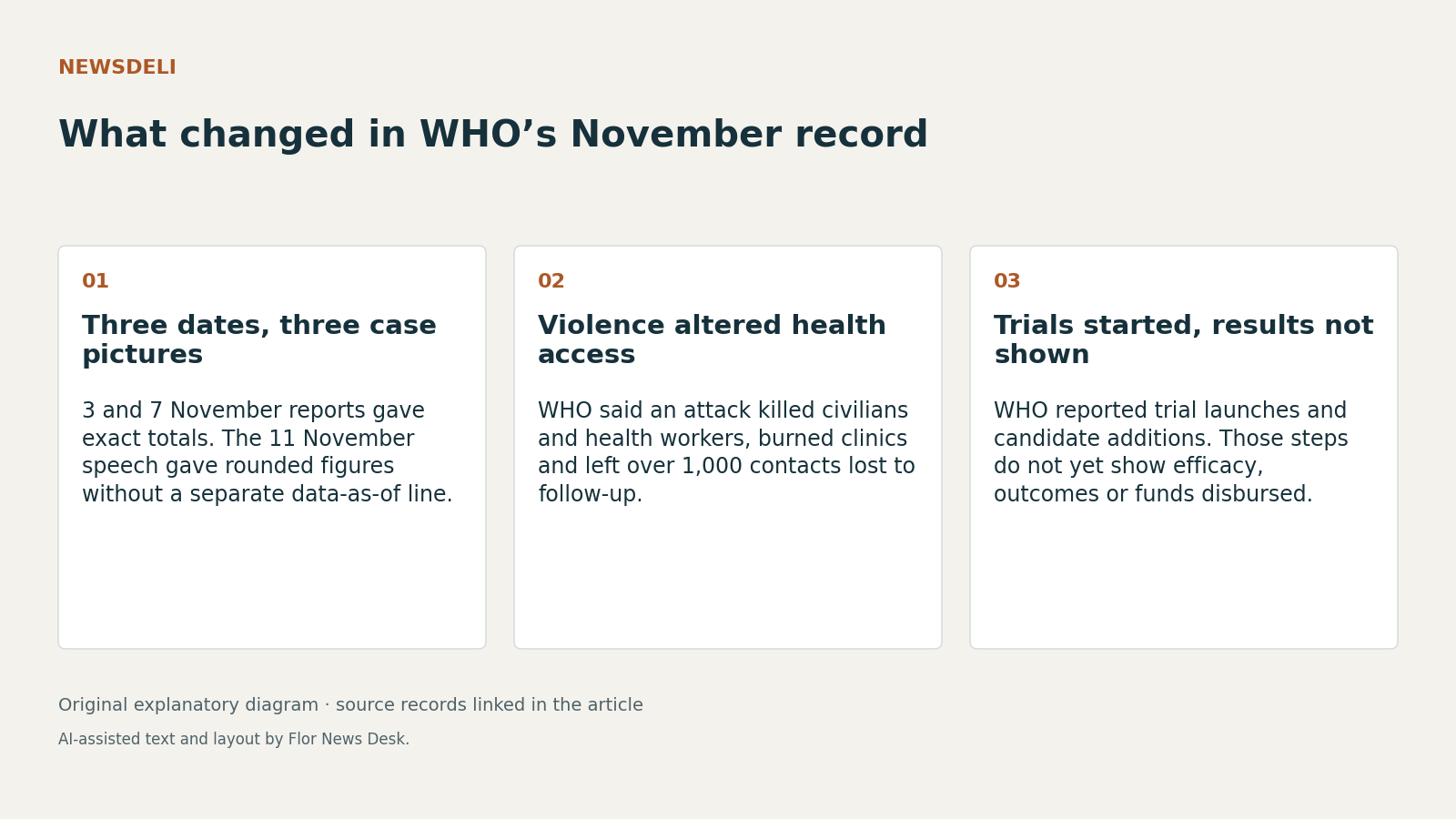
The case trend itself needs to be read as dated snapshots, not a single live total. WHO’s Disease Outbreak News, published on 6 November, said that as of 3 November the DRC had 10,668 confirmed cases, 5,198 deaths and 2,881 recoveries across 67 health zones in eight provinces, with active transmission in 51 health zones WHO Disease Outbreak News, 6 November 2026. The WHO Regional Office for Africa then said its External Situation Report 25 was using data as of 7 November, when the DRC had 10,920 confirmed cases and 5,323 confirmed deaths WHO AFRO External Situation Report 25. The 11 November briefing used rounded figures without a separate data-as-of line, so it shows direction and scale, but not a cleaner technical cut than the dated reports.
What makes the 11 November update more than another count is the way insecurity interferes with surveillance. The Director-General said more than 1,000 contacts had been lost to follow-up after the Cantine-Aloya attack and that three confirmed cases were unaccounted for WHO Director-General remarks, 11 November 2026. Separately, the WHO Africa regional summary said operational constraints already included insecurity in Beni health zone and Bafwasende, health-worker strikes in Bas-Uélé and Tshopo, and continued suspension of response activities in Bafwasende WHO AFRO External Situation Report 25. The analytical point is straightforward: when clinics are attacked and contacts disappear from monitoring, the problem is not only treatment capacity but reduced visibility into transmission.
WHO’s 6 November outbreak notice points in the same direction. It said 964 additional confirmed cases and 511 confirmed deaths had been reported since the previous Disease Outbreak News on 23 October, and that 335 of the 512 deaths reported since 21 October occurred in communities rather than treatment centres WHO Disease Outbreak News, 6 November 2026. Community deaths do not prove why people stayed outside care, but together with the later report of burned facilities and lost contacts, they suggest the published totals describe a response under strain, not a system steadily tightening control.
The cross-border picture is more limited than the headline numbers inside the DRC. WHO said that as of 3 November, Kenya remained at nine confirmed cases and two deaths, with no new confirmed case since 19 October WHO Disease Outbreak News, 6 November 2026. The regional summary said the importation events in Kenya and Nigeria remained contained as of 7 November WHO AFRO External Situation Report 25. On 11 November, the Director-General said Kenya discharged its final patient that day and began a 42-day countdown, while Nigeria had reported one imported case that was evacuated to Switzerland WHO Director-General remarks, 11 November 2026. That is evidence of importation and containment work, not evidence of sustained spread outside the DRC.
The vaccine and research record also needs careful separation between action and outcome. WHO’s 6 November notice said the Tumaini platform vaccine trial was launched in Bunia on 23 October 2026 and that expert groups had recommended adding the ChAdOx1 and Moderna mRNA-1469 candidates after national approvals WHO Disease Outbreak News, 6 November 2026. The Director-General said on 11 November that a trial using Ervebo had begun the previous month and that two vaccine candidates developed specifically for Bundibugyo virus had been recommended for addition WHO Director-General remarks, 11 November 2026. What the public record does not yet show is measured efficacy, treatment outcomes, or funding actually received and disbursed. So the main November shift is clear, but narrower than some headlines imply: WHO is reporting a larger outbreak, and also a response made harder to measure and harder to deliver.