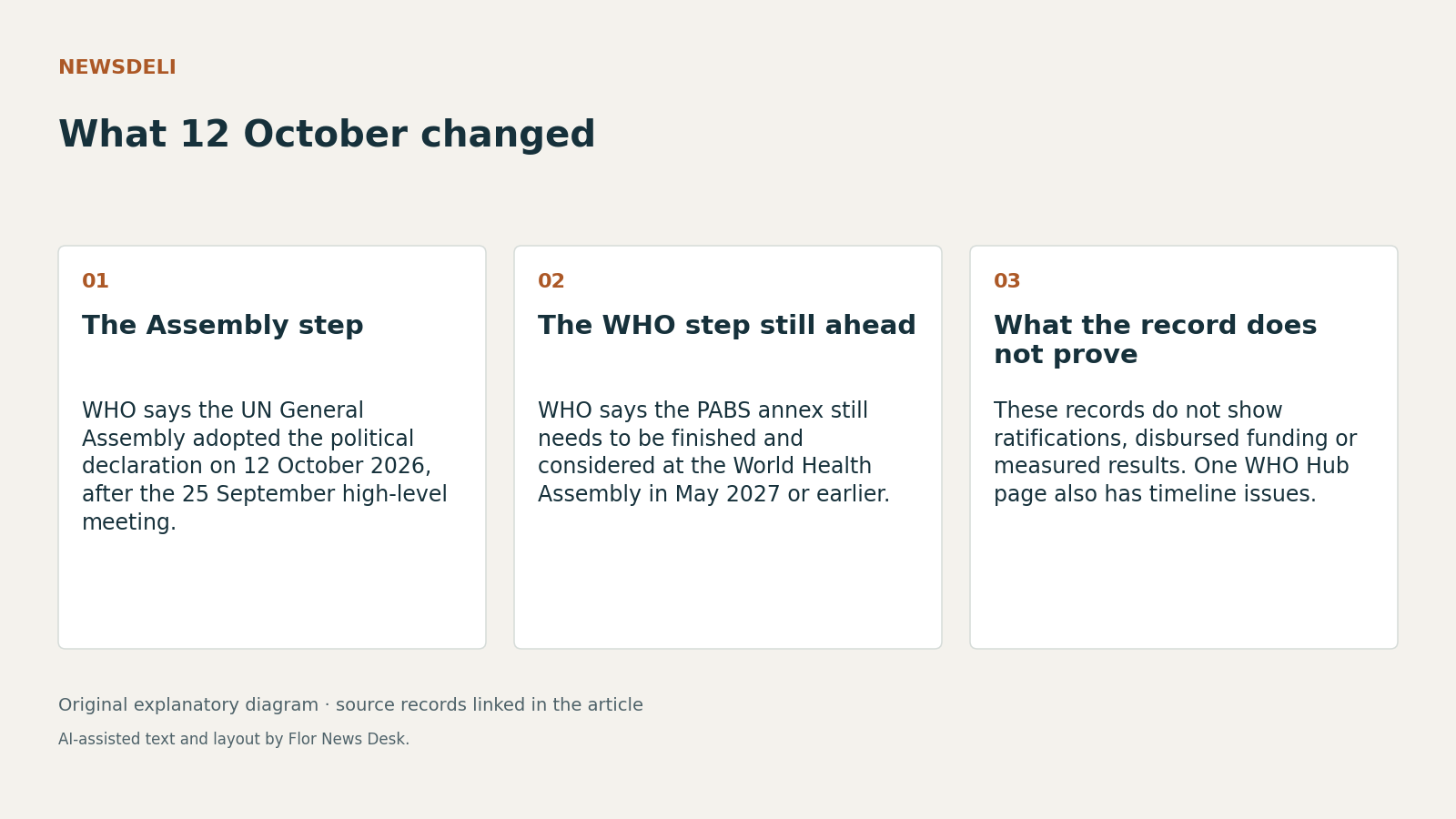
The clearest change on 12 October 2026 was diplomatic, not operational. The World Health Organization said the United Nations General Assembly adopted the *Political declaration on pandemic prevention, preparedness and response* on that date, after Member States had considered it at the second UNGA high-level meeting on 25 September 2026. That matters because it puts the Assembly behind a common text. But if readers were looking for the Pathogen Access and Benefit Sharing system itself, or for the WHO Pandemic Agreement to start operating, the supplied record does not show that happened on 12 October. WHO news release
The pre-history in the UN record helps explain why. A 7 October letter from the President of the eighty-first session of the General Assembly said intergovernmental negotiations had produced a draft with broad support but still some reservations, and that it was being sent to the plenary meeting on 12 October as an annex to draft resolution A/81/L.6. An earlier UN page, published on 14 September, had framed the 25 September high-level meeting as a political effort under resolution 79/333, with the expectation that it would end in approval of a declaration. Read together, those documents show a planned diplomatic process reaching a formal Assembly step, not a sudden new implementation regime. UNGA letter, 7 October UNGA meeting page, 14 September
What does the declaration appear to do now? WHO said it calls for stronger monitoring systems, investment in national capacities and implementation of the amended International Health Regulations (2005). The UN background page also described the problems governments were trying to answer: inequities in access to health products, fragmented financing and governance, and weaknesses in surveillance, laboratory and health-system capacities. Those are substantive priorities. But the same source record does not show money disbursed, national laws changed or measurable improvements achieved as of 12 October. WHO news release UNGA meeting page, 14 September
The main reason this is not the end of the story is the PABS annex. WHO said Member States highlighted the need to finish negotiations on the Pathogen Access and Benefit Sharing system annex within the WHO Pandemic Agreement. WHO also said the outcome of those negotiations is to be considered at the next World Health Assembly in May 2027, or earlier through a special session, and that adoption of that outcome would enable the WHO Pandemic Agreement to enter into force. That sequence is the key distinction. The 12 October declaration may add political pressure, but WHO’s own timeline places the legal and procedural hinge later. WHO news release
The biggest unanswered questions are therefore practical ones. The records provided here do not establish a final PABS text, an opening of the WHO Pandemic Agreement for signature, any national ratification, or any financing actually received and spent. They also do not supply the Assembly voting details or measured implementation results. Even the wider WHO ecosystem points to open work rather than closure: a separate 8 October update from the WHO Hub for Pandemic and Epidemic Intelligence advertised a 13 October discussion on financing collaborative surveillance, but that page is peripheral and contains inconsistent summit dating, so it cannot by itself settle the timeline. WHO Hub update, 8 October
So the practical reading of 12 October is narrower than the headline milestone. The General Assembly has now adopted a political declaration. The next records worth watching are the final PABS annex text, any move to a World Health Assembly decision in May 2027 or a special session, and evidence of what follows inside countries and budgets. On the supplied evidence, the declaration is a real signal of alignment, but not yet proof that the pandemic-sharing system, treaty entry into force or funding pipeline is in place. WHO news release