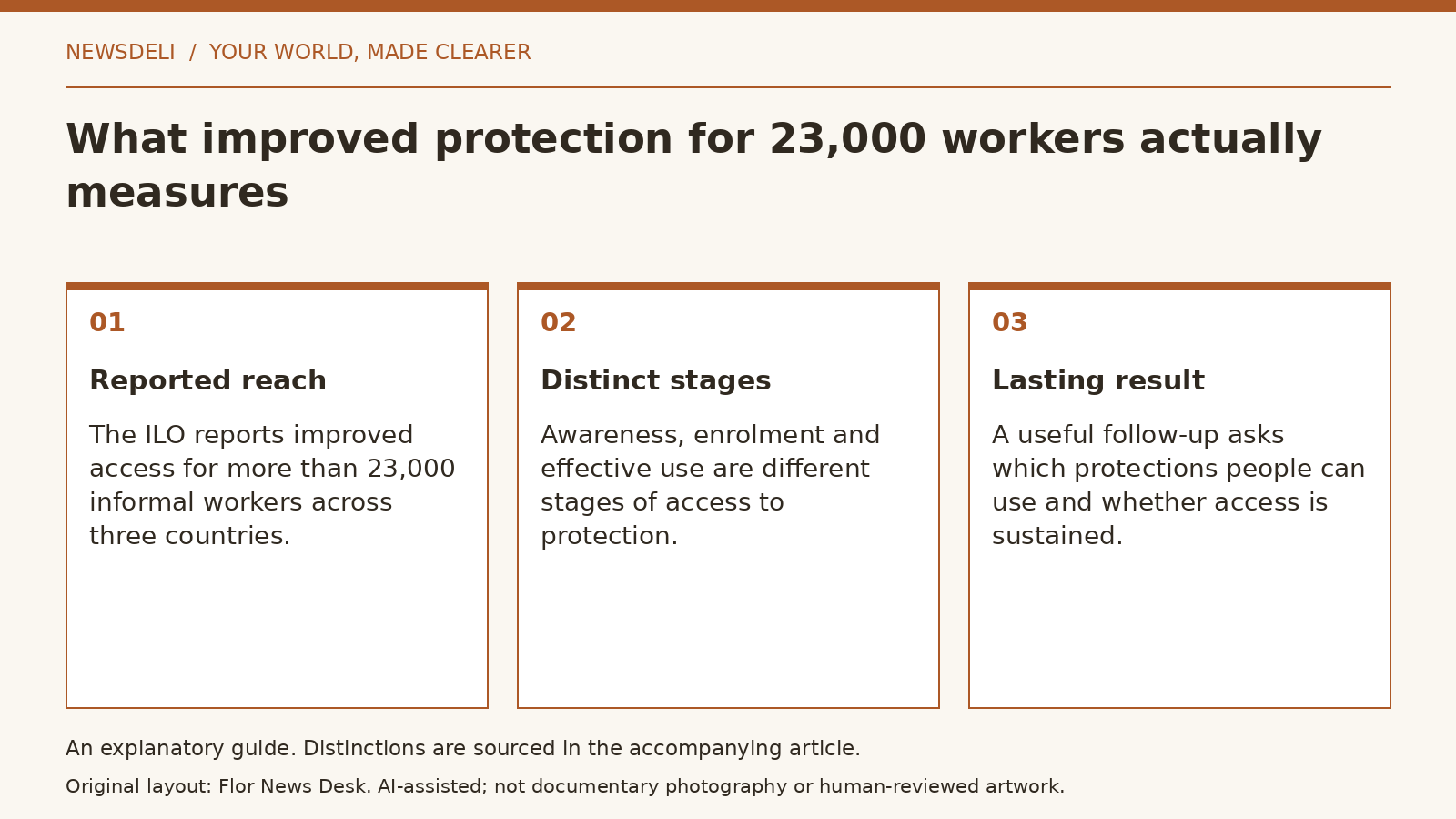
A programme can improve workers’ access to protection without every participant receiving the same benefit in the same way. A large reach figure is important, but it needs a description of what was reached.
In a September 21 account, the International Labour Organization said Japan-supported initiatives had helped more than 23,000 informal workers in India, Nepal and Pakistan gain improved access to formal employment, social protection, voice and representation. The account also describes work on institutional responses to child labour. Its wording does not establish that 23,000 identical new jobs were created or that every worker obtained every form of protection listed.
Access has several stages
An explanatory way to assess a result is to separate awareness, eligibility, enrolment and effective use. Someone might learn about a scheme without yet enrolling. Someone enrolled might still encounter difficulty obtaining a service. Someone receiving a benefit might need continued support to retain it. These are analytical distinctions, not a claim that a particular obstacle occurred in the projects described.
The distinction changes what a follow-up question should ask. A participation total may answer how many people an initiative reached. It cannot, on its own, answer how much their income changed, how many claims were paid or whether protection remained available after project activities ended.
Formalization is not only registration
The ILO’s informal-economy overview places the transition toward formality within a broader concern for decent work and protection. That framing is useful because a registration record and a change in working conditions are not the same kind of evidence.
Consider a hypothetical worker newly added to an administrative system. The record could be a necessary step toward obtaining a benefit, but judging the full result would require knowing what entitlement follows, whether it is usable and what responsibilities the worker or employer must meet. Counting only the record would leave the rest of that sequence unexplained.
Look for the distribution of results
A cross-country total also leaves open how outcomes differ by location or group. A transparent account could retain the overall reach number while separately showing which services were available, which participants used them and the period over which results were observed. That would make the figure more interpretable without dismissing the achievement it describes.
The ILO announcement is evidence of the institution’s reported project results, not an independent evaluation of every participant’s circumstances. Its immediate contribution is to describe improved pathways to employment and protection. The durable test is whether those pathways lead to rights and services that workers can continue to use.