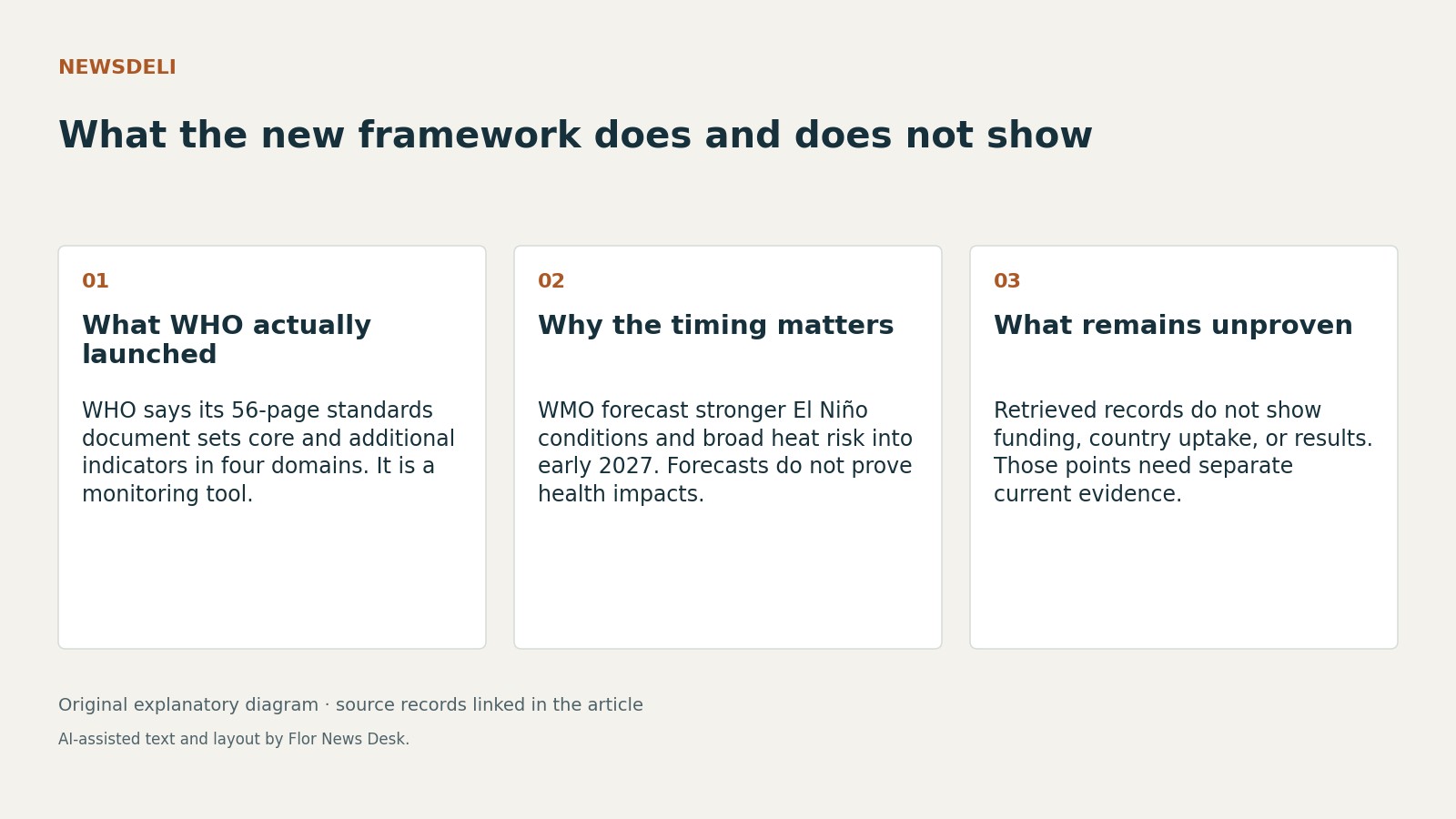
On 21 October 2026, the World Health Organization announced a new global framework on extreme-heat risks for pregnant women, newborns and children and linked it to a 56-page standards publication produced with the World Meteorological Organization, UNICEF and UNFPA.WHO news release The publication overview says it sets out priority indicators and guidance for analysing them together with heat-exposure data.WHO standards page
That matters because the climate backdrop is already becoming more hostile. On 3 September 2026, WMO said El Niño was firmly established, was highly likely to persist through February 2027, and increased the likelihood of above-normal temperatures across almost all land areas for September to November 2026.WMO El Niño outlook But WMO also said local impacts vary by region and season, and that national meteorological services are the authoritative source for official warnings.WMO El Niño outlook
So the WHO package is best understood as a measurement framework, not evidence that health systems have already adapted. The standards page says the indicators are organised in four domains: routine maternal, newborn and child health monitoring; public health and surveillance systems; climate and health monitoring; and measures of heat exposure.WHO standards page In plain terms, the framework tries to connect health records and heat records so officials can examine whether extreme heat coincides with changes in maternal, newborn or child health signals.
The source record also shows why readers should be careful not to read more into the launch than the documents support. The retrieved WHO release page is only a header and link block, not the body of the announcement, and the publication page is an overview rather than the full indicator table.WHO news release WHO standards page That means the available record supports the existence of a new monitoring standard on 21 October 2026, but not the exact final list of indicators, their technical definitions, or any operational thresholds that would trigger action.
Even with that limit, one implementation challenge is clear. A country cannot do the combined analysis described by WHO if health, surveillance and heat-exposure data are stored in separate systems that are not routinely compared. WMO's 23 September 2026 health advisory said it was working with partners to strengthen climate services for health by improving links between meteorological services and health authorities.WMO health advisory That fits the WHO framework's design: it assumes coordination across institutions, not just better weather forecasts.WHO standards page
Just as important is what the records do not establish. None of the retrieved documents shows donor financing, named pilot countries, ministry adoption, or measured effects on illness or deaths.WHO standards page WMO health advisory The WMO material is forecast-based and advisory, not a record of observed health outcomes.WMO El Niño outlook And the WHO standards page says countries can adapt both core and additional indicators to their own context, which signals flexibility but also means adoption may not look uniform across countries.WHO standards page
As of 23 October 2026, the strongest evidence is that UN agencies have published a common way to monitor heat-related risks in maternal, newborn and child health during a period when WMO expects elevated temperature risk to continue into early 2027.WHO standards page WMO El Niño outlook The next important proof point is different: current records showing that health ministries, meteorological services or funders have actually put the framework to work and published early results.WMO health advisory