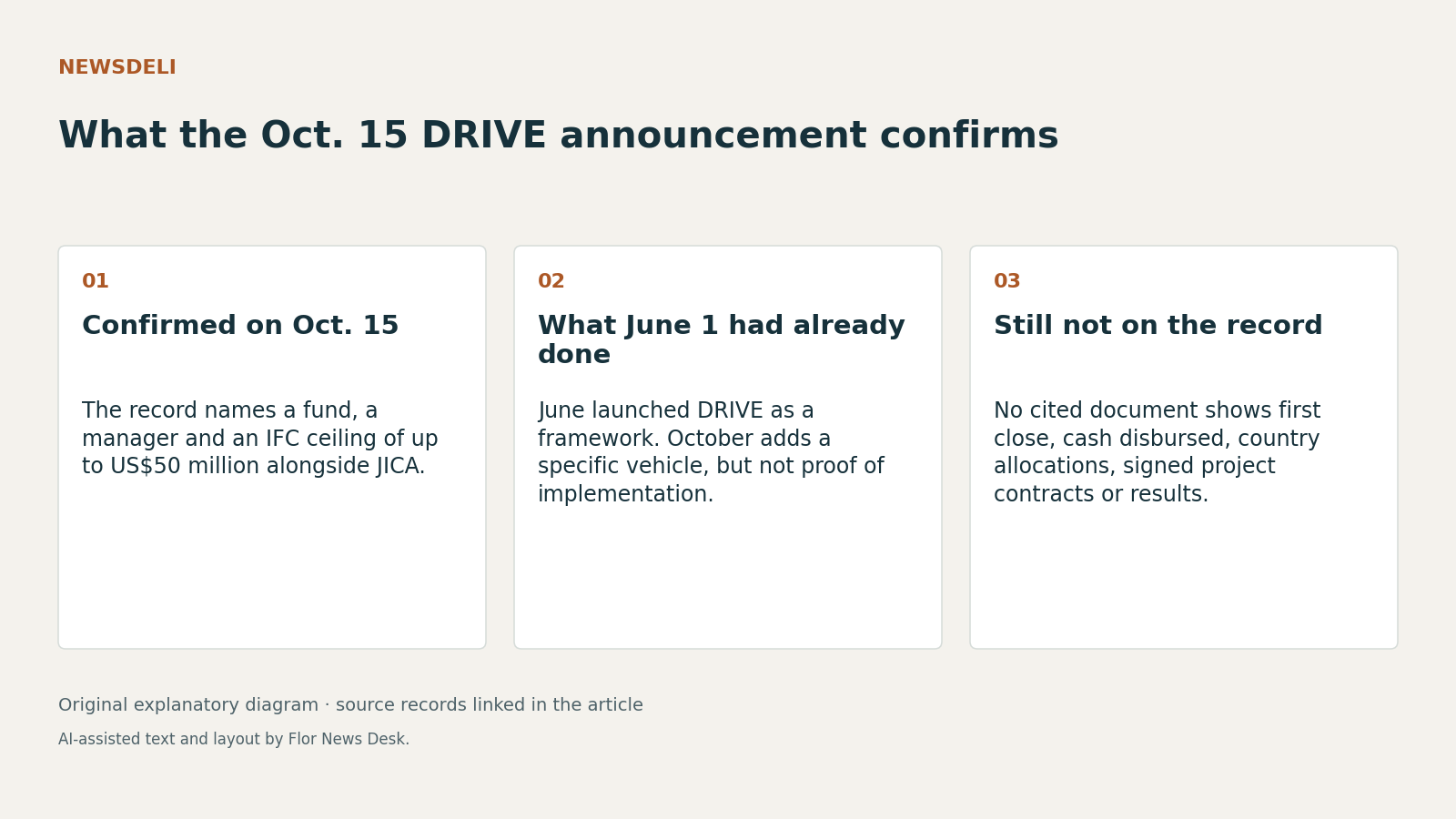
The clearest new fact in the World Bank Group’s October 15 announcement is not that Asia suddenly has new energy-resilience projects on the ground. It is that the public record now points to a specific financing vehicle. According to the World Bank press release, the first project under DRIVE is an IFC investment of up to US$50 million, alongside JICA, in the Emerging Asia Infrastructure Credit Fund, which is targeting US$750 million and is managed by Global Infrastructure Partners, part of BlackRock. That is a concrete institutional step, but it is still only that: a step announced by the institution itself, not proof that money has already moved or projects have begun. World Bank press release, Oct. 15, 2026
What changed between June and October is therefore important. On June 1, the World Bank Group said Ajay Banga and Japan’s finance minister, Satsuki Katayama, had agreed a new framework called DRIVE, alongside RISE+, as part of wider cooperation on supply chains and energy systems. That June record also linked DRIVE to Japan’s US$10 billion POWERR Asia framework and said Japanese agencies including JBIC and JICA would be involved. But June described a framework and future cooperation. October is the first record here that names a particular fund, manager and headline IFC amount. World Bank press release, June 1, 2026 World Bank press release, Oct. 15, 2026
That distinction matters because it changes what can be checked later. The October release says the fund was established under a Singapore government initiative and is aimed at investments across Southeast and South Asia that reduce carbon emissions and improve energy efficiency. Those details create a trail: reporters can now look for a first close, investor disclosures, portfolio investments, country approvals and environmental and social documentation tied to this named fund, rather than trying to verify a broad policy framework. World Bank press release, Oct. 15, 2026
Just as important is what the announcement does not establish. The wording says IFC is investing “up to” US$50 million. In plain terms, that sets a ceiling, not confirmed cash in hand. The cited public record does not show a fund first close, final subscription lists, signed downstream project agreements, disbursement dates, country-by-country allocations or measured results. The strongest supported reading is narrower: the World Bank Group announced an intended commitment into a named private fund under the DRIVE banner. It did not publish the evidence needed to say that private capital has already been mobilized into specific operating projects. World Bank press release, Oct. 15, 2026
The timing also helps explain why the announcement was made, though not what it proves. The World Bank’s Annual Meetings page says the 2026 IMF-World Bank Group Annual Meetings were held in Bangkok from October 12 to 18 and describes them as a gathering to discuss the global economy and development challenges. Announcing the first named DRIVE project in that setting makes political and institutional sense: it shows a partnership moving from framework language to an identifiable vehicle. But the event page is not transaction evidence, and meeting-stage visibility should not be confused with proof of execution. 2026 Annual Meetings page
So the October 15 development is meaningful, but in a limited way. It gives the story a fund name, a manager, a target size and two anchor public institutions to watch. The next decisive documents would be fund close notices, IFC transaction records, Japanese partner disclosures and any host-country approvals tied to actual projects. Until those appear, the announcement is best understood as a verifiable financing intent with a traceable vehicle, not as demonstrated energy-resilience delivery.