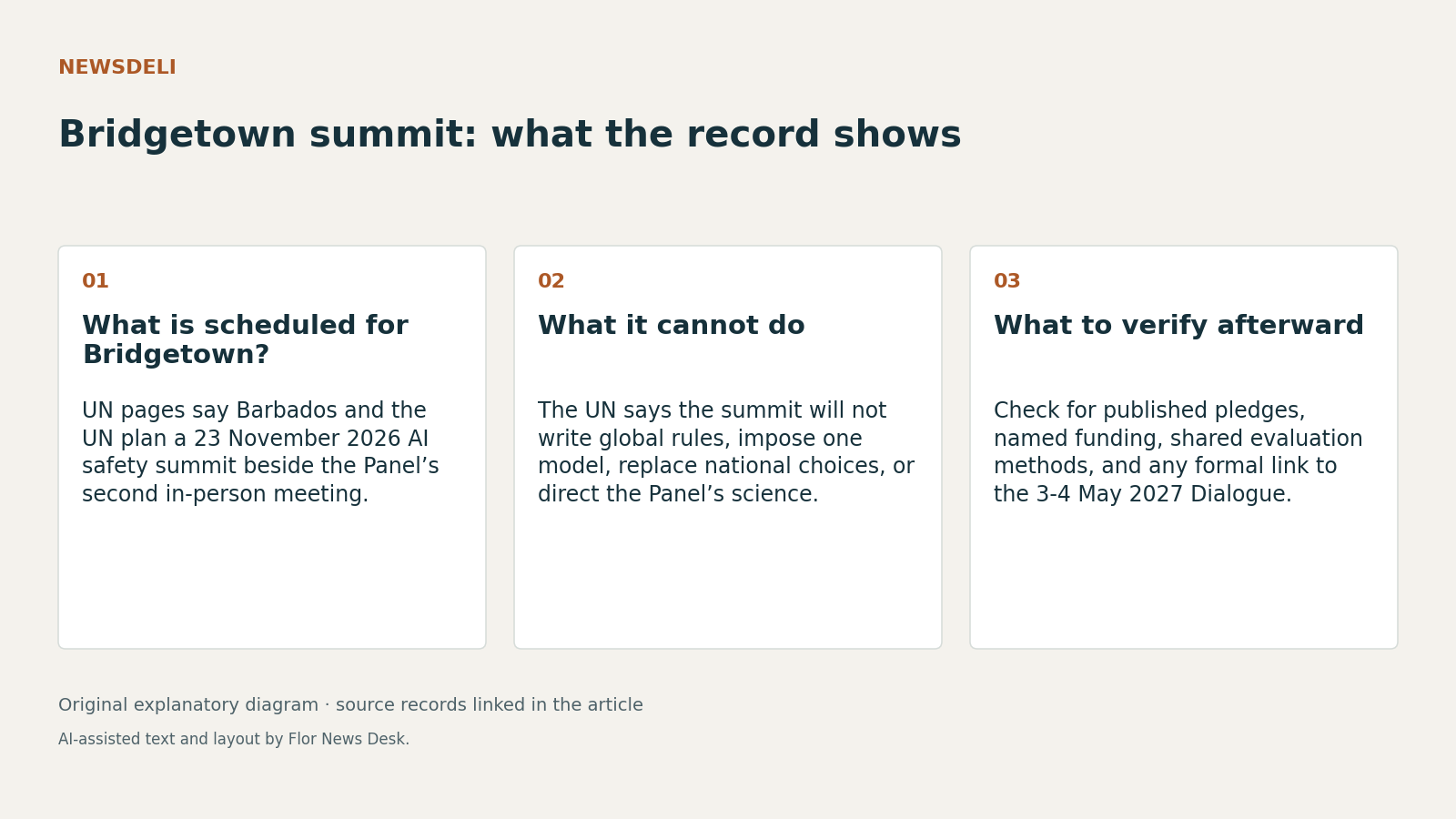
The most important fact about the Bridgetown Special Summit on AI Safety is also its clearest limit. United Nations pages say Barbados and the UN plan to co-host the summit in Bridgetown on 23 November 2026, with Prime Minister Mia Amor Mottley and Secretary-General António Guterres expected to attend, alongside senior figures from governments, technology companies, scientists, civil society, international organizations and UN entities UN summit page. But the same UN page says the summit will not create global rules, will not impose a single governance model and will not replace national decision-making UN summit page.
That means readers should treat Bridgetown as a political and agenda-setting meeting, not as a lawmaking conference. The published agenda points to debates over risk management, inclusion, access, capacity, diffusion, and cultural and linguistic representation UN summit page. Those are broad themes, and the source record does not yet show a negotiated text, enforcement mechanism, budget or list of concrete deliverables. As of 4 November 2026, the public page establishes plans for the event, not outcomes.
The summit also sits inside a wider UN process that is deliberately non-negotiating. The UN’s FAQ says the Global Dialogue on Artificial Intelligence Governance was established by General Assembly resolution A/RES/79/325, adopted by consensus on 26 August 2025, and that its first annual meeting took place in Geneva on 6 and 7 July 2026 Global Dialogue FAQ. The same FAQ says the second annual Dialogue is scheduled for 3 and 4 May 2027 in New York, and that each Dialogue ends with a co-chairs’ summary rather than a negotiated outcome document Global Dialogue FAQ.
That timetable matters because Bridgetown is scheduled back-to-back with the second in-person meeting of the Independent International Scientific Panel on Artificial Intelligence UN summit page. The FAQ says the Panel and the Dialogue are distinct but linked, and the UN milestones page says the May 2027 Dialogue is to be informed by the Panel’s next annual report Global Dialogue FAQ Key Milestones. In analytical terms, that makes Bridgetown look like a bridge between expert assessment and later diplomatic discussion, not the place where binding global AI rules suddenly appear.
What, then, would count as a meaningful result? Based on the limits the UN itself has published, the strongest evidence after 23 November 2026 would be voluntary and checkable commitments: named capacity-building programmes, shared approaches to evaluating AI risk, or formal referrals into later UN discussions. That is an inference from the record, not a stated UN promise. The milestones page notes that in 2025 the Secretary-General issued a report on innovative voluntary financing options for AI capacity-building, yet the summit page does not say whether Bridgetown will adopt, fund or expand any such option Key Milestones UN summit page.
Another reason for caution is that UN information channels do not all carry the same weight. A transcript tool page for a General Assembly plenary meeting on 24 September 2026 attributes AI remarks to Zimbabwe’s president, including support for human-centred and responsible innovation, but the page itself says its text is produced by automatic speech recognition and is not an official UN record UN transcript tool page. That does not make the remarks irrelevant. It does show why reporters should separate member-state speeches from institutional decisions when judging what Bridgetown changed.
So the immediate reporting test is simple. After 23 November 2026, look for documents that name who attended, what was agreed, whether any money was merely announced or actually committed, and whether any follow-up is explicitly tied to the next Global Dialogue on 3 and 4 May 2027 UN summit page Global Dialogue FAQ. Until such records appear, the best-supported conclusion is narrower: Bridgetown is a scheduled UN convening point on AI safety, with political significance, but no published mandate to impose global rules.