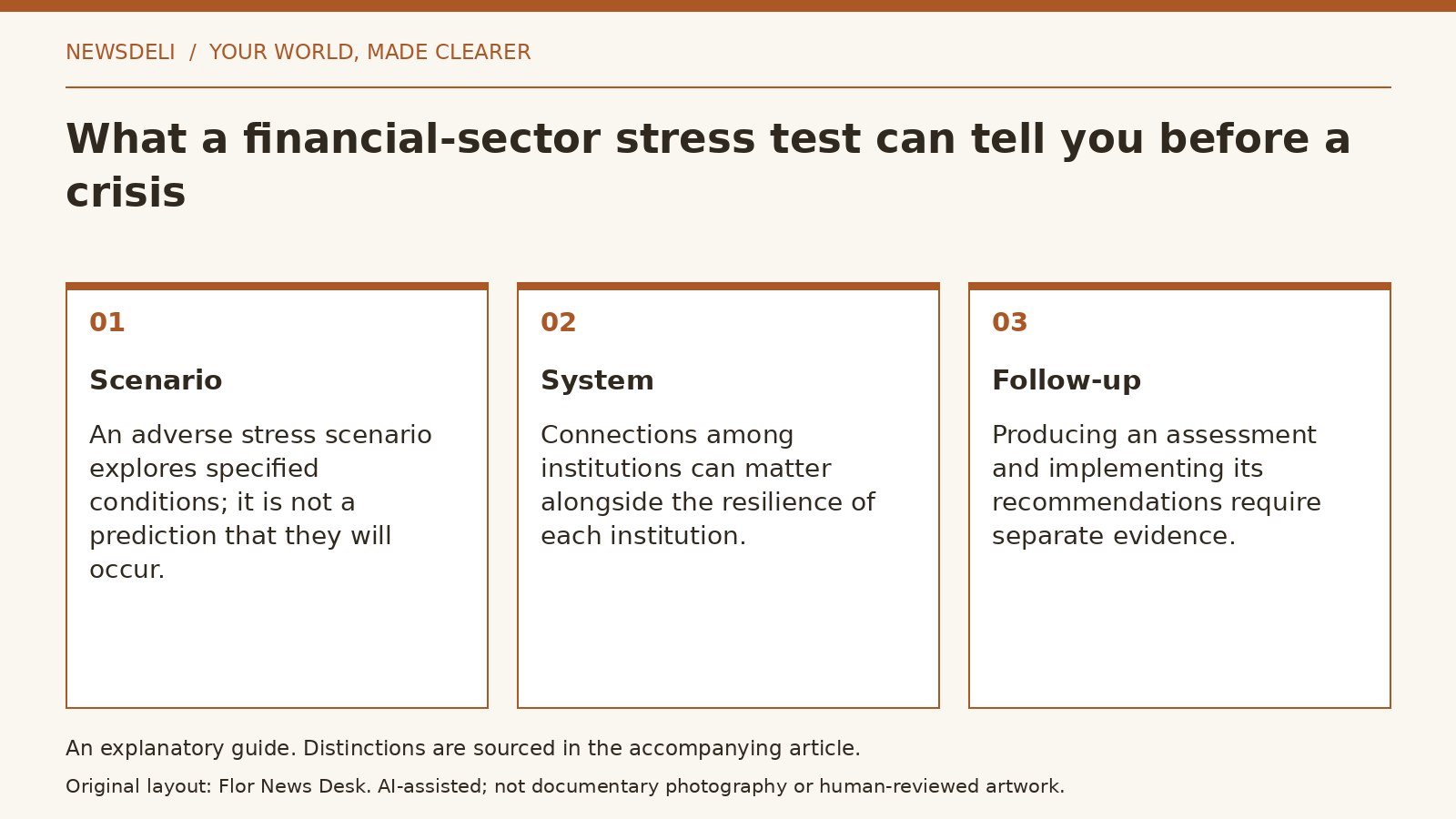
An adverse scenario is not a prediction that the scenario will happen. Its purpose is to reveal what could be vulnerable under specified conditions, and what authorities might need to examine before those conditions arise.
The IMF’s September 21 programme-review announcement follows a Board discussion on September 3. It says 416 Financial Sector Assessment Program assessments have been completed across 161 members since the programme began in 1999. That is a cumulative history, not evidence that 161 economies were all stress-tested against today’s conditions at the same time.
The review highlights growing connections among banks, non-bank financial intermediaries and market infrastructure, and calls for analysis that considers the system as a whole. The announcement is about the programme’s direction, rather than a newly issued assessment of any one institution.
Three parts of an assessment
The IMF’s FSAP explanation describes work on financial resilience, supervision and regulation, and the capacity to manage a crisis. That combination matters: a simulated loss calculation and a judgment about how authorities would respond are not the same test.
Imagine a hypothetical exercise in which funding becomes harder to obtain. Examining individual firms might identify direct pressure, while a wider analysis could ask how their responses affect others. The example illustrates the difference between an isolated balance sheet and a network of responses. It is not a claim about a current bank or a forecast of a particular shock.
The scenario needs its assumptions
A result is interpretable only alongside the conditions used to produce it. Readers should ask what changed in the exercise, over what period, and which parts of the system were included. A finding under one scenario should not be expanded into a guarantee of safety under every other scenario.
Equally, identifying a vulnerability does not prove that a crisis is imminent. It can provide a reason to investigate further or improve preparedness. Treating a diagnostic exercise as either a prediction of collapse or a certificate that nothing can go wrong would erase its analytical purpose.
Recommendations are another stage
The existence of an assessment also does not show that every recommendation has been implemented. A useful follow-up would identify which actions were proposed, which authority is responsible and what later evidence shows about completion. Those are implementation questions distinct from producing the assessment itself.
The review’s significance is therefore not a promise that crises can be forecast precisely. It is an argument for examining the most material risks and the connections through which they may spread, while retaining the uncertainty that makes preparedness necessary in the first place.