A poverty estimate can fall between two publications without the publications measuring a new period of economic improvement. The first question is not simply how large the change is. It is which year each number describes.
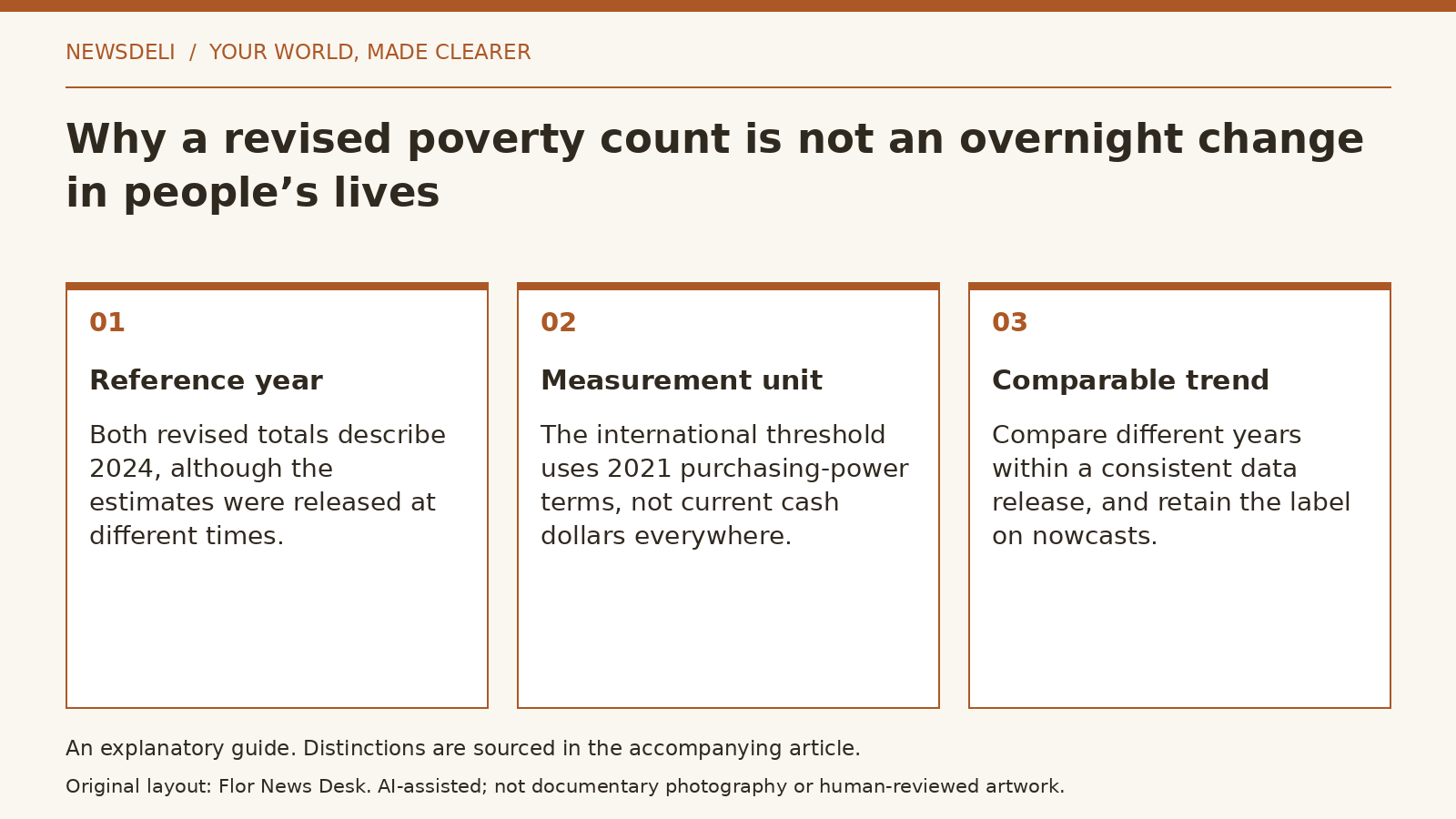
The World Bank’s September 22 update puts global extreme poverty in 2024 at 10.1 percent, or 824.3 million people. Its March 2026 estimate for that same year had been 10.4 percent, or 846.8 million. The Bank attributes much of the downward revision to new South Asian survey evidence replacing earlier extrapolations. These are two estimates of 2024, not counts of people leaving poverty between March and September 2026.
Two comparisons with different meanings
Comparing March’s estimate for 2024 with September’s estimate for 2024 asks how the information has changed. Comparing estimates for two different years within the September release asks how living standards are estimated to have changed over time. Both comparisons can be useful, but substituting one for the other would turn a statistical revision into an invented historical event.
A hypothetical school register offers a simpler parallel. Correcting last year’s attendance total after receiving missing records changes what the school knows about last year. It does not establish that the same number of pupils arrived today. Poverty statistics involve much more complicated measurement, but the timing distinction is the same.
What the dollar unit means
The Bank’s explanation of its poverty lines describes the international extreme-poverty threshold as $3.00 a day in 2021 purchasing-power-parity terms. Purchasing-power adjustments account for differences in prices across economies. The threshold is therefore not a claim that a person everywhere holds three current US dollars in cash each day. The Bank also distinguishes global comparison from national poverty lines used for country-specific analysis.
This creates a second reading rule: a number needs its unit as well as its date. A headline stripped of either can invite a comparison the underlying measure was not designed to support.
Keep the forecast label visible
The September release also contains estimates for later years, including nowcasts. A newer calendar year does not automatically mean a newly completed household survey. Readers should keep observed survey inputs, extrapolated estimates and projected outcomes separate rather than place them on one apparently uniform list.
The useful result of the update is a better-informed account of poverty, with continuing uncertainty. Its significance should be assessed through comparable periods and clearly identified methods, not by treating a revised historical total as a sudden change in millions of individual lives.