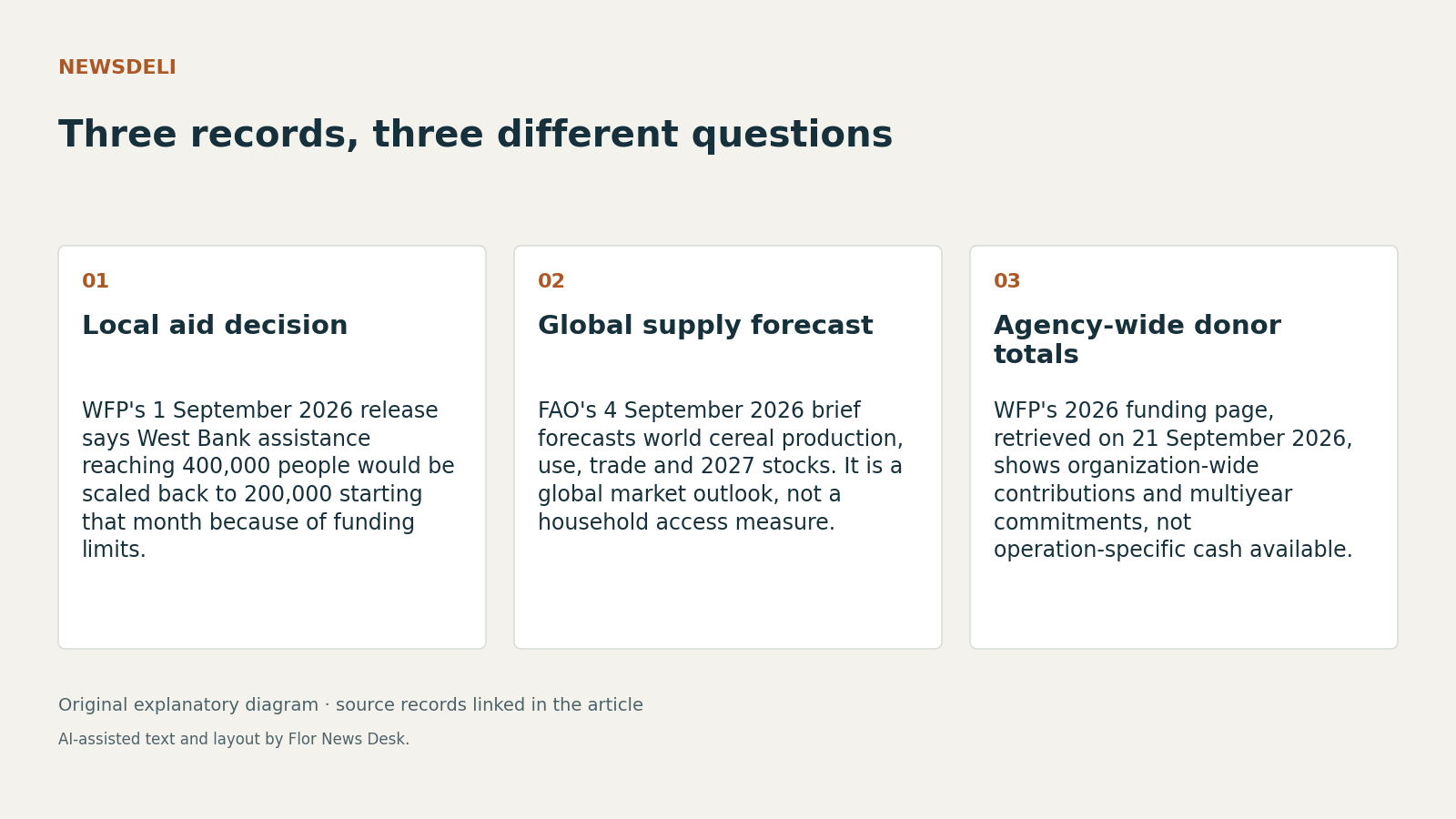
A big global grain forecast and a planned cut to food aid in one territory can both be true at the same time.
The key is that the records published in early September 2026 are not measuring the same thing. One is about expected world cereal supply. Another is about a local humanitarian programme facing a funding shortfall. A third lists donor contributions to the World Food Programme across the organization, not money shown as available for one place.
On 1 September 2026, the World Food Programme said it was cutting in half the number of people it could support with food assistance in the West Bank because of funding constraints. In WFP’s words, assistance that had been reaching 400,000 people “will be scaled back to 200,000 starting this month” (WFP release). That wording matters. The release was published on 1 September, but it does not show that the reduction took effect on 1 September itself, or how far it had been implemented by 21 September 2026.
FAO’s record is about something else entirely. In its 4 September 2026 Cereal Supply and Demand Brief, the UN Food and Agriculture Organization forecast global cereal production in 2026 at 2,980 million tonnes, 3.4 million tonnes below FAO’s July forecast and 2.0 percent below the previous year. Even so, FAO said that would still be the world’s second-largest harvest on record (FAO brief). The same brief forecast 2026/27 cereal utilization at 2,965 million tonnes, trade at 509.3 million tonnes and end-of-season stocks in 2027 at 947.2 million tonnes.
Those are global market projections. They do not tell readers whether a household in the West Bank has enough income to buy food, whether shops can get supplies to a specific area, or whether an aid agency has funds it can legally and practically spend on that caseload.
That gap between supply and access is the real point. Food insecurity is not only about how much grain exists worldwide. It is also about prices, income, transport, conflict conditions, distribution and whether assistance programmes are funded.
WFP’s 1 September release makes that local argument in institutional terms. WFP said food needs in the West Bank had more than doubled since 2023, estimated that 900,000 people there were food insecure, and said its latest quarterly food security analysis found major income losses and reduced ability to afford a nutritious diet (WFP release). Those figures are WFP’s claims in a news release. They are not independently verified in the supplied record.
The agency-wide donor table answers a third question. As retrieved on 21 September 2026, WFP’s 2026 funding page listed total contributions of US$5,414,820,258, including US$1,904,095,871 classified as multiyear (WFP funding table). The page says multiyear contributions are commitments lasting more than 24 months from when WFP can begin using the funds. But this is a global donor table. It does not show which funds were earmarked for Gaza, the West Bank or another operation, and it does not identify cash available to reverse the announced West Bank cut.
WFP also said on 1 September 2026 that it needed an additional US$386 million over the next six months to serve an estimated two million food insecure people across Gaza and the West Bank (WFP release). That requirement was not broken down by territory in the supplied record.
So these September documents do not cancel each other out. FAO described expected world cereal availability. WFP described a planned September 2026 reduction in one local assistance programme and, separately, an agency-wide funding total. To prove that the global harvest should have prevented the West Bank cut, or that WFP’s headline contribution total could have covered it, readers would need operation-level budget and earmarking records that are not in the supplied sources.