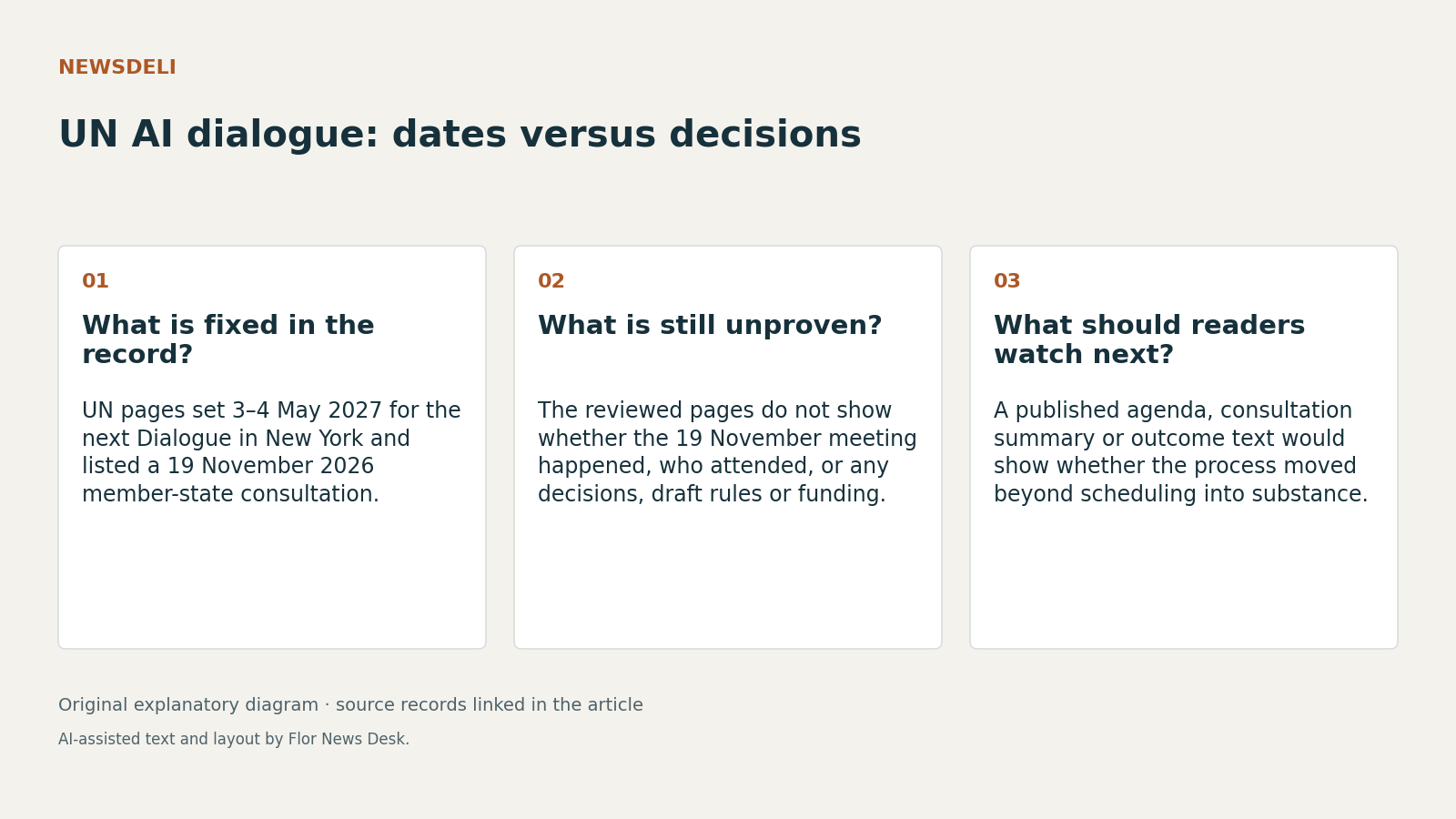
The United Nations now has a public timetable for its next Global Dialogue on Artificial Intelligence Governance. A UN consultations page says the 2027 Dialogue is scheduled for 3 and 4 May 2027 in New York, and it listed a first informal consultation with member states for 19 November 2026 in the Trusteeship Council chamber UN consultations page. As of the current date, 21 November 2026, that consultation date is already past. The page therefore proves a planned process step, but not whether the meeting happened or what it produced.
That distinction matters because AI diplomacy is full of headlines that sound larger than the institutional record. The reviewed UN pages do establish three concrete things. First, the process has named co-chairs: H.E. Ms. Mutryce Agatha Williams of Saint Kitts and Nevis and H.E. Mr. Jihoon Cha of the Republic of Korea UN consultations page. Second, the next full Dialogue has a date and city UN homepage. Third, the 2027 meeting is intended to run alongside the 12th Multi-Stakeholder Forum on Science, Technology and Innovation for the Sustainable Development Goals UN consultations page.
The same record also shows what this forum is, at least in UN institutional terms. The homepage says the Dialogue was established by General Assembly resolution 79/325, adopted by consensus on 26 August 2025, and that it is open to all member states UN homepage. A separate UN resources page links the “Terms of Reference and Modalities” for the Dialogue and the Independent International Scientific Panel on Artificial Intelligence under that same resolution UN resources page. That means readers should think of this as a formal UN track with a General Assembly basis, not just another conference announcement.
But the public record reviewed does not yet show a binding rule-making outcome. The consultations page is a scheduling page. The resources page is an index. The homepage is a high-level overview. None of them, in the material reviewed, publishes a negotiated draft, a voting plan, an enforcement mechanism or financial commitments by governments UN consultations page UN resources page UN homepage. Analysis: that makes the current moment more about agenda-setting and process control than about settled global AI rules.
There is also a second timing point worth keeping straight. The homepage says the inaugural Global Dialogue was held in Geneva on 6 and 7 July 2026, with delegations from 163 countries, and that the Independent International Scientific Panel on AI’s next annual report will inform the 2027 Dialogue UN homepage. So the May 2027 meeting is not a launch. It is the next stage after an initial convening, with scientific input expected to feed into it.
What the sources cannot establish is just as important. Because the 19 November 2026 consultation is already in the past, a reader would need a published summary, attendance record or outcome document to know whether states narrowed disagreements, expanded the agenda or simply traded opening positions. The reviewed resources page does list past materials, including a co-chairs’ summary from the July 2026 inaugural Dialogue released on 8 September 2026, which suggests the UN may publish similar documents later UN resources page. It does not yet provide that evidence for the 19 November session.
So the useful takeaway is narrower than the headline version of AI diplomacy. The UN has moved from broad launch language to a visible 2027 timetable, named chairs and a consultation track. It has not, on the pages reviewed, shown that member states have agreed on substance. The next meaningful proof will not be another save-the-date. It will be records that show what governments were actually asked to discuss, and whether any text emerged from that discussion.