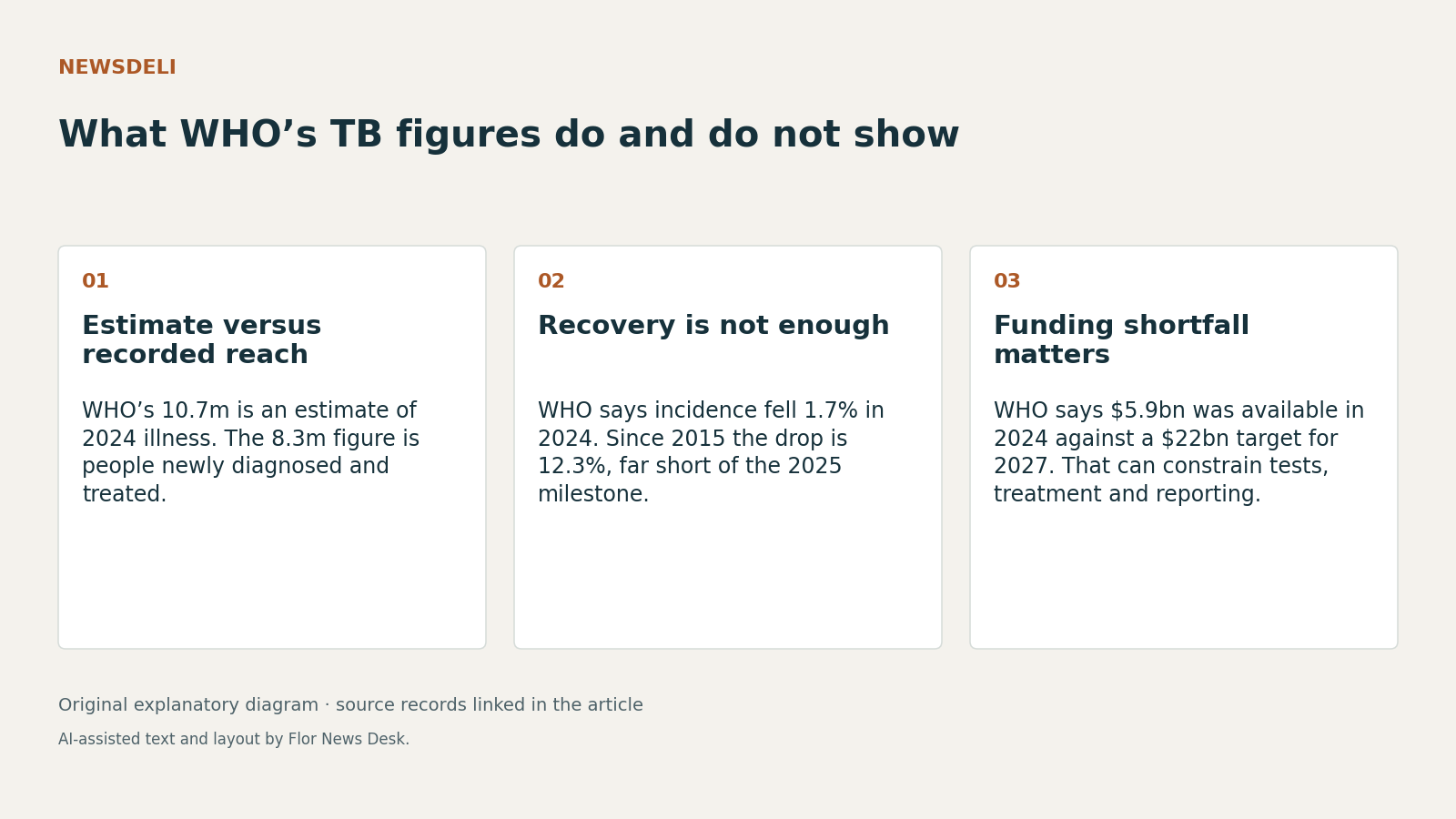
The most important finding in WHO’s latest tuberculosis assessment is not simply that TB remained deadly in 2024. It is that WHO’s own figures place millions of people outside the diagnosed-and-treated total that health systems actually recorded. WHO says TB caused more than 1.2 million deaths and an estimated 10.7 million illnesses in 2024, while 8.3 million people were newly diagnosed with TB and accessed treatment WHO news item TB incidence page. By simple subtraction, that leaves a gap of about 2.4 million people.
That gap matters, but the WHO record also sets limits on what can be claimed about it. The 10.7 million figure is an estimate, not a direct count, and WHO gives it a 95% uncertainty interval of 9.9 million to 11.5 million TB incidence page. The data portal says WHO combines country-reported data with WHO-generated burden estimates, and countries can update data at any time, so later profiles may differ slightly from the figures used in the 2025 report WHO TB data page. So the report supports a clear conclusion that many cases were not captured in the diagnosed-and-treated total, but it does not, by itself, sort that difference neatly into missed diagnosis, non-reporting or later data revision.
The report is also easy to overread as a simple recovery story. WHO says the global TB incidence rate fell by 1.7% between 2023 and 2024, and that several indicators improved after COVID-19 disruptions TB incidence page top findings. But WHO also says the net reduction in global incidence since 2015 was 12.3%, far short of the End TB Strategy milestone of a 50% reduction by 2025 TB incidence page. The analytical point is straightforward: improvement after disruption is not the same as being on track.
WHO’s financing figures help explain why. The organization says US$5.9 billion was available for TB prevention, diagnosis and treatment in 2024, against an annual target of US$22 billion for 2027. It also says TB research funding reached US$1.2 billion in 2023, equal to 24% of the target WHO news item. That does not prove which programme in which country failed for lack of money. It does show that the global resources WHO counts remain far below the level WHO says is needed for basic services and for better tools.
The same source gives one clue about how those constraints can appear inside programmes. WHO says rapid testing coverage for TB diagnosis rose from 48% in 2023 to 54% in 2024 WHO news item. That is progress, but it is also a reminder that nearly half of recorded diagnoses still did not involve rapid testing. A funding shortfall is therefore not an abstract budget problem. In the logic of the WHO categories, it can affect whether people are tested quickly, entered into reporting systems and linked to treatment.
The burden is not evenly spread, either. WHO says eight countries accounted for about two thirds of global TB cases in 2024, and that notifications were only 58% of estimated incidence among children aged 0-14 years and 50% among children under 5 TB incidence page. That suggests the global gap is not just large; it is likely sharper in some populations and places than the headline average implies.
What the WHO record does not establish is just as important in 2026. The top findings page says changes in the funding landscape threaten progress and that cuts in international donor funding in 2025 raise the importance of domestic funding in high-burden countries top findings. The data page says provisional notifications used in 2025 were not final WHO TB data page. And the news item’s warning of up to 2 million additional deaths and 10 million additional illnesses between 2025 and 2035 is a modelling projection, not a measured outcome WHO news item. So the report is strong evidence of a large 2024 diagnosis-and-treatment gap and a major financing shortfall. It is not evidence, on its own, of which 2026 budgets were disbursed, which national programmes absorbed the shock, or where services have already worsened.