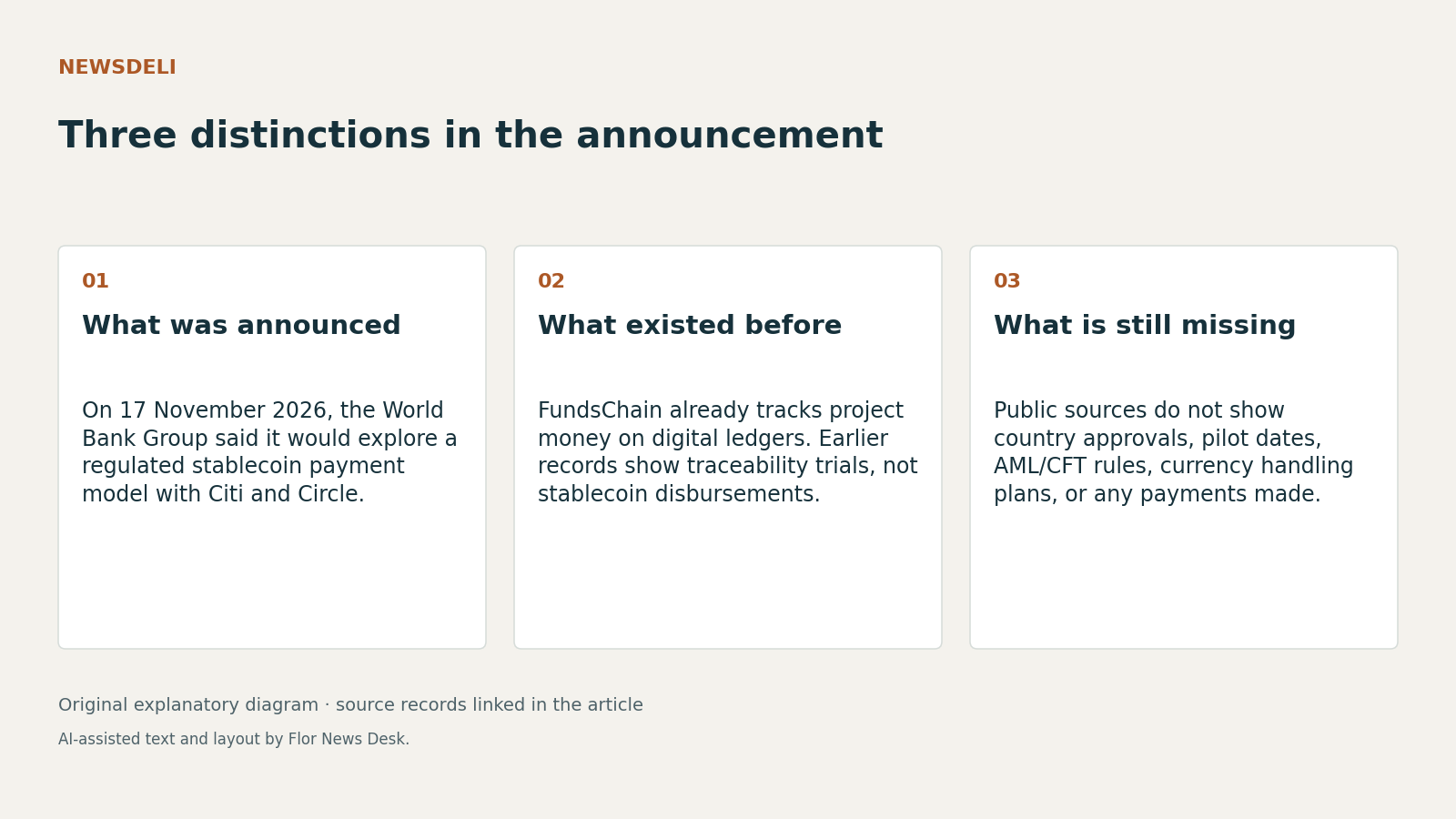
On 17 November 2026, the World Bank Group said it would explore regulated stablecoin infrastructure with Citi and Circle to make some payments and settlements faster, cheaper and more transparent for clients. The key word is explore. In the public record, this is not an approved rollout, a funded program, or proof that stablecoin-based development payments are already moving. It is an announced design exercise around a possible new payment rail. World Bank Group press release, 17 November 2026
What the Bank actually put on the table is fairly specific, but still preliminary. It said Citi would bring links to existing banking rails, while Circle would provide infrastructure to mint and settle funds in USDC. The release says the initial work will focus on an intermediated, interoperable model using U.S. dollar-denominated regulated stablecoins alongside, or as a possible improvement on, current disbursement arrangements based on correspondent banking. That matters because it points to a hybrid design, not a plan to replace banks or bypass institutions altogether. World Bank Group press release, 17 November 2026
The announcement also leans on infrastructure the Bank says it already has. In September 2025, the World Bank Group announced FundsChain, a blockchain-based tool for tracing project funds, and said it had been tested in 13 projects across 10 countries. That earlier release described a mobile-accessible ledger using Hyperledger Besu so development partners, borrowers, auditors and payment recipients could track disbursements and monitor fund use. In other words, the existing public record is strongest on traceability. It is much thinner on tokenized settlement. The 2025 release also projected a scale-up by 30 June 2026, but that wording was an expectation at the time and does not by itself show whether the milestone was met. World Bank Group press release, 26 September 2025
The newer materials suggest FundsChain has expanded, but they do not close the implementation gap. The 17 November 2026 stablecoin release says more than 350 projects across 96 countries are onboarded to FundsChain digital ledgers. Separately, the World Bank Group’s Annual Report 2026 says 315 projects were onboarded in fiscal 2026, with half in Africa, and says fiscal 2027 is expected to bring deeper interoperability with country financial management systems. That supports one clear reading: the Bank is trying to build a stablecoin experiment on top of a growing traceability network, not from scratch. But the annual report’s fiscal 2027 language is still a stated expectation, not evidence that those links were operating by 18 November 2026. World Bank Group press release, 17 November 2026 World Bank Group Annual Report 2026 chapter
The unresolved questions are not side issues. A World Bank digital finance background page defines stablecoins as cryptoassets pegged to another asset or currency, and warns that wider adoption can create financial disintermediation and currency substitution risks, with consequences for financial stability and consumer protection. It also says stablecoins are not a digital substitute for central bank currency. Those cautions help explain why the Bank’s own announcement only promises engagement with borrower countries where digital-asset use is supported and permitted. If the proposed settlement asset is dollar-denominated, country-level legal fit, currency treatment and official consent become central, not administrative details. World Bank stablecoins topic page World Bank Group press release, 17 November 2026
So what changed on 17 November 2026? The Bank moved beyond broad digital strategy and named partners, a candidate asset, and a payment architecture it wants to test in principle. What the public record still does not establish is just as important: no borrower-country approvals, no pilot start date, no published AML/CFT framework, no currency-handling rules, no budget, and no evidence of a single stablecoin disbursement. Until those documents appear, readers should treat this as a serious policy exploration with operational ambition, but not as a functioning development-payments system. World Bank Group press release, 17 November 2026