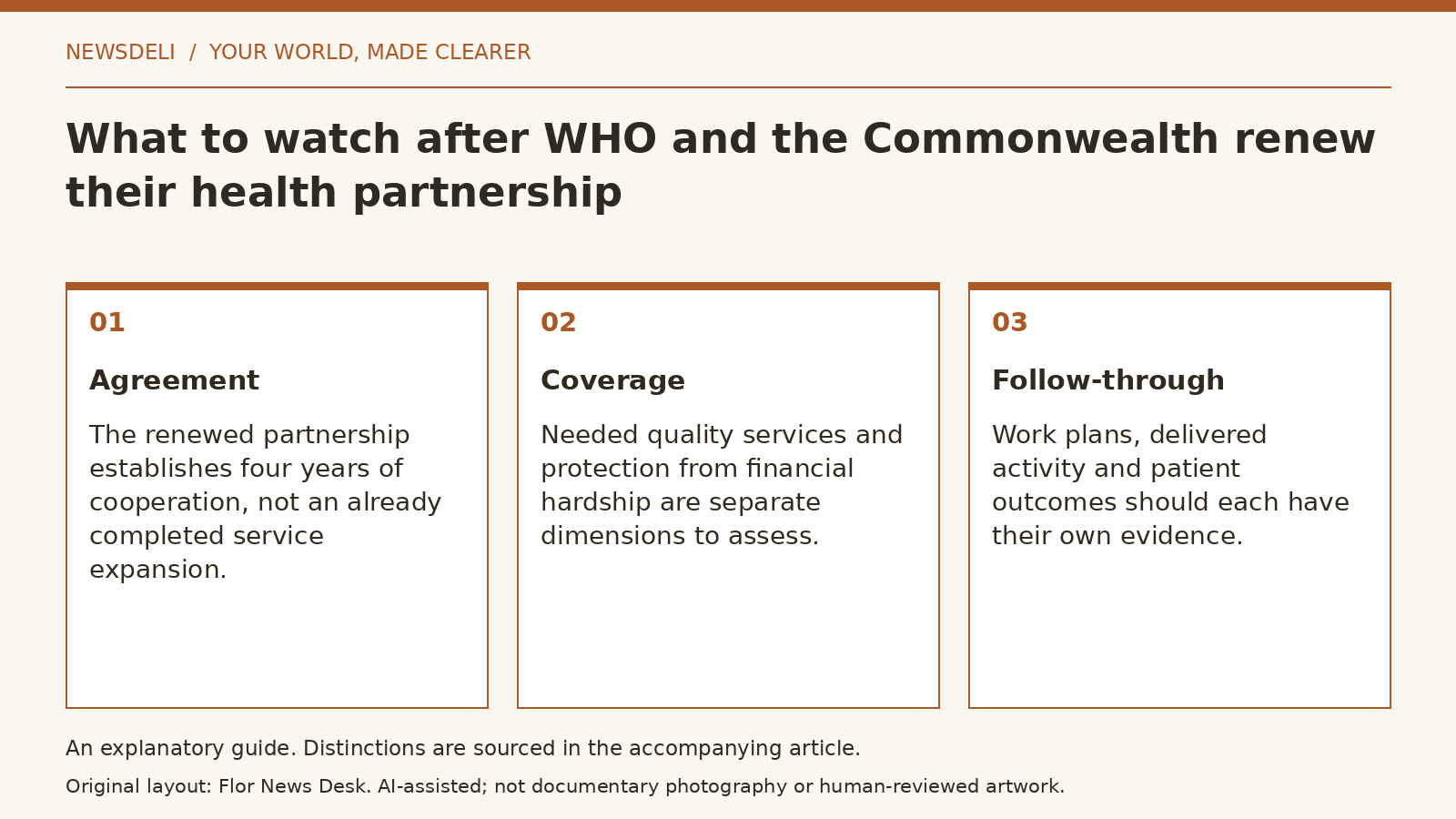
A health partnership can create a framework for cooperation without immediately changing a patient’s access to care. The useful question after an agreement is signed is how its stated priorities will be translated into observable results.
WHO and the Commonwealth Secretariat announced a renewed partnership on September 15. The four-year agreement concerns stronger health systems and progress toward universal health coverage across the Commonwealth’s 56 member countries. The stated areas of cooperation include primary health care, digital approaches and more resilient systems. These are priorities for cooperation, not evidence that all member countries have already achieved the same service improvements.
Coverage has two essential dimensions
WHO’s explanation of universal health coverage combines access to needed quality services with protection against financial hardship. That definition makes a simple facility count an incomplete measure. A service can exist without being affordable or practically reachable for everyone who needs it.
Consider a hypothetical clinic that expands its appointment capacity. More available appointments could be useful, but evaluating the full change would still require asking who can obtain them, what care is provided and what the patient must pay. These questions do not diminish the additional capacity; they clarify what it does and does not demonstrate.
Match the measure to the promise
An agreement’s implementation can be followed at several levels. Publishing a joint work plan would demonstrate an administrative step. Delivering a supported service would demonstrate activity. Showing a change in access or financial hardship would require outcome evidence. Treating these as interchangeable would make it difficult to know where progress has occurred.
The same applies to digital initiatives. The availability of a new channel is different from evidence that it reduces an access barrier. An evaluation would need to identify the barrier, the population affected and the comparison used. Technology is a possible means, not the definition of coverage.
Cooperation is not uniformity
A partnership covering many countries also needs room for differences in circumstances. A single network-wide label cannot explain every national starting point or result. Clear reporting could identify shared priorities while preserving country-specific measures and periods.
The announcement establishes a renewed commitment and a time horizon. Its eventual significance will rest on the work that follows. Readers can assess that work more fairly by separating institutional cooperation, delivered services and changes in people’s experience of care, rather than expecting the signing of an agreement to prove all three at once.