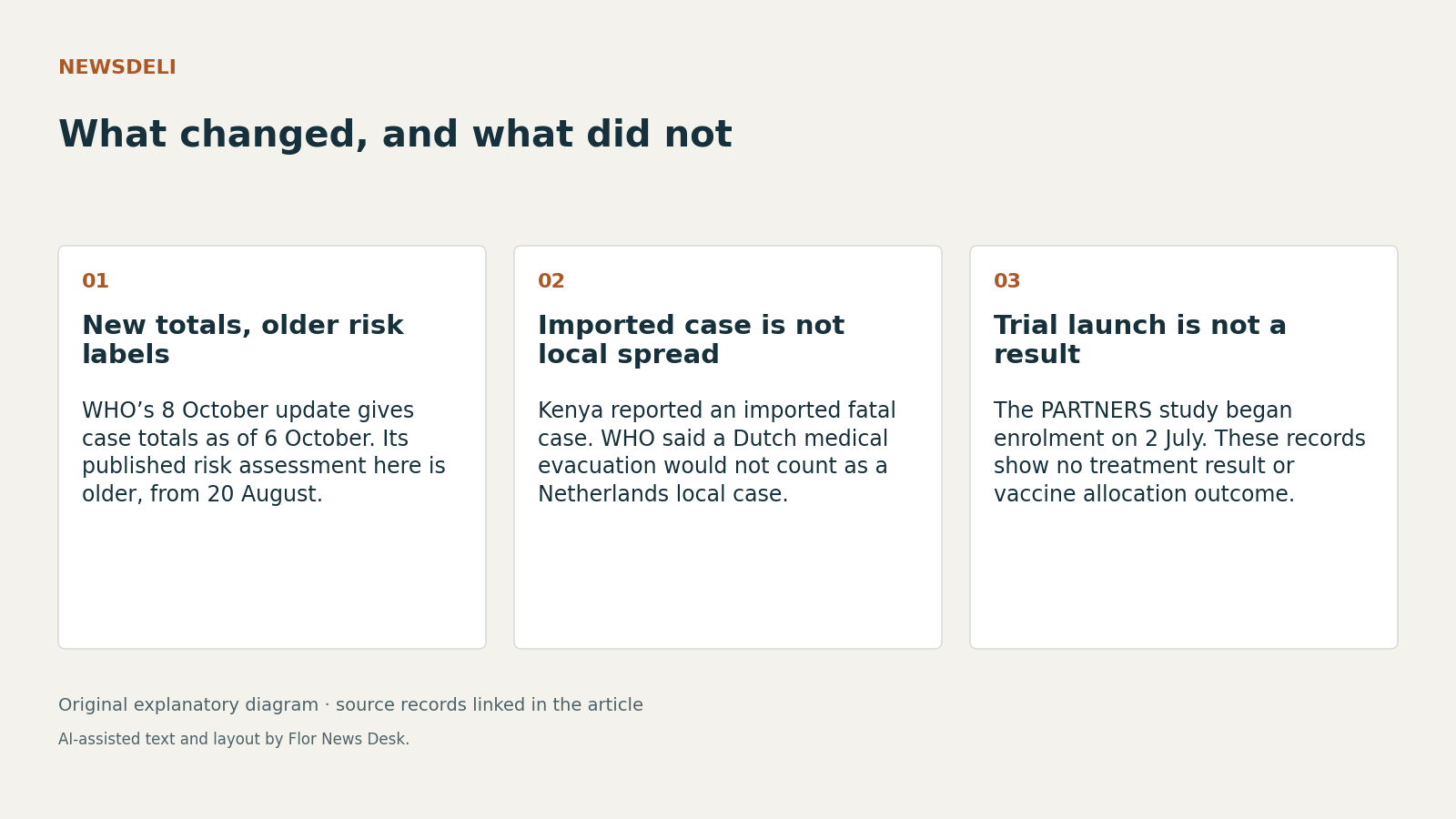
WHO’s 8 October 2026 outbreak update moves the main question from whether the Democratic Republic of the Congo is still facing a serious Bundibugyo virus disease emergency to how far that emergency is now reaching. WHO said that, as of 6 October 2026, the DRC had recorded 8,728 confirmed cases, 4,205 confirmed deaths and 2,269 recoveries, with confirmed cases in 64 health zones across seven provinces. The same update also said Kenya had reported its first laboratory-confirmed imported case on 6 October, after the patient died on 5 October following travel from the DRC through Uganda to Kenya. WHO Disease Outbreak News
The internal DRC picture matters because it shows expansion, not just persistence. WHO’s 20 August 2026 rapid risk assessment had described 4,566 confirmed cases and 2,128 deaths across six provinces, with Ituri Province as the epicentre. By 8 October, WHO was reporting a seventh affected province and a newly affected health zone, Alimbongo in North Kivu, with four confirmed cases including two deaths. WHO Rapid Risk Assessment v4 WHO Disease Outbreak News That comparison supports one clear conclusion: the outbreak spread geographically between the August assessment and the October update. It does not, by itself, prove whether the response is catching up, because the public records here are snapshots taken on different dates.
The cross-border signal is sharper than before, but it still needs careful reading. WHO’s August assessment had already reported imported cases in Uganda, France and Germany, while judging overall risk very high in the DRC, high in neighbouring countries, and low at regional and global levels. WHO Rapid Risk Assessment v4 The 8 October update adds Kenya’s imported death and notes that the Netherlands received a medically evacuated healthcare worker who tested PCR-positive in the DRC, which WHO said would not be counted as a local Dutch case. WHO Disease Outbreak News The practical distinction is important: an imported infection or evacuation is not the same thing as established local transmission. The records supplied here do not establish any onward spread in Kenya or the Netherlands, and WHO said a detailed risk assessment for Kenya was still ongoing in that outbreak notice.
Another reason not to over-read the case totals is that some response indicators were lagging. In the same 8 October notice, WHO said contact follow-up in the DRC stood at 80.4%, or 23,741 of 29,535 contacts reached, as of 4 October 2026, below the response target. WHO Disease Outbreak News That does not tell readers how many missed contacts later turned into cases. It does show why WHO’s August warning about unidentified transmission chains, insecurity, limited healthcare capacity and funding gaps still matters when interpreting October’s higher totals. WHO Rapid Risk Assessment v4
The science story is more limited than the outbreak story. WHO said patient enrolment for the PARTNERS randomized controlled trial began on 2 July 2026 in the DRC, testing MBP134, remdesivir and their combination in patients with confirmed Bundibugyo virus disease, with follow-up for at least 28 days. WHO also said no treatment is currently approved for this disease. PARTNERS trial launch But the supplied record is a launch announcement, not a results paper. It does not give enrolment totals, interim findings or any October treatment outcome. The same is true for vaccines in this source set: the reviewed records do not establish any current allocation or effectiveness result.
One additional WHO page from 8 October shows how the outbreak is being used in a broader policy argument. The WHO Hub for Pandemic and Epidemic Intelligence said a planned World Health Summit session on surveillance financing would use the DRC outbreak as an example of the costs of delayed detection and response. WHO Hub update That is useful context, but only as context: the page is an event notice with inconsistent dating, not evidence that financing rules changed or that new money reached the response.
So the most evidence-based things to watch next are narrower than the rhetoric around the outbreak. Readers should look for later WHO updates that separate imported cases from local transmission, show whether contact follow-up improves, and provide any actual PARTNERS trial readout. Until then, the strongest confirmed change is the outbreak’s wider footprint inside the DRC and the appearance of a fatal imported case in Kenya, both recorded by WHO on specific October dates rather than as general regional trend lines.