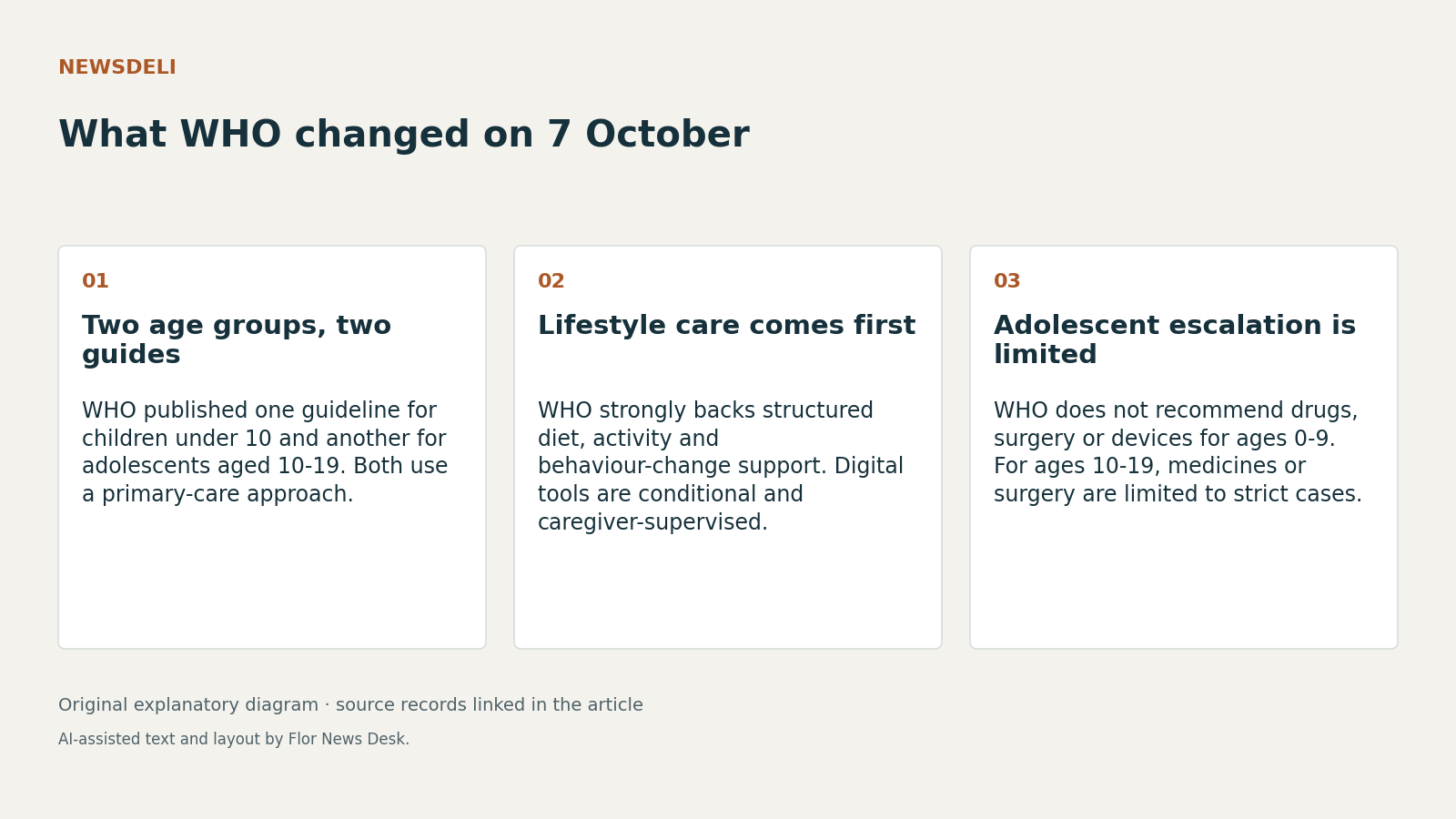
On 7 October 2026, the World Health Organization published what it describes as its first global guidelines focused on obesity care for children and adolescents (news release). The important change is not a new single treatment. It is that WHO has now set out one global framework, split by age, for how health systems should manage obesity in younger patients. That matters because guidelines can shape national clinical standards, but they are recommendations, not automatic law, funding or service expansion.
WHO’s structure is itself a signal. It released one guideline for children aged 29 days to under 10 years and another for adolescents aged 10 to 19 years, and both are presented as clinical and public-health guidance delivered through a primary health care approach (children guideline overview, adolescent guideline overview). WHO says the two documents fill a gap in global obesity-care guidance and, together with existing adult recommendations, create a more complete life-course approach (launch event page).
The pressure behind the move is large. WHO says that in 2024, 170 million people aged 5 to 19 were living with obesity, including 70 million children aged 5 to 9 and 100 million adolescents aged 10 to 19, and that obesity prevalence in that age band rose from 2% in 1990 to 8% (news release). A separate WHO event page says an estimated 400 million people aged 5 to 19 were overweight in 2024, including the 170 million living with obesity (launch event page).
What does WHO actually recommend? The centre of gravity is not drugs or surgery. WHO says it strongly recommends structured dietary, physical-activity and behaviour-change interventions, either one-to-one or as part of a multimodal programme (news release). The two overview pages show that these programmes are meant to consider sedentary behaviour and sleep as well, and that WHO weighed evidence reviews alongside harms, feasibility, costs, equity and the preferences of children, adolescents and caregivers (children guideline overview, adolescent guideline overview). WHO also conditionally recommends digital health interventions when parents or caregivers supervise them (news release).
The sharpest line is age. For children aged 0 to 9, WHO says it does not recommend pharmacological treatment, bariatric surgery or weight-loss devices (news release). For adolescents aged 10 to 19, WHO says approved medicines may be considered only after a supervised multimodal lifestyle programme has not achieved the desired results, and bariatric surgery may be considered only under strict conditions for severe obesity (news release). That is narrower than a headline about obesity drugs might suggest. The overview pages list medicines, surgery and devices as topics, but they do not on their own show broad endorsement or the exact eligibility criteria (children guideline overview, adolescent guideline overview).
The practical question after 7 October is implementation. WHO’s broader nutrition page says the agency develops evidence-informed guidance, supports adoption and implementation, and monitors policy and programme outcomes (nutrition topic page). But, as of 8 October 2026, the record here does not show which countries will adopt these recommendations, which budgets will pay for primary-care programmes, whether regulators have approved adolescent medicines in particular places, or whether services exist outside specialist centres. That is analysis based on what the documents do and do not contain, not proof that rollout will be slow.
One limit matters for readers: the launch page was an announcement for a 7 October webinar and still contained forward-looking wording when checked on 8 October 2026, so it helps explain WHO’s framing but not any post-event decisions (launch event page). So the safest reading is narrow but important: WHO has published a new policy anchor for child and adolescent obesity care. Whether it changes treatment on the ground depends on decisions that have not yet been shown in these records.