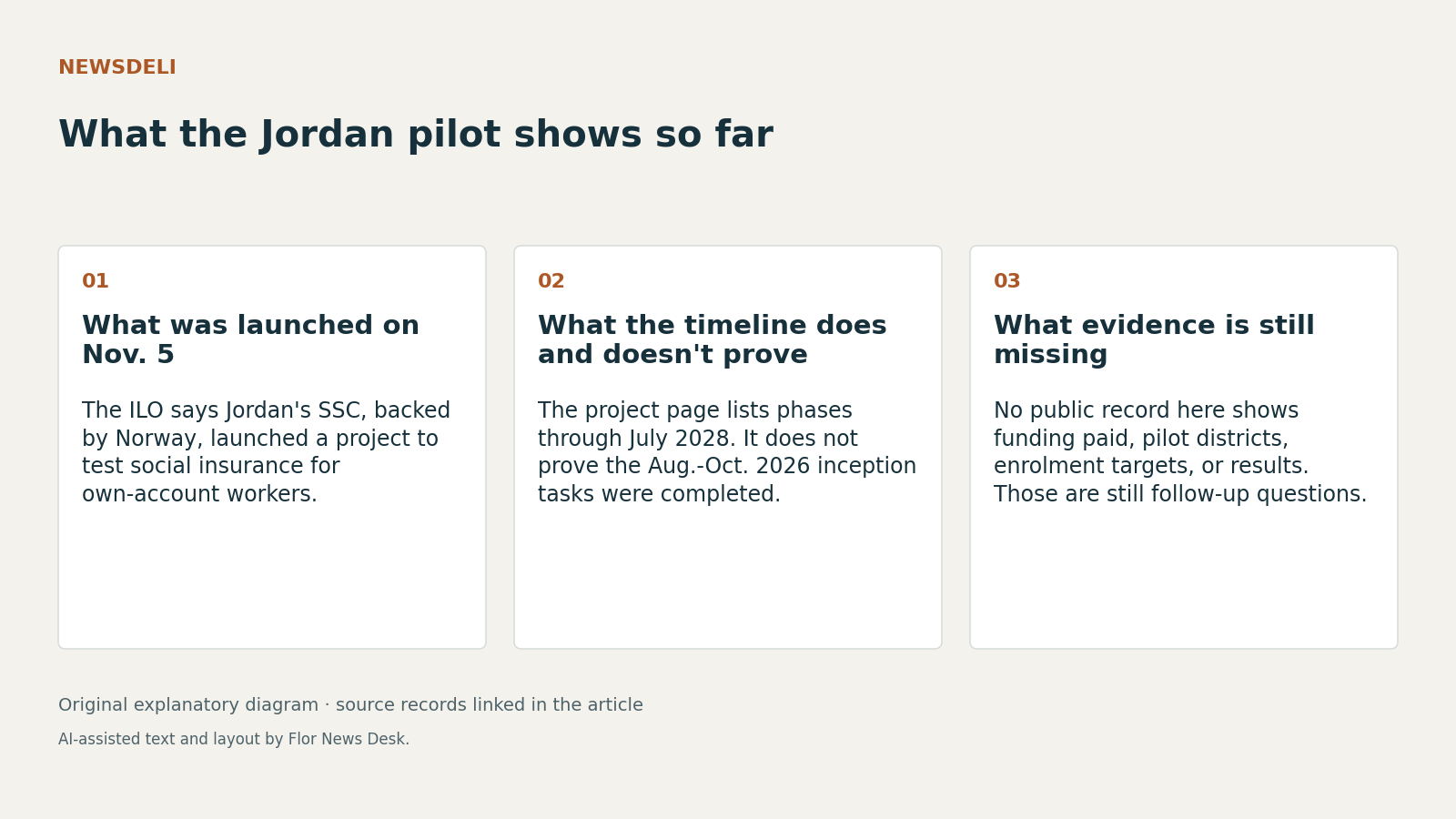
Jordan’s partnership with the International Labour Organization and Norway, launched in Amman on 5 November 2026, is notable less for what it has already delivered than for the specific problem it is trying to solve: how to make social insurance work for people who work for themselves and do not earn a steady payroll wage. The ILO says the project is aimed at own-account workers in Jordan and is meant to design, test and eventually integrate more flexible arrangements into the Social Security Corporation system, with the Kingdom of Norway funding the effort and SSC leading implementation with ILO technical support (ILO news announcement, ILO project page).
That makes this a policy test, not a proven expansion in protection. According to the ILO, the project will examine flexible contribution mechanisms, digital and administrative changes, temporary support for contributions, and targeted communication so workers understand rights, benefits and procedures (ILO news announcement, ILO project page). The project page also says a joint analysis by SSC, the ILO and the World Bank identified barriers that make enrolment and regular contribution payments difficult for this group (ILO project page).
The timetable is unusually clear, but readers should be careful with it. The project page lists a full duration of 1 August 2026 to 31 July 2028, with four phases: inception in August-October 2026, development and operationalisation in November 2026-July 2027, pilot implementation and institutionalisation in August 2027-April 2028, and closure and transition in May-July 2028 (ILO project page). But as of the current date, 10 November 2026, that same page does not establish whether the August-October inception tasks were actually completed. It records an earlier plan; it is not proof of completion or delay.
That distinction matters because the public record is still missing the evidence that would let readers judge delivery. Neither ILO page, as summarized in the source record, gives the funding amount, a disbursement schedule, pilot districts, enrolment targets, eligibility rules, contribution levels, evaluation metrics, enacted legal changes, or any measured results on sign-up and continued participation (ILO news announcement, ILO project page). So the launch is real, but success remains unproven.
Why does that still matter beyond Jordan? Because the background problem is large. The World Bank’s *State of Social Protection Report 2025* says 2 billion people in low- and middle-income countries are inadequately covered by social protection and that 80% of them have no coverage at all. The same report page says coverage in those countries rose from 41% to 51% between 2010 and 2022, but that progress remains slow enough that full coverage for people in extreme poverty would still take years at current rates (World Bank report page). Those figures are global, not Jordan-specific, but they help explain why institutions are testing designs that do not rely on standard payroll relationships.
A second World Bank record sharpens that point from a different angle. Its 5 November 2026 feature is about Bangladesh’s RAISE project, not Jordan, and it discusses private capital and employment support rather than social-insurance design. Still, the Bank says it has reached 259 million people toward its SP500 target of 500 million by 2030, and presents social protection as a tool that can help informal workers overcome barriers to jobs and finance (World Bank feature). That does not validate Jordan’s model. It does show that Jordan’s pilot sits inside a broader push to make social protection systems do more than serve workers with formal, regular wages.
The practical question now is narrower: when SSC and its partners move beyond launch language, will they publish the rules of the pilot, the terms of any temporary contribution support, the places being tested, and the measures they will use to judge enrolment and continued participation? The ILO says pilot evidence is supposed to guide adjustments before any wider application or national scale-up is considered (ILO news announcement, ILO project page). Until those details appear, the project is best understood as a serious experiment, not a demonstrated fix.