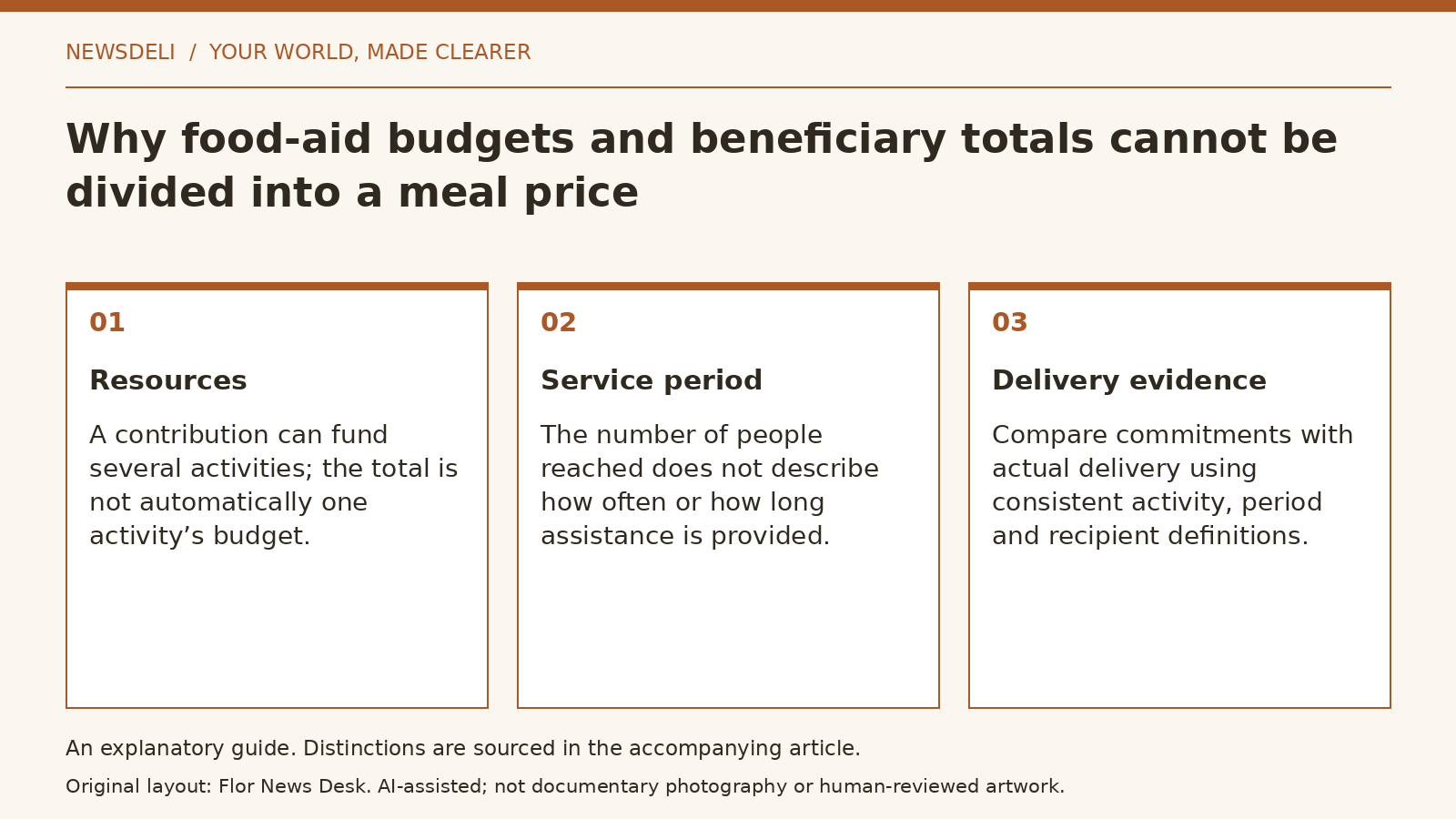
A food-assistance announcement may contain a budget, a quantity of food and a number of people. Dividing one headline number by another can look informative while producing a figure that the programme never promised.
In a September 8 announcement for Chad, WFP described a Japanese contribution of about $1.3 million. The agreement includes school meals for 16,400 children over six months of the 2026–27 school year, alongside malnutrition-prevention support for another specified target group. The release describes intended assistance, not a completed six-month delivery record.
A separate September 9 announcement for Sudan describes a $5 million contribution from the Republic of Korea for emergency food assistance and school meals. WFP gives target figures of 365,000 people for emergency assistance and 23,000 children for school meals. Those figures concern different activities. Without an explicit allocation and deduplicated recipient count, they should not be turned into a single per-person entitlement.
People and service-days are different units
Imagine two hypothetical programmes, each serving 100 children. One supplies meals for a week and the other for a school term. Their reach totals match, but the service provided does not. To compare them meaningfully, the number of days and the kind of assistance would need to remain visible.
The same reasoning applies to a funding announcement covering several activities. The total contribution is not necessarily the budget of any one component. Dividing the whole amount by the school-meal target would silently assign all funding to that component, even when the announcement says otherwise.
A pledge is not a delivery ledger
There are also separate stages between an agreement and a meal being served. A reporting framework can distinguish committed funds, procured supplies, delivered assistance and people actually reached. The announcements establish their own stated commitments and plans; they do not fill in every later stage.
That is not a reason to ignore them. It is a reason to ask the right follow-up questions. Which activity received which resources? Over what period? How many unique people were reached, and with what frequency? Were planned and actual results reported using the same definitions?
Compare like with like
The two releases should therefore be read as descriptions of different programmes rather than ranked by a crude dollars-per-beneficiary calculation. A smaller contribution might support a longer or different service for a narrower group. The figures alone cannot settle that comparison.
For readers following humanitarian funding, keeping the units intact offers a better test of accountability: trace the commitment through to delivery, instead of making a meal price out of numbers that describe different things.