The UN’s 2 October 2026 announcement of a $160 million Central Emergency Response Fund allocation matters because it records a funding decision inside the UN system, not just another warning about unmet need. OCHA presented the move at the UN Geneva press briefing, and UN News reported the same day that the package targets 12 underfunded humanitarian crises. That is a clearer fact than a general appeal for help, but it is still only the start of the story, not evidence that assistance has already reached people or that access obstacles have been removed. UN News UN WebTV briefing
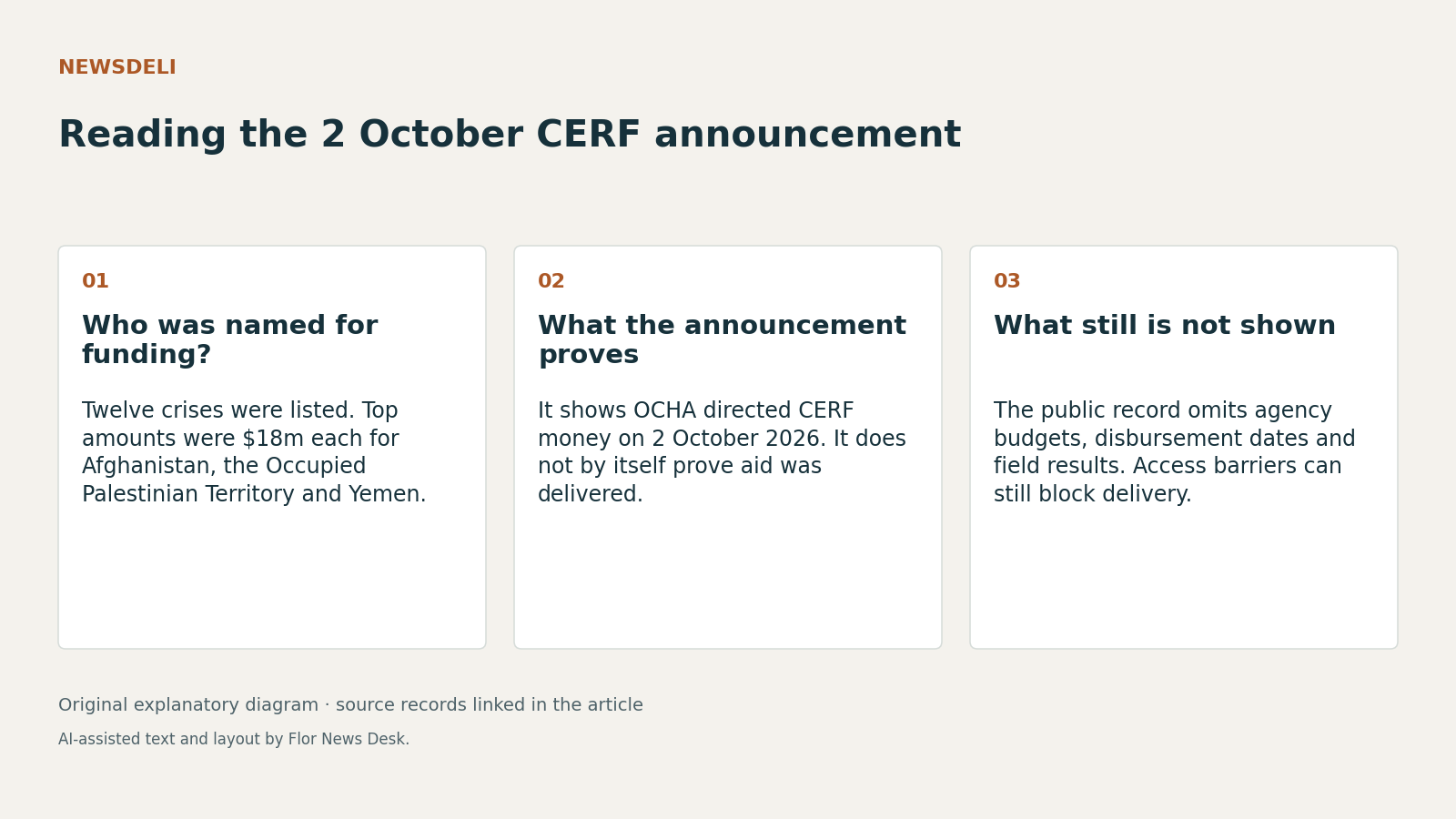
According to UN News, $150 million of the package is divided among Afghanistan, the Occupied Palestinian Territory and Yemen at $18 million each; Somalia and Sudan at $16 million each; South Sudan at $15 million; Burkina Faso, Mali and Niger at $10 million each; Chad at $9 million; Cameroon at $6 million; and Cuba at $4 million. A further $10 million is set aside for people with disabilities across the same 12 crises. OCHA also said the UN Global Disability Fund would add up to $4 million in complementary funding and technical support through its Inclusion Catalyst Hub, and that the new decision brought CERF allocations in 2026 to $483 million. UN News UN WebTV briefing
What does that announcement actually establish? Because OCHA said it released money from CERF, it shows the UN directing resources from an existing pooled fund rather than announcing a fresh outside pledge. But the public records available here do not identify which UN agencies will implement each country plan, how the money is split by sector, when funds move to field operations, or what delivery targets are attached to each grant. Readers therefore know the ceiling and the intended destinations, but not yet the operational chain between allocation and assistance. UN News UN WebTV briefing
The same records also show why funding is only one part of the equation. UN News attributed to OCHA the view that five of the 12 crises are among 10 contexts where urgent diplomatic action is needed to secure humanitarian access, and that improved access would open the way to help for 11 million people. That figure should be read carefully. It describes OCHA’s broader access assessment across those contexts, not a measured outcome that this one CERF allocation will itself deliver. UN News
The WebTV briefing gave two concrete examples of the gap between money allocated and aid physically delivered. WHO’s representative in the Occupied Palestinian Territory said medical supplies for Gaza faced a median 74-day wait for Israeli approval, and that 40 per cent of laboratory and diagnostic equipment remained pending approval. In the same briefing, WFP said conflict had cut off access to parts of Taiz and Hodeidah in Yemen, preventing assistance from reaching 350,000 people in need. Those statements do not describe all 12 crises, but they do show why a funding decision does not by itself move supplies, staff or convoys. UN WebTV briefing
The most useful way to read the 2 October package, then, is at three levels. The country amounts and the disability set-aside are announced UN allocations. The extra support from the UN Global Disability Fund is prospective, because the public record says it would add up to $4 million. And the real-world effect remains unproven in these records because they do not yet show partner disbursements, commodity deliveries or outcome measures. To judge what changed after 2 October 2026, readers would need later agency allocation notices and field reporting, not just the announcement itself. UN News UN WebTV briefing