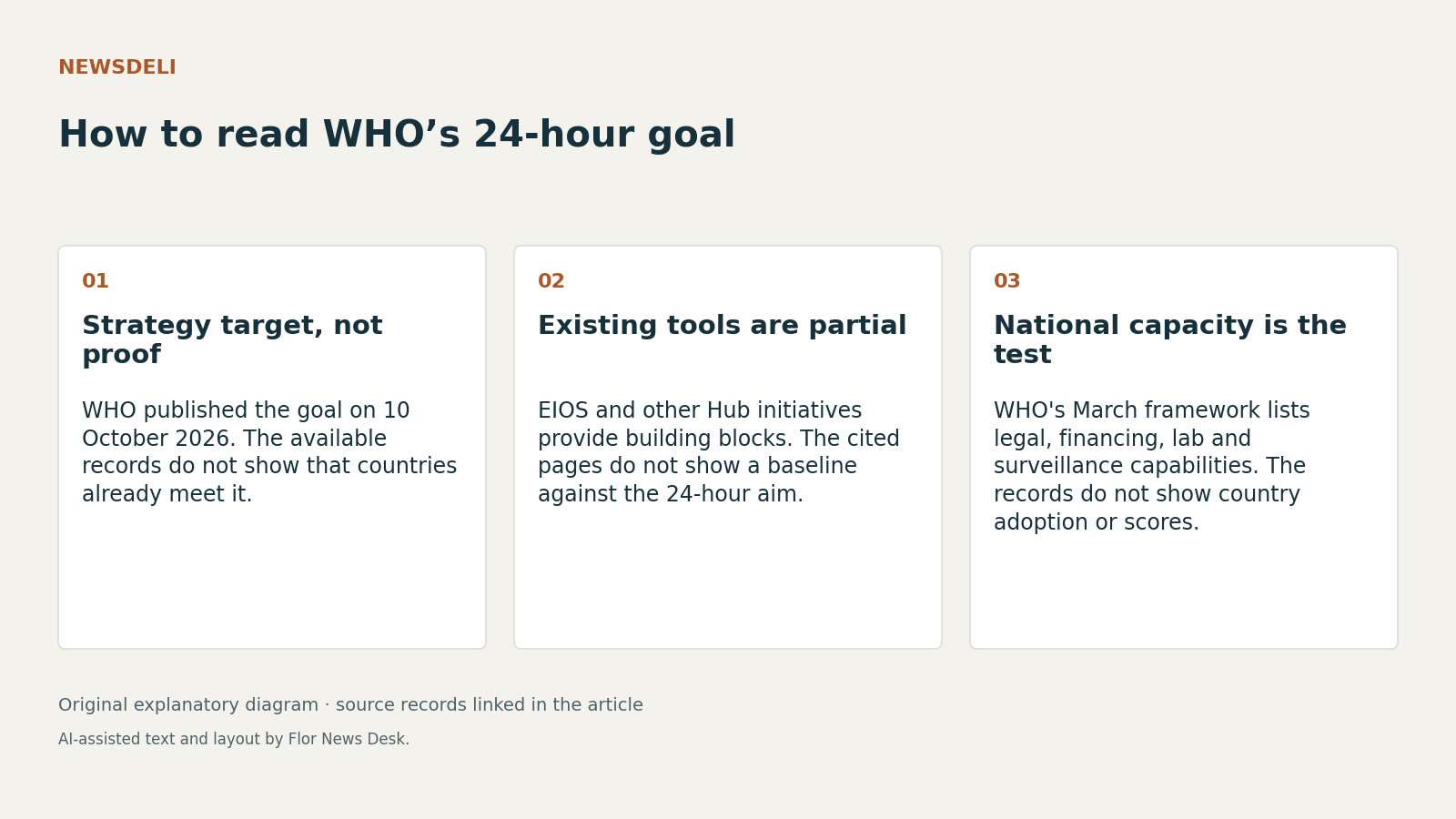
On 10 October 2026, the WHO Hub for Pandemic and Epidemic Intelligence published a five-year strategy with a striking deadline: by 2030, it wants new health threats to be detected and understood within 24 hours of their emergence. WHO repeated the point in a 12 October news release and framed it even more broadly as a world where every country can do this. What happened, then, is not a system rollout. It is the publication of a strategy target that still needs financing, country uptake and a way to measure success. WHO Hub strategy 2026–2030 WHO news release, 12 October 2026
The available records show a fairly specific delivery plan, but mostly at the programme level. The strategy overview lists four strategic objectives: stronger surveillance systems, faster detection through innovation, applied analytics and knowledge translation, and trusted digital foundations. WHO says five initiatives are meant to carry that work: Epidemic Intelligence from Open Sources, the International Pathogen Surveillance Network, the Collaboratory, the Collaborative Surveillance Initiative, and the Digital Enablers for Public Health Intelligence Initiative. That makes the 24-hour goal more concrete than a generic preparedness pledge, but it still leaves the operational question open: how WHO will define detection and understanding for measurement. The available overview does not provide that metric. WHO Hub strategy 2026–2030 WHO news release, 12 October 2026
Some building blocks already exist. WHO’s EIOS initiative says it uses open-source data in near real time for public health threat detection and that, by the end of 2025, 120 countries and 30 organizations and networks were leveraging the system. WHO also says EIOS leadership has been hosted in the Hub since January 2022. Separately, the Hub’s 2025 annual report overview says it was based on achievements in 2025 and presents 10 actions for 2026 and beyond. The analytical reading is that the Hub is extending existing surveillance and collaboration platforms, not starting from zero. But these pages do not show how close those tools are to a 24-hour global standard in October 2026. EIOS initiative WHO Hub annual report 2025
The tougher gap may sit inside national institutions rather than in a single WHO platform. A March 2026 WHO framework for national public health agencies groups 12 core capabilities into foundational and technical domains, including legal authority, secure and flexible financing, surveillance and intelligence, laboratory and diagnostic systems, coordination, emergency management and workforce development. If the 2030 aim is truly for every country, the logic of that framework matters: rapid global intelligence depends on whether national agencies can lawfully collect, analyse and share data fast enough. The current records do not show which countries have adopted those capabilities or how they are scored. Framework for national public health agencies WHO news release, 12 October 2026
That is why the missing evidence matters as much as the ambition. The strategy overview does not provide a baseline, country-by-country implementation status, financing commitments or measured results for the 24-hour target. The news release says the Hub was created in 2021 with foundational support from the German Government and says the new strategy will require sustained investment and trusted partnerships, but it does not identify binding budgets, legal obligations or an independent evaluation method. Even the participation figures, such as work with more than 160 Member States and 190 partner organizations, are institutional counts, not proof that all those participants can meet the same response time or data-sharing standard. WHO Hub strategy 2026–2030 WHO news release, 12 October 2026
So the most useful way to read the announcement is as a benchmark that creates a reporting agenda. The next evidence to look for is not another aspiration statement, but public documentation on four points: how WHO will define detection and understanding within 24 hours; what interim milestones or indicators will be published; what funding WHO and donors actually commit; and which countries can demonstrate the legal, laboratory and surveillance capabilities the March framework describes. Until those records appear, the October 2026 strategy shows direction and urgency, not verified readiness. WHO Hub strategy 2026–2030 Framework for national public health agencies EIOS initiative