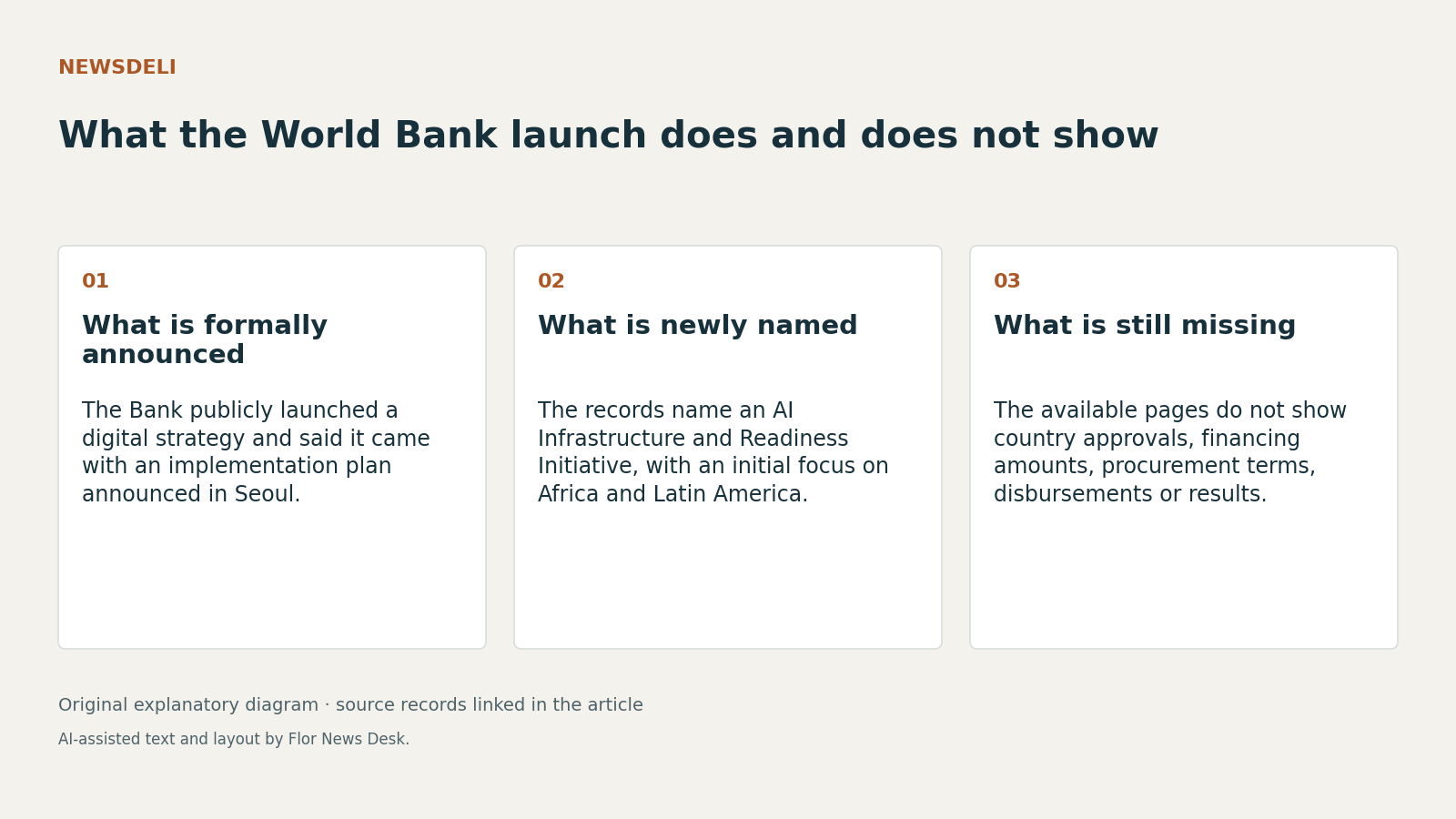
On October 20, 2026, the World Bank Group said in Seoul that it had launched its first digital strategy, and Vice President Sangbu Kim said the launch included an implementation plan. What that public record clearly establishes is narrower than the headline can suggest: the Bank has set institutional priorities and attached them to a named AI initiative, but it has not yet published evidence of country-by-country delivery, approved funding envelopes, or results. Press release Speech
The strategy itself is fairly concrete at the level of policy direction. The Bank’s release lists four priorities: expanding connectivity, lowering the cost of devices and data, improving digital services and skills, and building readiness for artificial intelligence. In summit remarks presented on the event page, World Bank Group President Ajay Banga described similar building blocks, though with slightly different emphasis: electricity and connectivity, affordability, digital public infrastructure and related systems, and AI tools fitted to local uses. That overlap matters because it suggests a common internal frame, even if it is not yet the same thing as an approved program list. Press release Event page and transcript
The most specific new item in the release is the AI Infrastructure and Readiness Initiative. According to the Bank, it is meant to help governments in emerging markets gain access to computing power through shared pay-as-you-go GPU infrastructure, with an initial focus on Africa and Latin America and knowledge partners including Cassava Technologies and NVIDIA. That is more definite than a general promise to support digital development because it names a mechanism, regions, and partners. But it still stops short of showing which governments have signed on, what infrastructure will be procured, or who will pay under what terms. Press release
The speeches add ambition, not proof of execution. Kim said trust and safety run across all four parts of the plan and described an ambition to connect one billion people to digital opportunity by 2030. Banga, in the summit transcript, spoke of intended reach to 600 million people with broadband access and 400 million using digital services. Those figures show the scale of the Bank’s pitch. They do not, on their own, establish baselines, funded pathways, or progress as of November 3, 2026. Speech Event page and transcript
What is missing from the available record is just as important. Across the three public pages, there are no country project approvals, signed financing amounts, guarantee terms, procurement terms, disbursement figures, pilot site lists, or measured outcomes. That gap means readers cannot yet tell whether this launch will translate into new International Bank for Reconstruction and Development or International Development Association operations, private capital mobilization, or smaller technical pilots. Press release Event page and transcript Speech
The release does say the Bank plans to use financing, policy advice, private investment, and guarantees around country priorities. That is meaningful as an institutional toolkit, but it does not itself identify new money. In analysis terms, the October 20 announcement is best read as a framework for future operations and partnerships, not evidence that those operations have already been approved or delivered. Press release
So the practical test comes next. If the strategy is to become more than a summit launch, the public record will need to expand to include project documents, financing commitments, implementation milestones, partner terms, and eventual outcome reporting. Until then, the strongest claim supported by the sources is that the World Bank Group has defined a digital policy agenda and attached a named AI access initiative to it. Press release Speech