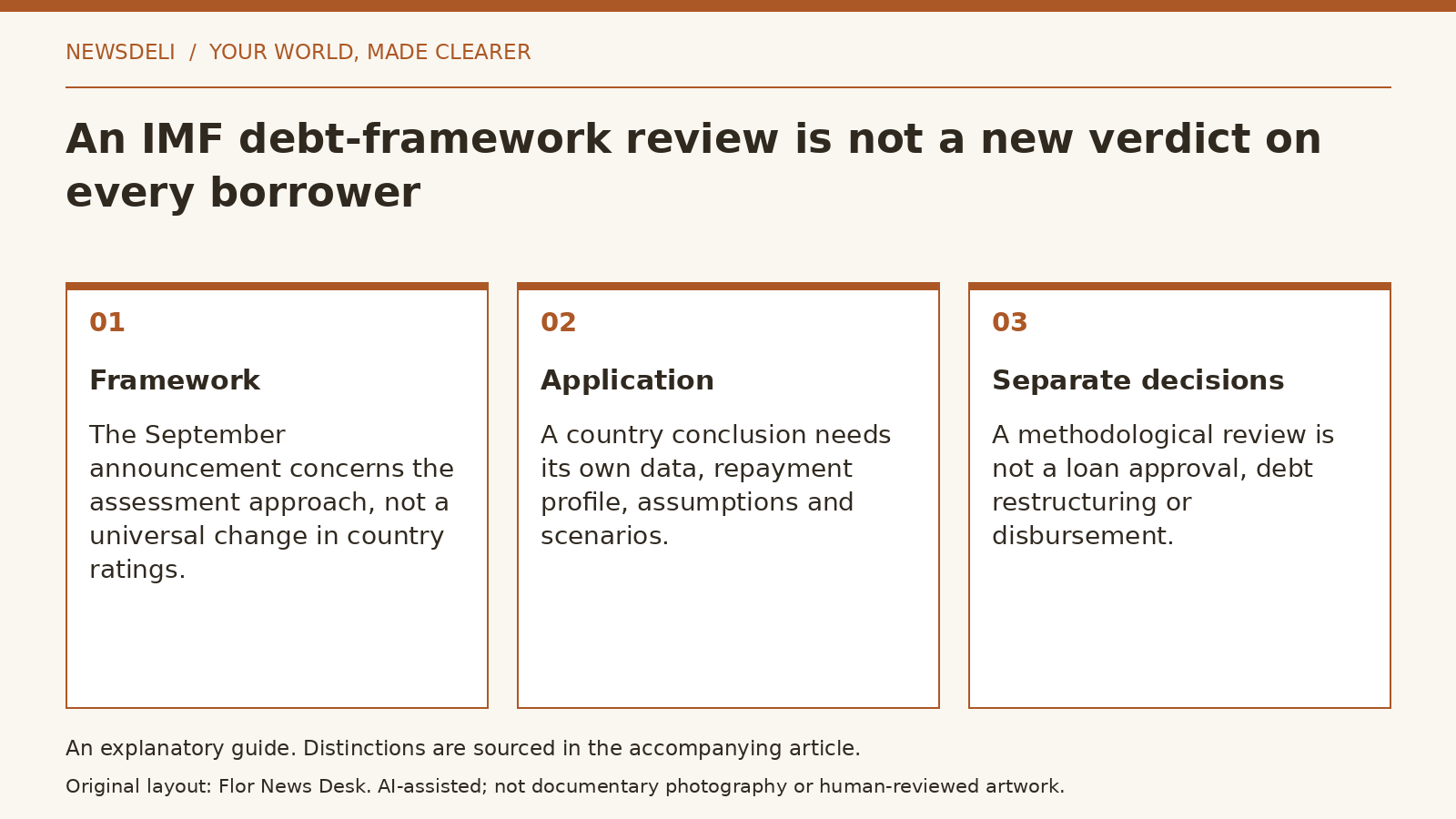
Reviewing an assessment framework and reassessing a particular borrower are different operations. A change in the discussion of the method should not be reported as though it were a new country-by-country debt judgment.
In a September 21 release, the IMF described its Executive Board’s September 9 review of the joint World Bank–IMF Debt Sustainability Framework for low-income countries. The account treats the framework as broadly fit for purpose while discussing improvements in a more complex borrowing environment. It is a review of the assessment approach, not a press release announcing that every participating country has received a revised risk classification.
Method and application belong on separate pages
A framework specifies how an assessment is organised. Applying it requires information about a particular country and judgments about future conditions. The IMF’s background explanation describes a system for analysing debt vulnerabilities and informing borrowing and lending decisions. The existence of that system does not remove the need to examine the individual assessment.
A hypothetical comparison makes the distinction clearer. Two borrowers could have similar headline debt totals while facing different repayment schedules or income paths. A common method would help organise the comparison; it would not justify assigning the same conclusion merely because one number matches. This is an explanatory example, not a classification of any country.
Assumptions deserve attention
When reading a country analysis, a useful question is what would have to remain true for its projected path to hold. Another is what happens under less favourable conditions. A baseline and a stress scenario serve different purposes. Neither should be described as an observed future outcome.
That also means a framework review cannot, by itself, establish how a later assessment will change. The direction would depend on the details of the method, the evidence supplied and the circumstances of the country concerned. Claiming a universal upgrade or downgrade from the review headline would skip those steps.
A review is not a financing transaction
The announcement should also be kept separate from a loan approval, a restructuring agreement or a transfer of funds. Those actions would require their own identifiable decisions and records. An analytical framework can inform a financing discussion without itself completing a transaction.
For readers following public debt, the immediate development is institutional: the assessment approach has been reviewed. The next useful evidence is the published country analysis that applies it, with its reference date, assumptions and limitations intact. That is where a general methodological discussion becomes a specific risk assessment.