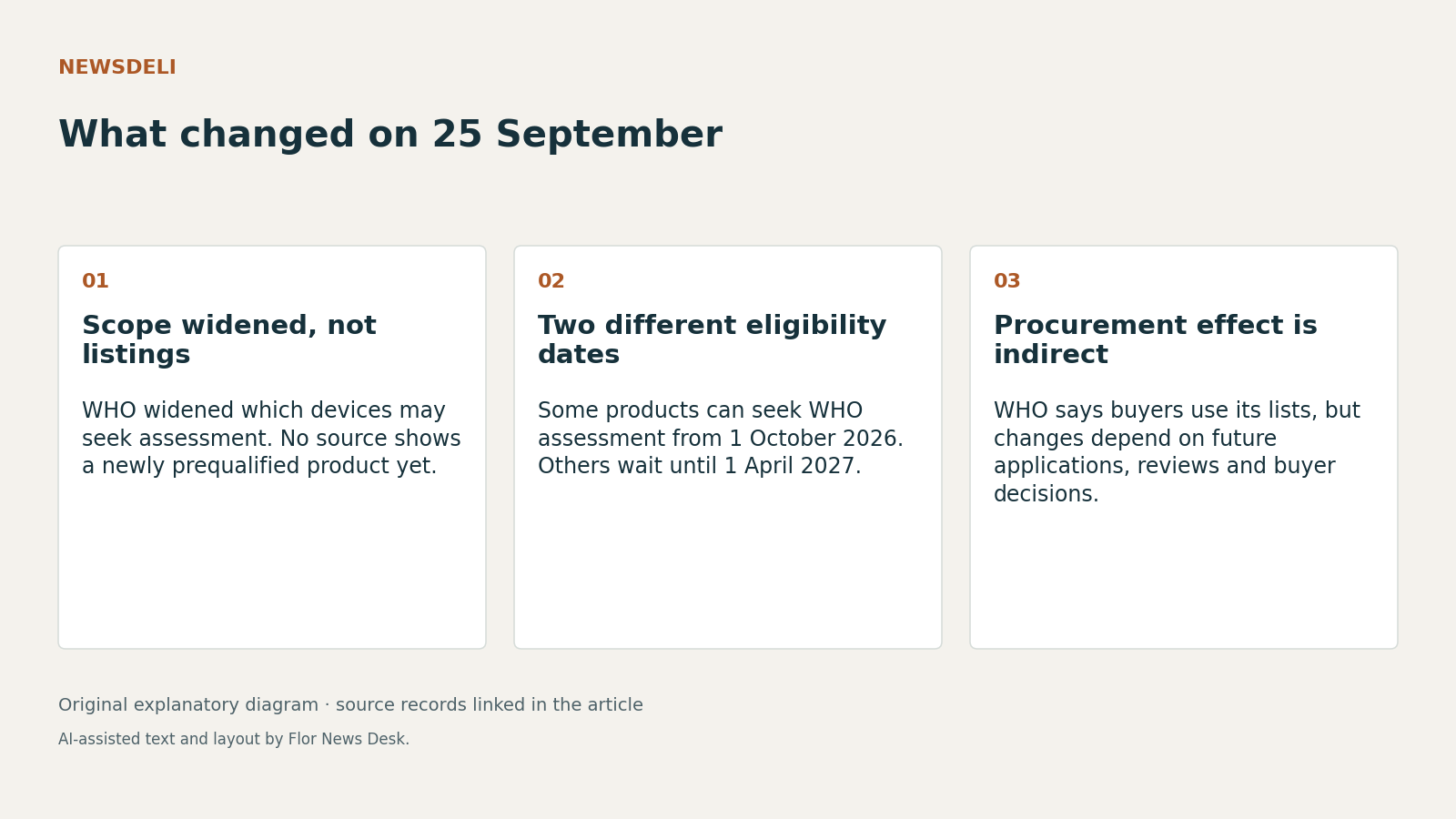
WHO’s 25 September announcement about medical-device prequalification matters because it changes who can apply and when, not because it has already added new products to WHO buying lists. In a WHO news release and an eligibility table updated the same day, WHO said it is widening the programme to cover contraceptive devices and computer-aided tuberculosis screening tools. But as of 30 September 2026, the key 1 October 2026 date on the eligibility page is still a planned start for some applications, not evidence that reviews or purchases have happened.
That distinction matters because WHO describes prequalification as a check on quality, safety, efficacy and performance for products used in international procurement, while also saying the programme is not itself a regulator. In its fact sheet, WHO says products that pass can become eligible for procurement by UN agencies, governments and partners. In the 25 September announcement, WHO says the resulting list is used by UN agencies, procurement organizations, donors and national authorities. So the policy change opens a pathway; it does not by itself certify a single new device.
The immediate scope is narrower than the headline can sound. The eligibility page lists five device types now eligible for prequalification assessment: male latex condoms, female condoms, copper-bearing intra-uterine devices, CAD-TB medical devices, and male circumcision devices. It also splits them by timetable. Products previously submitted to UNFPA, plus CAD-TB products and male circumcision devices, are stated to be eligible for WHO assessment from 1 October 2026. Contraceptive devices not previously submitted to and accepted by UNFPA are stated to become eligible only from 1 April 2027. Applications for changes to contraceptive devices already listed by UNFPA may be submitted to WHO from 1 October 2026.
For TB screening, WHO has not opened the door to every digital tool. The same eligibility record says CAD-TB devices must be intended for use instead of human readers when interpreting digital chest X-rays for tuberculosis screening and triage, and must already have policy endorsement by WHO’s Department for HIV, TB, Hepatitis, and Sexually Transmitted Infections. That makes this a defined route for a specific class of software, not a blanket approval lane for all TB technologies.
Why does that matter? WHO frames prequalification as especially relevant where regulatory capacity is limited. The announcement links the expansion to that problem, although the numerical estimate it cites concerns medicines and vaccines rather than medical devices specifically. The fact sheet adds that the broader programme had listed more than 1,700 health products as of the end of 2025. The analytical point is that WHO is extending an existing procurement signal into new device categories, but the current record does not show which buyers will change their purchasing rules for those categories, or when.
The contraceptive shift also looks more like a staged administrative transfer than a one-day market reset. WHO says in the announcement that prequalification for male and female condoms and intrauterine devices is being transferred from UNFPA to WHO, while the fact sheet says contraceptive devices were transitioned in 2025. The extranet timetable helps reconcile that wording: products already in the earlier UNFPA channel get access first, while products outside that pipeline wait until April 2027.
What remains unresolved is exactly what readers are likely to ask next: whether manufacturers actually apply, how fast WHO reviews them, when any device appears on a WHO prequalified list, whether UN agencies or donors redirect purchases, and whether national regulators treat WHO outputs as enough for local action. None of the three WHO records establishes those outcomes yet, and as of 30 September 2026 the first eligibility milestone has not arrived.