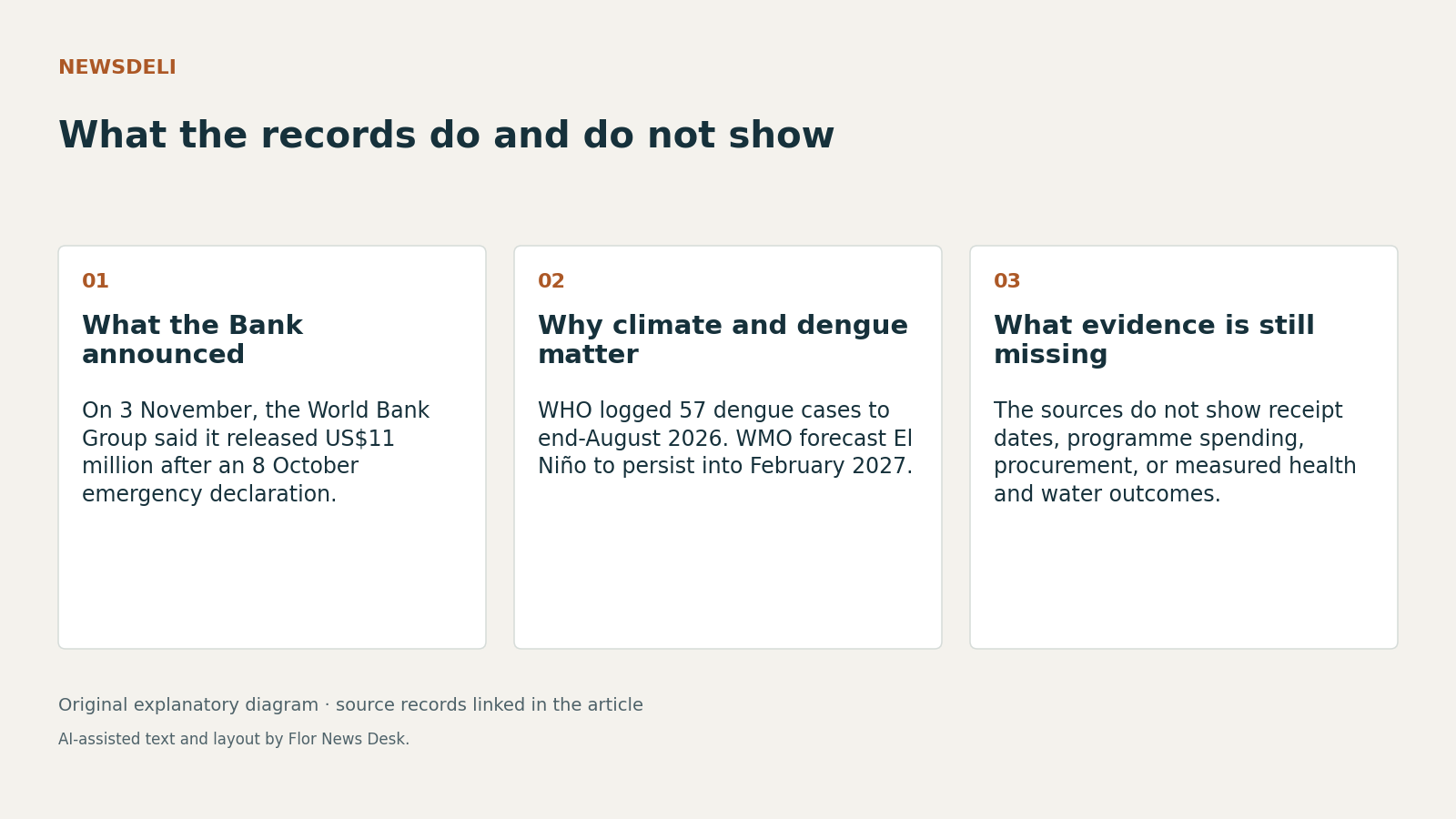
On 3 November 2026, the World Bank Group said it released US$11 million to the Republic of the Marshall Islands for response to El Niño impacts and an ongoing dengue outbreak, using the country’s Catastrophe Deferred Drawdown Option after a government request and a State of Emergency declared on 8 October 2026 (World Bank press release). That is a concrete financing action in the public record. It is not the same thing as proof of where the money went next.
The key distinction is between activation and outcome. On the available record, the World Bank says a pre-arranged financing source for qualifying emergencies was triggered after the emergency declaration (World Bank press release). As analysis, that suggests the value of arranging contingency finance before a crisis, because the 3 November announcement did not have to wait for a brand new facility to be publicly created. But the same press release does not show treasury receipt timing, ministry allocations, procurement, or delivery to clinics, water systems or households.
The climate case for urgency is supported, but only at a broad level. In a 3 September 2026 update, the World Meteorological Organization said El Niño was firmly established, likely to strengthen, and had an almost certain chance of persisting through February 2027 (WMO update). WMO also warned that event strength alone does not determine what any specific country will experience (WMO update). That matters here: the forecast helps explain why pre-arranged emergency finance exists, but it does not by itself prove conditions in the Marshall Islands on 3 November.
The health evidence has a similar limit. WHO’s Weekly Epidemiological Record, published on 9 October 2026 with data stated to be as of the end of August 2026, lists 57 dengue cases in the Marshall Islands for January to August 2026. The same table shows zero for the January to August periods of 2024 and 2025, while WHO cautions that case definitions and ascertainment vary across reporting places (WHO Weekly Epidemiological Record). That is enough to show dengue activity in 2026. It is not enough to establish the size or direction of the outbreak after August, including around the 8 October emergency declaration.
The World Bank press release adds that El Niño brought hazardous winds, ocean swells and drier conditions, and that the dengue outbreak affected Majuro and Ebeye (World Bank press release). Those are institutional claims, not audited field results in the fetched record. WHO’s Western Pacific dengue page says the region uses indicator-based and event-based surveillance and publishes situation summaries every two weeks, and the landing page lists updates dated through 28 October 2026, but the visible page text does not provide Marshall Islands case counts or response details (WHO Western Pacific dengue page).
So what does the announcement actually prove? It shows that a named emergency financing instrument was used for a small island state facing overlapping climate and disease risks, and that the World Bank says Global Facility for Disaster Reduction and Recovery technical assistance is part of the package (World Bank press release). It does not prove how much money, if any, had reached particular programmes by 3 November, or whether health and water outcomes had improved.
For accountability, the next decisive records would be government budget or allocation documents, procurement notices, implementing-partner delivery logs, and fuller WHO or health-ministry situation updates. The source set here points to the need for those records, especially because WHO’s regional page indicates more frequent surveillance products exist than the global August-end table alone captures (WHO Western Pacific dengue page; WHO Weekly Epidemiological Record). Until those documents are checked, the strongest verified conclusion is narrower: the funding was publicly announced as released, and the public evidence of impact remains incomplete.