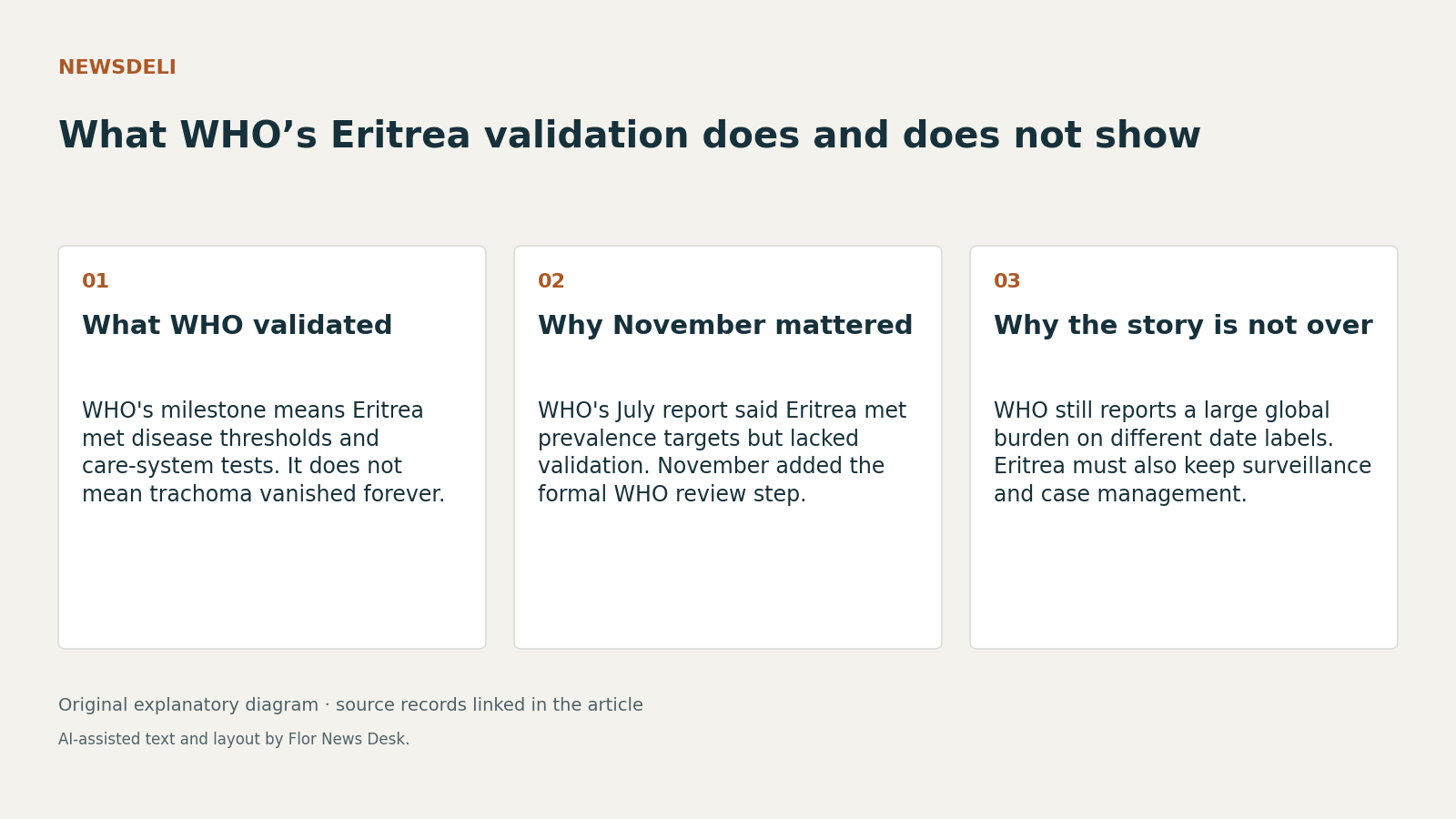
On 16 November 2026, WHO said it had validated Eritrea’s elimination of trachoma as a public health problem, making Eritrea the 11th country in WHO’s African Region and the 34th worldwide to reach that milestone WHO release. The important part of that headline is the full WHO category. In WHO’s system, this is a judged public-health threshold, not proof that trachoma can no longer appear in Eritrea WHO trachoma fact sheet.
WHO’s fact sheet defines the milestone with three tests: trachomatous trichiasis unknown to the health system must be below 0.2% in adults aged 15 years and older; trachomatous inflammation-follicular must be below 5% in children aged 1 to 9 years for at least two years without ongoing mass antibiotic treatment in each formerly endemic district; and there must be a system, with resources, to find and manage new trichiasis cases WHO trachoma fact sheet. A 2016 WHO guide explains that WHO uses the term validation for this category and that it replaced the older label elimination of blinding trachoma 2016 WHO validation guidance.
That is why the public record does not support reading the milestone as eradication or permanent disappearance. WHO’s own criteria require a continuing ability to detect and treat new trichiasis cases, and the 16 November release says Eritrea will continue surveillance after validation WHO trachoma fact sheet WHO release. So the sourced conclusion is narrower: WHO judged that trachoma is no longer a public-health problem by its thresholds.
The release also outlines how Eritrea got there. WHO says baseline surveys were carried out in different parts of the country between 2006 and 2020; all 58 sub-zobas were surveyed; and the SAFE strategy was applied or expanded where trachoma was endemic WHO release. WHO also says the antibiotics distributed were mainly oral azithromycin donated by Pfizer Inc. through the International Trachoma Initiative WHO release. What the release does not provide are Eritrea’s prevalence tables, district-by-district results or antibiotic totals.
An earlier WHO record shows why validation is a separate step from reporting good survey results. In the Weekly Epidemiological Record, WHO said that as of 16 July 2026 only 32 countries had been validated, and Eritrea was among six countries that had reported achieving the prevalence targets but had not yet been validated Weekly Epidemiological Record. Read alongside the 2016 guidance, that suggests WHO’s November announcement followed dossier review against a standardized process, not just field data alone 2016 WHO validation guidance.
The broader disease picture also matters. WHO’s Global Health Observatory says the estimated population living in endemic districts and at risk of trachoma blindness fell from more than 250 million in 2010 to 101.5 million in 2025 WHO Global Health Observatory. A different WHO dataset in the fact sheet, labelled as March 2026 data, says 92 million people still lived in trachoma-endemic areas; the same fact sheet reports that in 2025, 47.4 million people were treated with antibiotics and 98,829 people received surgery for advanced disease WHO trachoma fact sheet. These dates are not interchangeable, but they point the same way: Eritrea’s milestone sits inside a still unfinished global campaign.
The same caution applies to country counts. The July 2026 WER said trachoma remained a public-health problem in at least part of 29 countries on 20 March 2026 Weekly Epidemiological Record, while the later WHO fact sheet says 28 countries and lists 34 countries validated as of 16 November 2026, including Eritrea WHO trachoma fact sheet. For readers, the reliable takeaway is specific: WHO says Eritrea met the agreed thresholds and has systems to manage future cases. The public documents cited here do not let us say more than that.