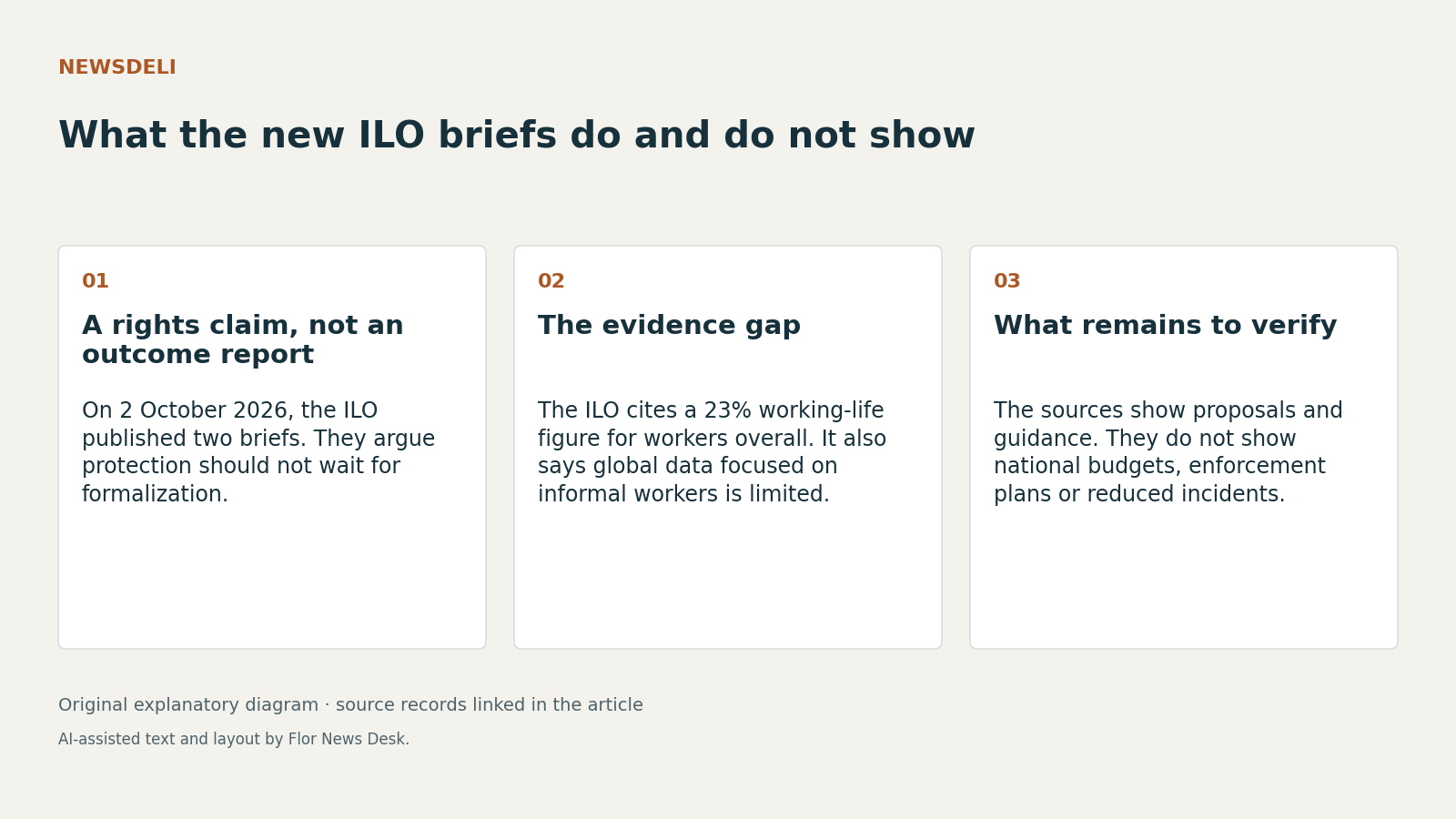
Two policy briefs published by the International Labour Organization on 2 October 2026 make a more immediate argument than a standard call to formalize jobs. According to the ILO’s public summary, the briefs say violence and harassment in the informal economy should be prevented and addressed now, rather than treated as a problem that can wait until workers enter formal employment ILO news release.
That matters because informal work is not a marginal part of the labour market. In its *Employment and Social Trends 2026* report, published on 14 January 2026, the ILO estimated that 2.1 billion workers remained in informal employment and described informality as a major job-quality deficit. The same report projected a global jobs gap of 408 million in 2026 Employment and Social Trends 2026. Those January figures are not October outcome data, but they help explain the ILO’s reasoning: if protection depends on completed formalization first, a very large group may remain exposed in the meantime.
The evidence base in the public record is mixed. The ILO release cites research with Gallup and Lloyd’s Register Foundation finding that 23% of people in employment had experienced physical, psychological or sexual violence and harassment at work during their working life ILO news release. But that number is not presented as a global prevalence rate for informal workers specifically. The same ILO record says comparable worldwide evidence focused on informal-economy workers remains limited. So the briefs are better understood as a policy response to a serious risk, not as proof of prevalence by country, sector or legal status.
The clearest analytical shift is that the ILO is separating two policy questions that are often bundled together. One is the long-term transition from the informal to the formal economy. The other is whether people linked to work already have practical protection against abuse, threats and coercion. The ILO says risks are higher where labour and social protection are weaker, employer responsibility is unclear or dispersed, and inspection, complaint and redress channels are hard to use. It also says more than 60% of informal work in low- and middle-income countries takes place away from fixed, visible business premises, including homes and public spaces ILO news release. That helps explain why the briefs are tied both to Recommendation No. 204 and to Convention No. 190 with Recommendation No. 206.
The ILO release does not spell out every operational step in the briefs, so it helps to compare it with narrower guidance from other institutions. WHO’s health-sector page on violence and harassment recommends work-organization changes, adequate staffing, limiting lone work, incident reporting, confidential complaint procedures and monitoring of trends WHO technical guidance. That WHO page is not about the whole informal economy, and its prevalence figures come from a 2019 review rather than a 2026 update. Still, it shows the difference between affirming a right in principle and setting out concrete prevention and remedy tools.
Readers should also keep separate types of danger that can look similar in headlines. On a World Humanitarian Day page tied to 19 August 2026, WHO said its Surveillance System for Attacks on Health Care had documented 914 attacks on health care so far in 2026, causing 911 deaths and 1,486 injuries, mostly in Ukraine, Lebanon, the occupied Palestinian territory and Myanmar WHO World Humanitarian Day 2026 page. Those are conflict-and-crisis figures, not an update on everyday workplace violence across informal jobs globally.
So the strongest conclusion from the available record is limited but important. The new ILO briefs shift the policy frame: protection from violence and harassment is presented as a current obligation, not a reward for later formalization. What the sources do not establish is just as important. They do not show which governments have adopted the proposals, what budgets have been allocated, how enforcement would work, or whether incidents have fallen anywhere as a result.