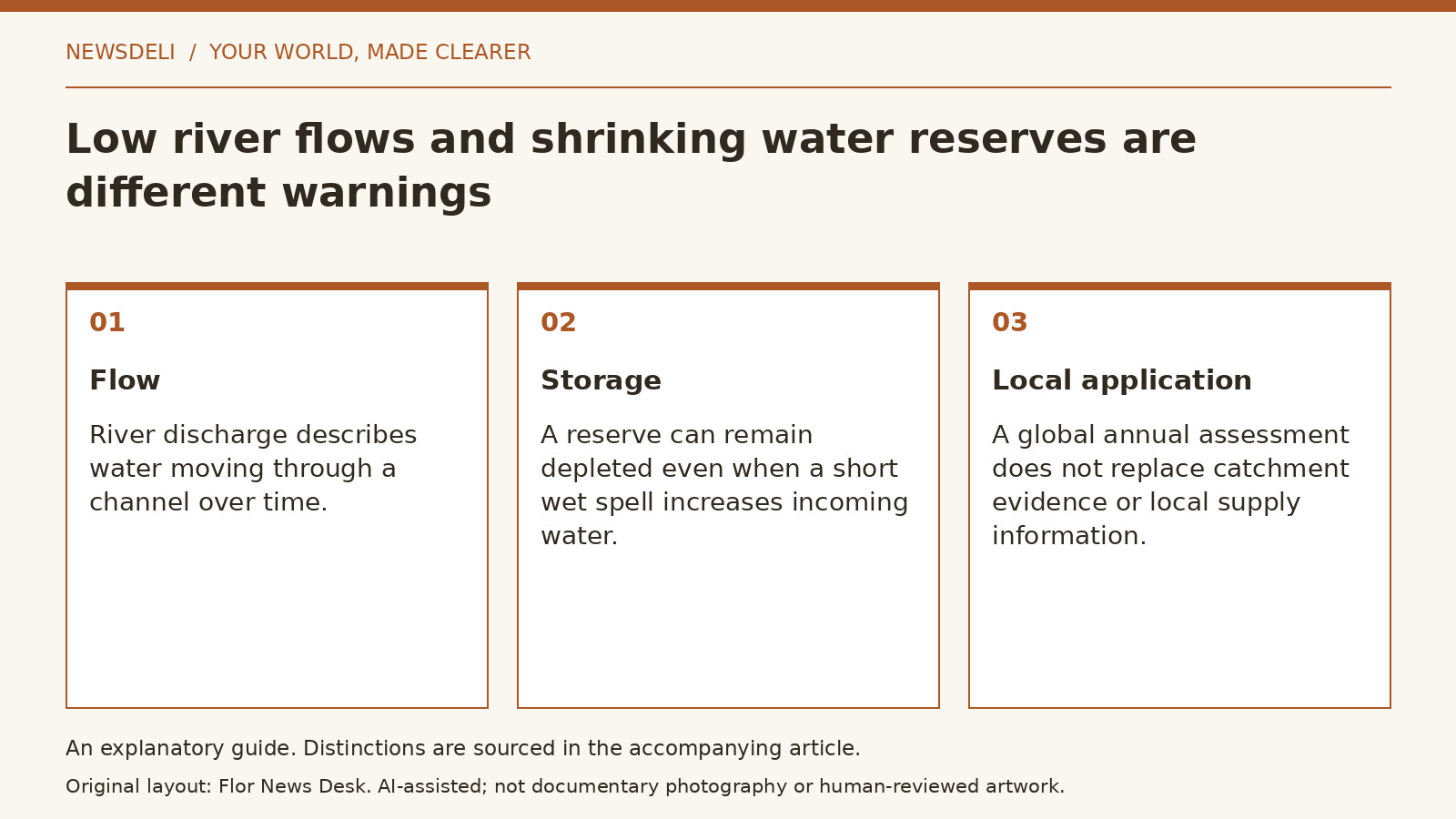
A dry river and a depleted water reserve are related concerns, but they are not interchangeable measurements. One describes water passing through a channel; the other concerns the water retained across a wider system.
In its September 17 account of recent water trends, the World Meteorological Organization described 2025 as one of the driest years for river discharge in more than three decades. It also reported a continuing decline in terrestrial water storage. The reporting date is in 2026; the annual conditions being assessed are principally those of 2025.
Movement is not the same as a reserve
A helpful conceptual distinction is between a flow and a stock. A flow has a time interval: how much water passes a point during a period. A stock asks how much is held at a particular time. A short spell of rapid flow does not, by itself, establish that a depleted reserve has recovered.
Consider an imaginary reservoir supplied by a river. A storm could briefly increase the incoming flow while the reservoir remains far below its previous level. Alternatively, a reserve could support downstream supply during a dry interval while being drawn down. These examples are explanatory possibilities, not observations from a particular basin in the report.
The assessment uses several kinds of evidence
WMO’s report overview describes coverage extending beyond river discharge to groundwater, evaporation and transpiration, land-water storage, snow and ice. It draws on member contributions, hydrological models and satellite observations. WMO also notes that data availability has improved while important gaps remain.
For readers, that breadth is a reason to ask which variable a headline is summarising. A change in river discharge, a groundwater observation and a glacier-loss estimate should not be presented as three versions of the same percentage. Each has its own geography, reference period and measurement method.
A global finding is a starting point
A worldwide pattern does not determine the condition of an individual town’s supply. Applying it locally requires evidence about the relevant catchment, sources, infrastructure and demand. Conversely, a wet day in one place cannot refute an assessment covering many regions over an entire year.
The distinction matters for evaluating responses. A proposal intended to address short-term delivery and one intended to rebuild long-term reserves should be judged against the problem each claims to solve. Treating every water problem as simply a shortage of recent rain would obscure that difference.
The report’s central value is the combined picture. Flow conditions show how water moved during the year, while storage measures help explain what may remain available beyond it. Neither should be read alone as a forecast of what will come out of a particular tap tomorrow.