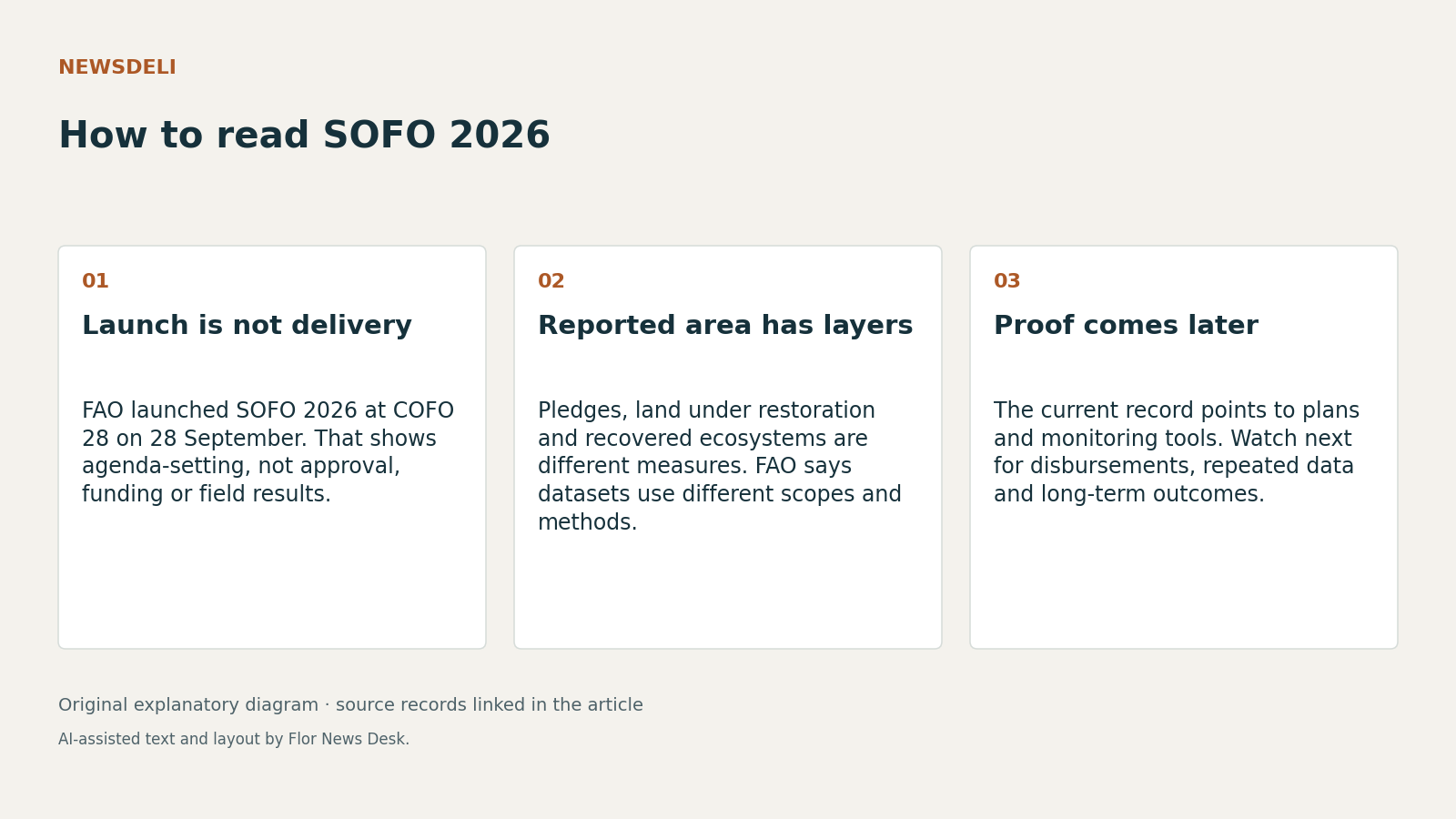
FAO used the release of *The State of the World’s Forests 2026* on 28 September 2026 to make a sharper political argument than a routine forestry update: forest and landscape restoration should be treated as an investment tied to food security and rural development, not only as a conservation project. FAO launched the report during the 28th Session of the Committee on Forestry, or COFO 28, in Rome, but that launch is not the same thing as a committee decision, approved financing package or measured field outcome (FAO newsroom, 28 September 2026; COFO 28 opening statement, 28 September 2026).
What FAO says the report establishes is substantial. Its 28 September release cites 4.14 billion hectares of forests worldwide, 489 million hectares of forest lost through deforestation from 1990 to 2025, and more than 460 million hectares of degraded forest within 1.56 billion hectares of degraded land overall. It also says governments in 91 countries and areas have pledged more than 190 million hectares for forest restoration, and it presents large economic estimates for the cost of not restoring degraded ecosystems and the potential annual benefits of restoring more than 1 billion hectares (FAO newsroom, 28 September 2026).
Why does that framing matter? In analytical terms, it tries to move restoration from a narrower environment portfolio into broader fights over national and donor budgets. FAO’s own acceleration routes point that way: stronger rights and participation, landscape-scale implementation, finance and business models suited to restoration, and coherent policy and legal frameworks (FAO newsroom, 28 September 2026). But the current source record does not show which governments or lenders have actually committed new money, signed financing instruments or disbursed funds because of SOFO 2026. On the question of who pays, the reliable answer here is: FAO says finance is a central gap, but these records do not document payment.
The measurement question is where the report becomes more useful, and also more complicated. An FAO explainer on Chapter 2 says SOFO 2026 combines data from the Global Forest Resources Assessment 2025, national reporting under the Rio Conventions, the Bonn Challenge and the Framework for Ecosystem Restoration Monitoring, or FERM. It says FRA 2025 is the first assessment round to collect country-reported data on restoration commitments, areas needing restoration and reported progress (FAO monitoring explainer, 28 September 2026).
That does not produce one neat global scoreboard. The same FAO explainer says 70 countries and areas reported almost 44 million hectares of forest under restoration in FRA 2025, while 62 countries reported about 206.5 million hectares of forests and landscapes under restoration in seventh national reports to the Convention on Biological Diversity. FAO explicitly warns that these figures use different definitions, reporting periods, methods and ecosystem scope, so they cannot simply be added together or treated as the same metric. Just as important, land reported as under restoration is not the same thing as an ecosystem shown to have recovered over time (FAO monitoring explainer, 28 September 2026).
So who measures success? On the current evidence, several reporting systems do, imperfectly. FAO says Chapter 2 also analysed 111 restoration initiatives documented through FERM, covering about 24 million hectares, with spatially explicit information for around 72 percent of that area (FAO monitoring explainer, 28 September 2026). That is a step toward traceable monitoring, but not proof of long-term ecological or social outcomes.
As of 2 October 2026, the strongest supported reading is that SOFO 2026 is an agenda-setting report with fresh compilation work behind it, not a ledger of delivery. Readers should treat the next real milestones as separate events: published national restoration roadmaps, signed and disbursed finance, and repeated monitoring that can show whether restored hectares stay restored.