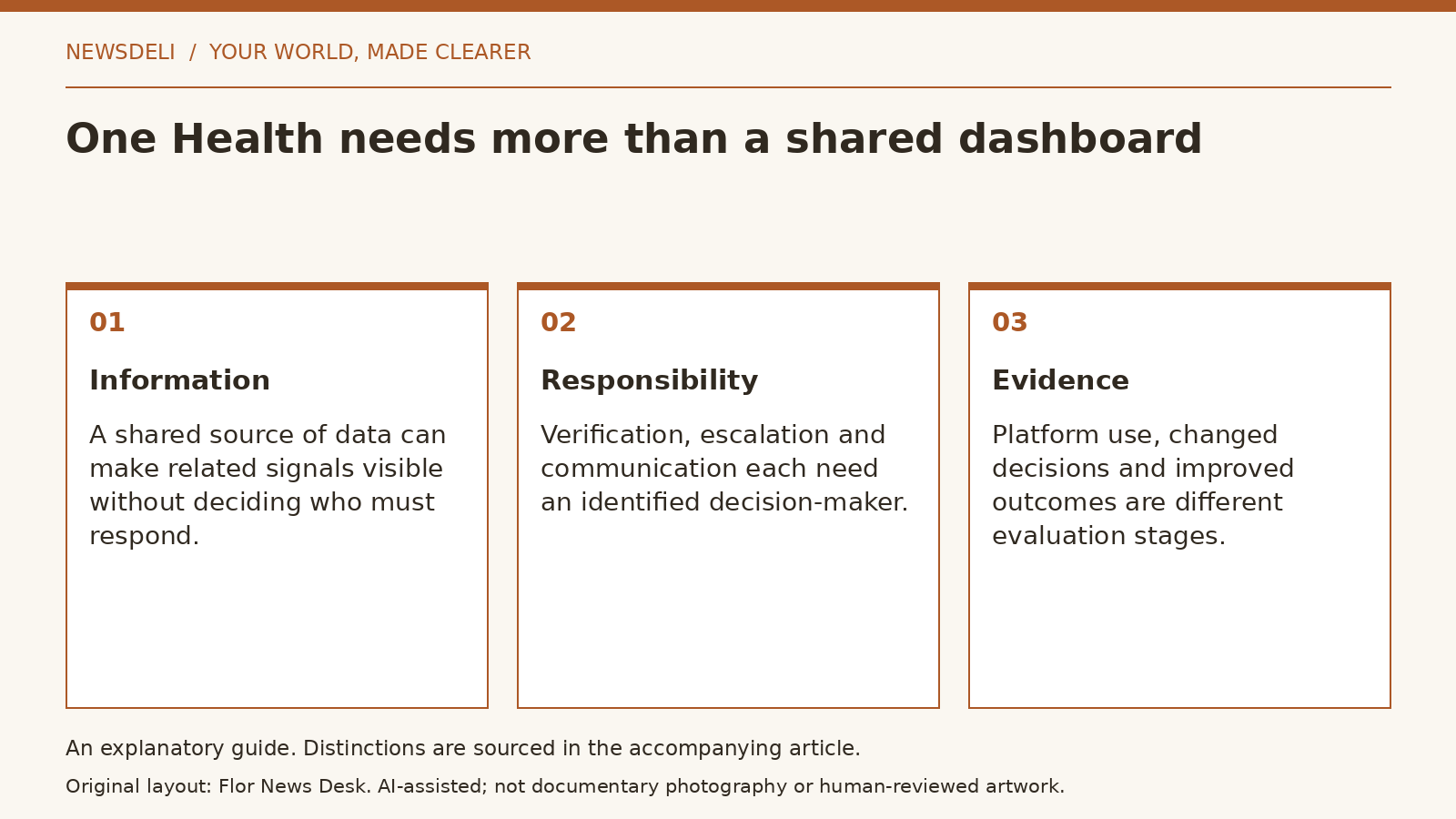
Bringing information into one place is not the same as deciding who should act on it. That distinction sits at the centre of a practical question for One Health: how do connected risks become coordinated decisions?
FAO opened a global conference on September 21 focused on applying One Health across agrifood systems. Its opening account describes connections among people, animals, plants and the wider environment, and presents a new online hub intended to bring together livestock-related data and tools. The opening announcement establishes the initiative and its intended use; it does not demonstrate that a new information platform has already prevented a particular outbreak.
A common signal needs an owner
In a hypothetical early-warning system, several agencies might see the same unusual signal. One could be responsible for checking the data, another for investigating conditions and another for communicating with affected groups. Displaying the signal to all three does not automatically establish those responsibilities.
This is why a useful coordination design would identify the decision that information is meant to support. It would specify who checks the signal, what would justify escalation and how a later correction reaches everyone involved. These are proposed tests for evaluating a system, not a description of the hub’s unreported operating procedures.
Connected health concerns require connected work
FAO’s One Health overview describes an integrated approach to balancing and improving the health of people, animals and ecosystems. Reading the conference announcement in that context makes the purpose broader than collecting more data in one sector.
A shared record could help two teams recognise that their concerns overlap. But the benefit would depend on whether they can interpret it consistently and use it in time. A larger volume of information would not, on its own, answer questions about reliability, access or responsibility.
Separate an input from an outcome
An evaluation could distinguish several achievements: making a dataset available, enabling its use, changing a decision and improving an outcome. Each requires different evidence. A count of platform users might describe uptake while leaving the effect on decisions unknown. A successful demonstration might establish technical capability without proving routine use.
Keeping those stages separate also makes failure easier to diagnose. When a desired outcome is not observed, the question becomes where the chain broke rather than whether the entire approach should be accepted or rejected on the basis of one number.
The conference opening places implementation at the forefront. The next test is not whether the idea of connected health is compelling, but whether participating systems can turn shared knowledge into clear, accountable action. That remains a question for follow-through, not a result established by the launch announcement alone.