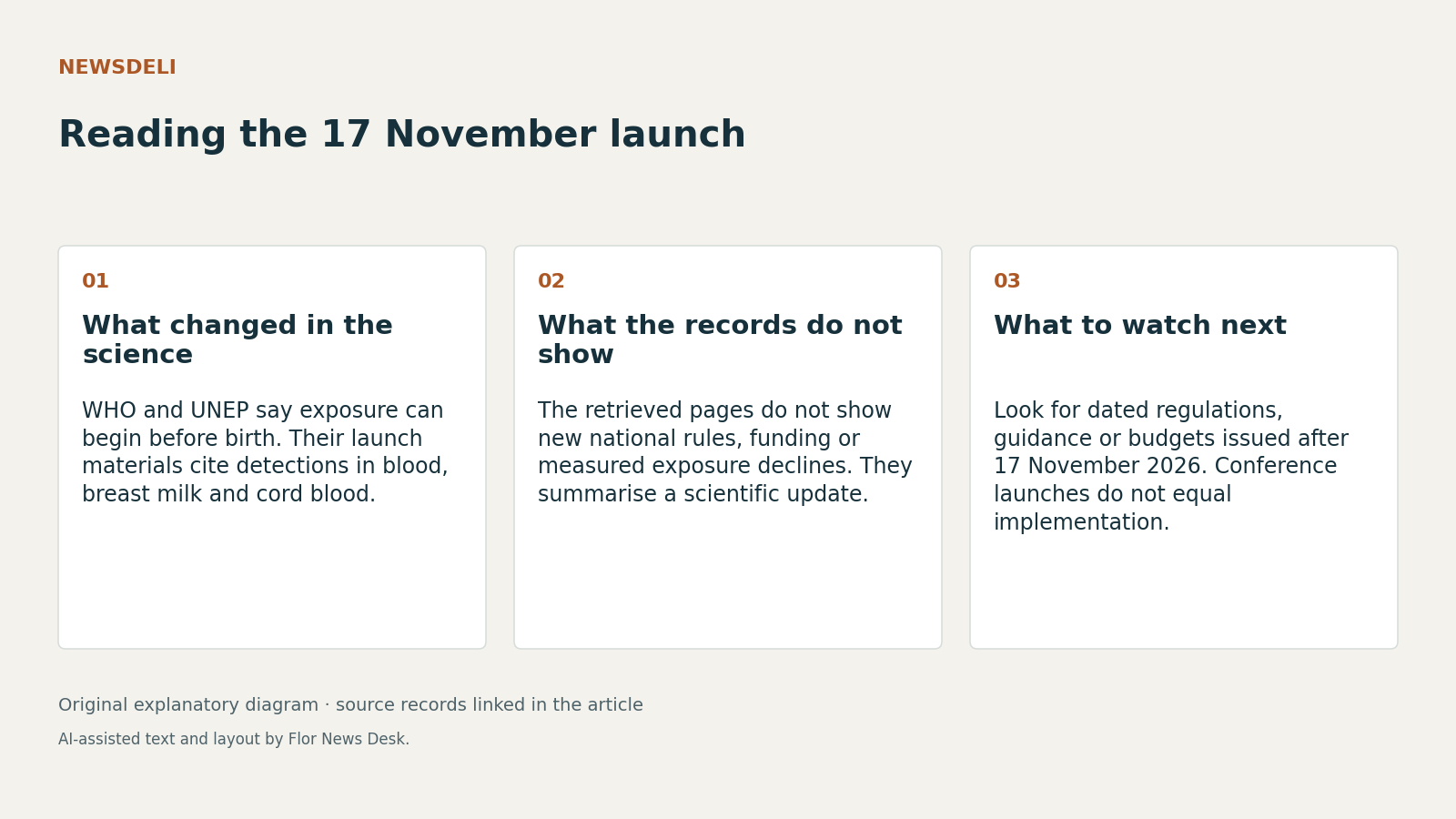
WHO and the United Nations Environment Programme used a 17 November 2026 assessment to make a sharper public claim than their earlier materials had put at the centre: exposure to endocrine-disrupting chemicals can begin before birth, with detections reported in blood, breast milk and cord blood. WHO says the release of *State of the Science on Endocrine-Disrupting Chemicals 2026* is the first major global update since 2012, and the launch was tied to the first International Conference of the Global Framework on Chemicals in Geneva, held from 16 to 20 November 2026. The report’s existence and date also appear in the UN media reports index. WHO news item UN Web TV briefing UN reports index
What is new here is not that WHO considered pregnancy important. Its background material has long said exposure during pregnancy and early childhood may affect a child’s health and development across the rest of life. The shift is that WHO and UNEP are now presenting prenatal exposure as part of the updated global science record itself, not only as a longstanding concern. That matters because it moves the issue earlier in the life course: the question is no longer only what happens after birth, but whether exposure can already be occurring before a child can avoid it. WHO activity page WHO news item
According to the 17 November launch materials, WHO and UNEP also say the evidence has strengthened linking endocrine-disrupting chemical exposure with fertility and reproductive development, brain development and neurological function, thyroid and other hormone regulation, metabolism, immunity and cardiovascular health. At the Geneva press briefing, UNEP and WHO speakers also pointed to newer concern areas, including metabolic liver disease and possible kidney effects, while saying scientific gaps remain. That is a meaningful widening of the health discussion, but the retrieved records are still summaries of the assessment, not its full methods or evidence tables. WHO news item UN Geneva transcript UN Web TV briefing
The same records show why this is likely to become a testing and regulation story, not just a health warning. WHO and UNEP say more than 350,000 chemicals and chemical mixtures are registered for production and use globally, but only a small fraction has been evaluated for endocrine-disrupting properties. At the Geneva briefing, speakers said regulation is fragmented and testing and monitoring capacity is uneven, especially in developing countries. The analytical point follows from those premises: if exposure may start before birth, then the bottleneck is not only individual behaviour but which chemicals are assessed, monitored or restricted before people encounter them. WHO news item UN Geneva transcript UN Web TV briefing
What the 17 November records do not establish is just as important. They do not show any new national ban, donor pledge, implementation timetable or measured fall in population exposure. The UN index is useful because it confirms that a report was launched on that date, but an index entry is not evidence that governments have acted on it. The retrieved source set also does not provide the report’s cost estimates or modelling, so any headline economic number circulating elsewhere cannot be checked from these documents alone. UN reports index WHO news item UN Web TV briefing
The next records worth watching are therefore dated regulatory reviews, technical guidance, budgets and conference decisions issued after 17 November 2026. One caution already appears on WHO’s own site: a background page retrieved on 19 November still says WHO is “currently working on an update” of the assessment, even though a separate WHO record shows the 2026 update was released on 17 November. That mismatch does not refute the launch. It does show why event dates, publication dates and older background wording need to be kept separate. For now, the clearest documented change is a sharpened scientific warning, not a delivered policy outcome. WHO activity page WHO news item