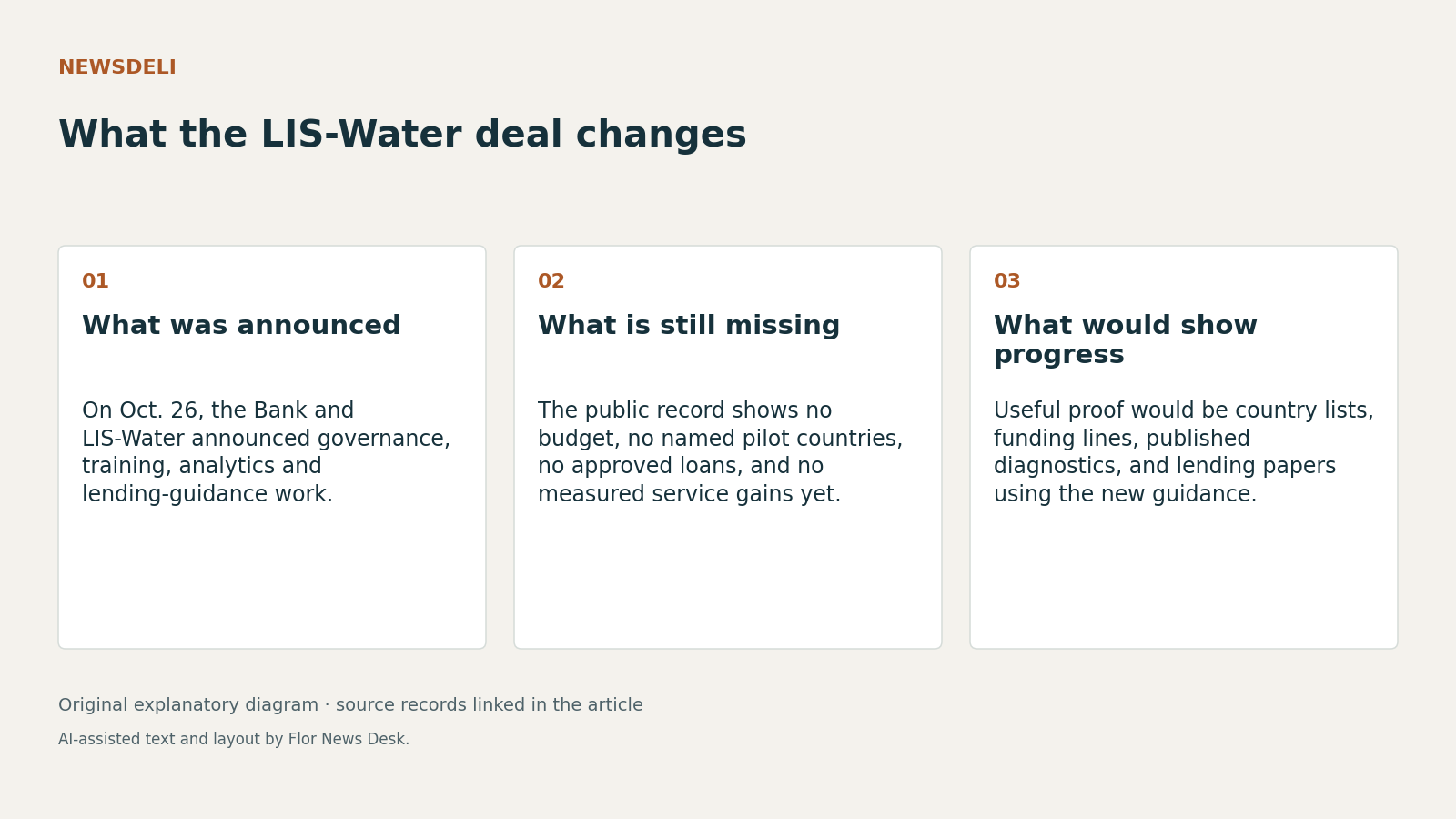
The World Bank Group’s October 26 partnership with the Lisbon International Centre for Water, or LIS-Water, matters because it gives the Bank a concrete governance vehicle inside its broader water agenda. The immediate change, based on the public announcement, is not fresh project money or new pipes in the ground. It is a multi-year agreement to work on five things the Bank lists: governance diagnostics, regulatory and institutional strengthening, executive leadership training, analytical work including artificial intelligence for water governance, and operational guidance for World Bank Group lending. Those are preparation and capacity tools, not service outcomes on their own. World Bank press release
That distinction matters because the Bank has already framed Water Forward as a platform for aligning action rather than as a standalone pot of money. On the World Bank’s Spring Meetings event page, Water Forward is described as launched on April 15, 2026, with a shared ambition to help deliver water security to more than one billion people by 2030, and with fourteen countries launching country-led water compacts at that event. The same page records Ajay Banga saying the Bank’s own share of that ambition would be 400 million people by 2030 and describing Water Forward as a delivery platform rather than a new fund. Spring Meetings 2026: Water Forward
So what does the LIS-Water deal add? The strongest reading from the documents is that the Bank is trying to turn a coalition-level ambition into repeatable country-preparation work. If governance diagnostics and regulatory support are paired with guidance for Bank lending, the practical target appears to be making water and sanitation systems more investment-ready before financing decisions. That is an analytical inference from the listed work streams, not a reported implementation result. The October 26 release does not name any pilot country, approved loan, signed country agreement, publication schedule for diagnostics, or timetable for the five work streams. World Bank press release
The funding question is even less settled in the public record. The Bank’s Governance & Institutions Umbrella Program page shows that governance work already has outside contributors, including a European Union contribution of EUR 3,000,000 recorded on June 30, 2026 and a Foreign, Commonwealth and Development Office contribution of GBP 3,100,000 recorded on February 26, 2026. The same page says the program supports institutional reform, digital and technology use in the public sector, and transparency and accountability. But that page does not say those funds pay for the LIS-Water partnership or for Water Forward water-governance work. Governance & Institutions Umbrella Program
As of October 28, 2026, that leaves several reporting gaps that matter more than the announcement language. The Bank says the Lisbon event was supported by the Government of Portugal and attended by policymakers from more than 40 countries, but the release does not identify which countries will receive support first or how success will be measured. World Bank press release And the April 15 Water Forward page mixes launch-day commitments with speaker remarks, so it cannot by itself establish what has since been approved, implemented, or funded. Spring Meetings 2026: Water Forward
That is why the partnership is best understood as a governance operating framework, not yet as evidence of delivery. If later records show named country engagements, budgets, published diagnostics, or lending documents that embed the new guidance, the October 26 announcement may look like a meaningful institutional hinge. Until then, the sourced record supports a narrower conclusion: the Bank and LIS-Water have announced a mechanism for technical and regulatory work that could shape future water financing, but the public documents do not yet show who pays, where it starts, or what results it has produced. World Bank press release Governance & Institutions Umbrella Program