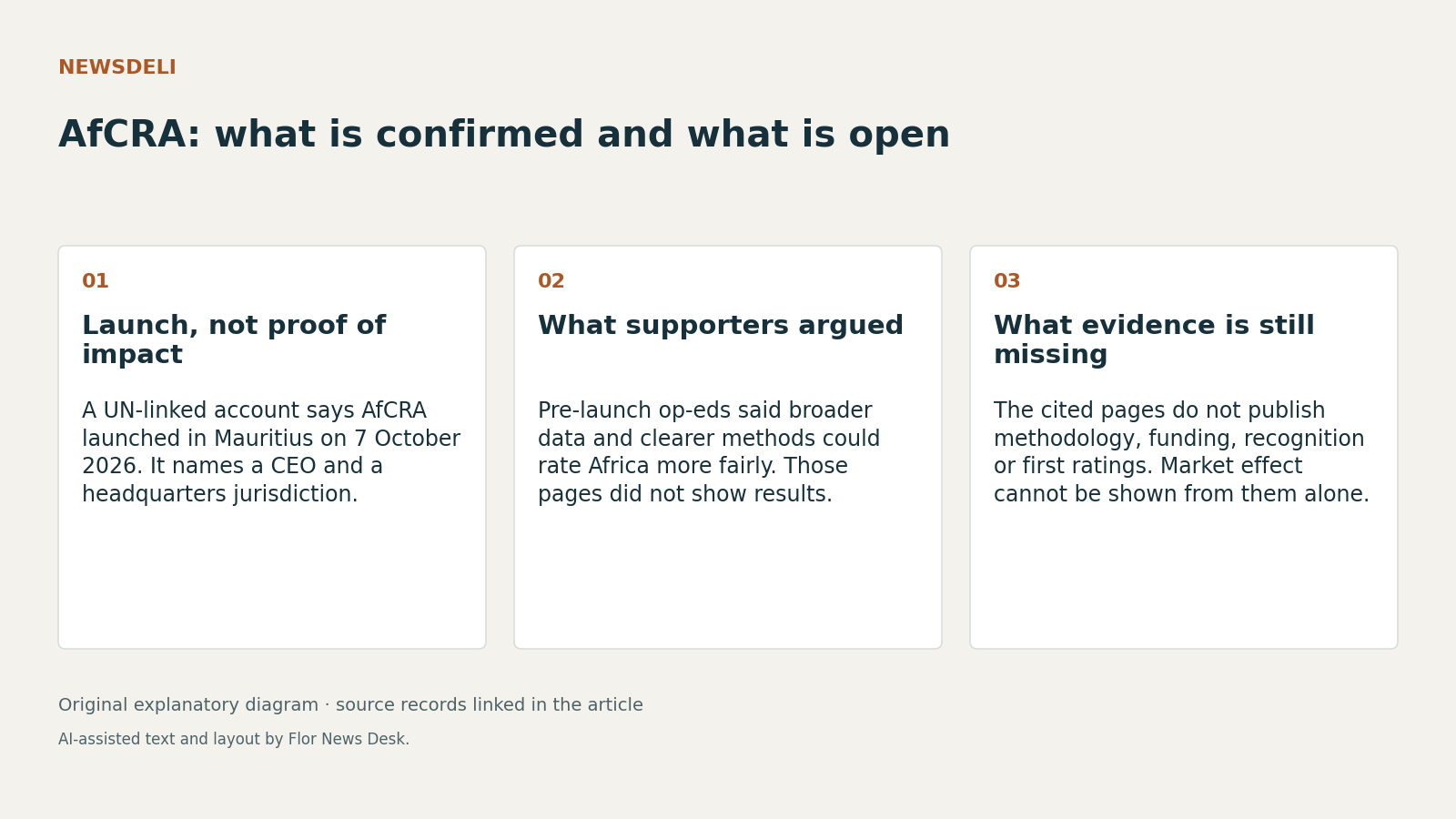
Africa’s new continental ratings project moved from proposal to event on 7 October 2026, when the Africa Credit Rating Agency, or AfCRA, was launched in Mauritius, according to a 12 October article carried by the UN Office of the Special Adviser on Africa and credited as originally published by the UN Economic Commission for Africa UN OSAA launch note. That is the clearest point the public record establishes. It confirms a launch took place. It does not, by itself, show that African borrowers are already paying less to raise money.
The same institutional account says AfCRA is intended to be an independent, private sector-driven agency that complements existing international credit rating firms rather than replacing them UN OSAA launch note. It says Mauritius was chosen as the primary jurisdiction for the headquarters and names Sifiso Falala as chief executive officer. It also links the project to years of work by the African Union, the African Peer Review Mechanism, the Economic Commission for Africa and other partners UN OSAA launch note. Those facts show political backing and a basic organisational outline, but not yet the full machinery of a functioning ratings business.
Why was AfCRA launched at all? Pre-launch opinion pieces made the case that Africa is routinely judged too harshly in global debt markets. A 5 October Africa Renewal op-ed by Ahunna Eziakonwa and Marie-Antoinette Rose-Quatre said inaccurate or unfair ratings cost the continent US$74.5 billion a year, and argued that AfCRA would use broader data, including estimates of informal-sector activity, while expanding coverage beyond sovereign states to companies, banks, infrastructure projects and municipalities Africa Renewal op-ed. A 6 October OSAA op-ed by the same authors repeated that broader argument and tied it to projected Africa-wide growth of about 4 percent in 2026, citing the African Development Bank and the IMF OSAA op-ed.
But those op-eds were published before 7 October 2026 and described the launch as an upcoming event, so they are evidence of expectations and political framing, not proof of what AfCRA had operationalised by 21 October 2026 Africa Renewal op-ed, OSAA op-ed. The later 12 October article confirms the launch happened, yet none of the three cited pages publishes AfCRA’s methodology, governance charter, funding terms, registration or regulatory-recognition records, first client mandates, or dated first ratings UN OSAA launch note, Africa Renewal op-ed, OSAA op-ed. Without those records, readers cannot tell how the promised fairer approach would be translated into rating decisions or whether investors can already rely on those opinions.
The 12 October account itself argues for caution. It attributes to African Union Commission Chairperson Mahmoud Ali Youssouf the view that AfCRA must preserve its independence and would not on its own sharply reduce Africa’s cost of capital UN OSAA launch note. That narrows the immediate takeaway. The launch matters first as institutional infrastructure and as a challenge to how Africa says it is assessed, not as measured proof that the disputed Africa risk premium has fallen.
The next reporting test is documentary and dated: publication of methodology, public governance terms, evidence of recognition where the ratings are meant to be used, and named initial ratings or mandates. Until records like those appear, the strongest sourced conclusion is also the simplest. Africa has launched a new credit-rating agency. Whether AfCRA becomes a trusted market actor remains unproven in the source record available on 21 October 2026.