The clearest way to read two new World Meteorological Organization updates from COP31 is as a mismatch between risk and readiness.
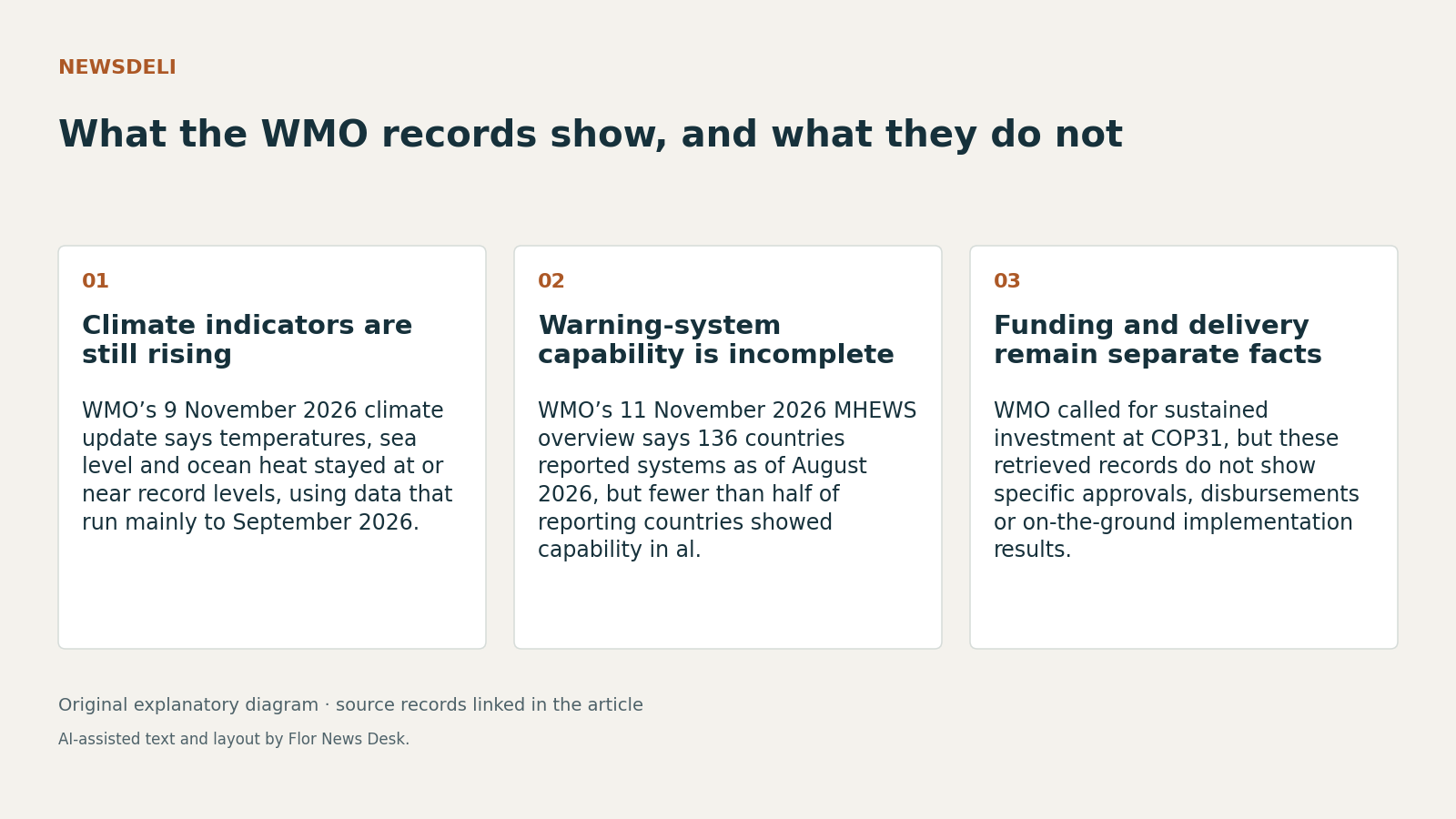
On 9 November 2026, WMO’s State of the Climate Update for COP31 said January to September 2026 global average surface temperature was about 1.47°C above the 1850–1900 average. It said 2026 is set to be one of the four warmest years on record, that global mean sea level has reached the highest level in the satellite record, and that preliminary data through July 2026 point to a tenth consecutive annual record for ocean heat content.
Those are strong findings, but they come with important date limits. The page says its data run only to September 2026 where available, and the ocean-heat figure is based on preliminary data only through July 2026. It also says the update does not reflect the most recent impacts of El Niño. So this source supports a clear point about climate indicators staying near record highs, but not a claim that late-2026 or 2027 impacts have already been measured by this report.
Then, on 11 November 2026, WMO published its Global Status of Multi-Hazard Early Warning Systems 2026. That overview says 136 countries had reported multi-hazard early warning systems as of August 2026, and that 70% of countries report having them. But it also says fewer than half of reporting countries demonstrate capabilities across all four pillars of such systems.
That matters because it is narrower, and more useful, than saying countries simply do or do not have warning “coverage.” The retrieved WMO record supports a claim about system capability, not a population-level measure of who is fully covered. The same WMO page also says major gaps persist in the countries most at risk. However, in the retrieved public text, WMO does not provide the country list, the denominator behind the 70% figure, or the exact share of reporting countries with all four pillars. Readers therefore can see the top-line warning, but not inspect the country breakdown from this page alone.
Taken together, the two releases show this: climate stress is being measured at record or near-record levels at the same time that warning-system capacity is still incomplete.
A third WMO record, Secretary-General Celeste Saulo’s 9 November 2026 COP31 press conference statement, pushes the discussion toward urgency and funding. In that statement, Saulo said WMO forecasts that Tropical Pacific sea-surface temperature anomalies may be nearly four times the El Niño threshold between November 2026 and January 2027. That is not the same as proving when the event will peak. The climate update separately says El Niño is expected to reach record strength by December.
The statement also calls for funding and says the number of countries reporting multi-hazard early warning systems rose from 56 in 2015 to 136 in 2025. That timing does not neatly match the dedicated MHEWS overview, which dates the 136-country figure to reporting as of August 2026. Either way, the speech is still an advocacy document, not evidence that money has been approved, disbursed or translated into better forecasts, communications or evacuation plans.
So the practical reader question is not whether climate indicators are worsening. WMO’s November 2026 releases say they are. The harder question is whether governments and donors can produce current, country-level proof that warnings can be issued, understood and acted on before the next major shocks arrive. These COP31 records make that gap easier to see. They do not, on their own, prove it has been closed.