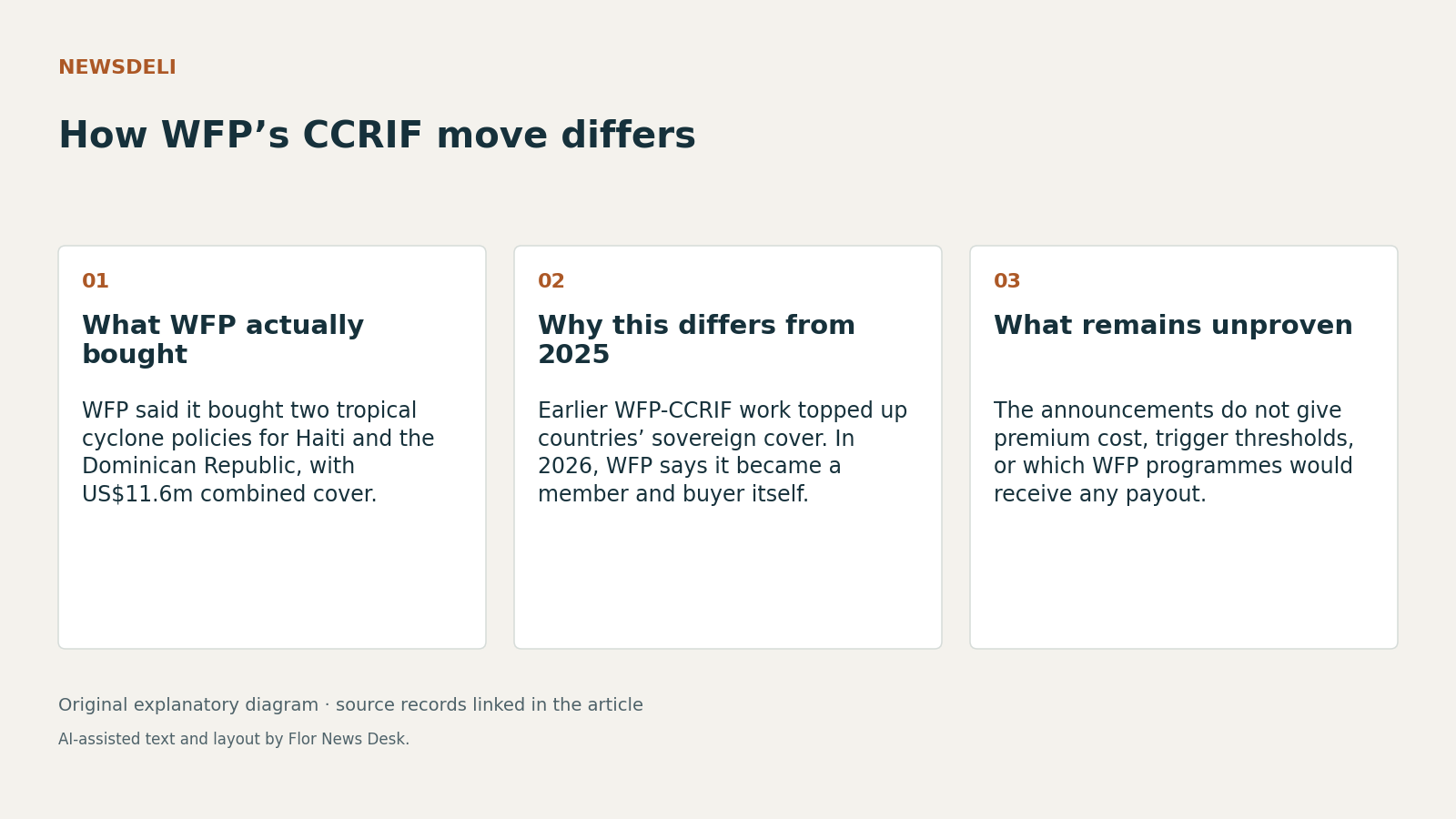
On 22 October 2026, the World Food Programme said it had become the first UN agency and multilateral organization to join CCRIF SPC and had bought two parametric tropical cyclone policies covering Haiti and the Dominican Republic, with a combined coverage limit of US$11.6 million. The important change is structural: WFP says it is now an insured participant in the regional risk pool, not only a partner around it. WFP announcement
Why that matters becomes clearer when the two countries are separated. WFP said the Dominican Republic was not yet a CCRIF member, while Haiti has been a member since 2007 and had received more than US$80 million in sovereign-policy payouts, most recently for Hurricane Melissa in 2025. On WFP’s account, the new arrangement could therefore give the agency a rules-based financing route in one country already inside CCRIF and another still outside it. The Spanish-language version published the same day repeats those figures and framing, which is useful for consistency checking but does not add independent corroboration. WFP announcement Spanish version
This is also different from the WFP-CCRIF model the agency described on 11 February 2025 after Hurricane Beryl. In that earlier release, WFP said governments in Grenada, Jamaica, and Saint Vincent and the Grenadines were using US$5.5 million from insurance payouts for social subsidies, under arrangements where countries topped up sovereign coverage and a fixed share of any triggered payout went to social assistance. That mattered for delivery, but governments still held the core sovereign policies. The October 2026 step matters because WFP now says it joined CCRIF and bought cover itself. Hurricane Beryl background
The appeal of that shift is speed, at least in theory. WFP says CCRIF’s parametric policies are based on modelled loss rather than post-disaster ground assessments, and says CCRIF has made 82 payouts totaling US$483 million since 2007, all within 14 days of a triggering event. But those are background claims presented in WFP’s announcement, not proof about these two new policies. The records reviewed do not establish that either policy has triggered, what storm intensity or modelled-loss threshold would trigger one, or how quickly a payout would move from WFP’s policy to country-level operations. WFP announcement
That uncertainty is not a minor footnote. Buying coverage and receiving cash are separate events, and receiving cash is still separate from deciding which programmes, budgets, or households benefit. In the English and Spanish announcements, WFP did not state the premium cost, the funding source for the premium, the trigger thresholds, or the programme allocation plan for any future payout. Those omissions mean readers can identify the financing mechanism, but not yet judge its accountability in practice. WFP announcement Spanish version
WFP also said its entry brought CCRIF to 40 members and lifted total coverage for the 2026/27 policy year to US$1.8 billion, up 25 percent from US$1.44 billion. The broader point is that the agency is testing whether a humanitarian actor can use a sovereign-style disaster risk pool more directly. The evidence so far supports a real institutional change on 22 October 2026. It does not yet support claims about implementation success. The next meaningful proof would be a disclosed trigger, a disclosed payout amount, and a disclosed use of funds after an actual storm. WFP announcement