A probability is only useful when the event it describes is clear. A very high chance that a climate pattern will persist is not the same as a very high chance of one particular weather disaster at one address.
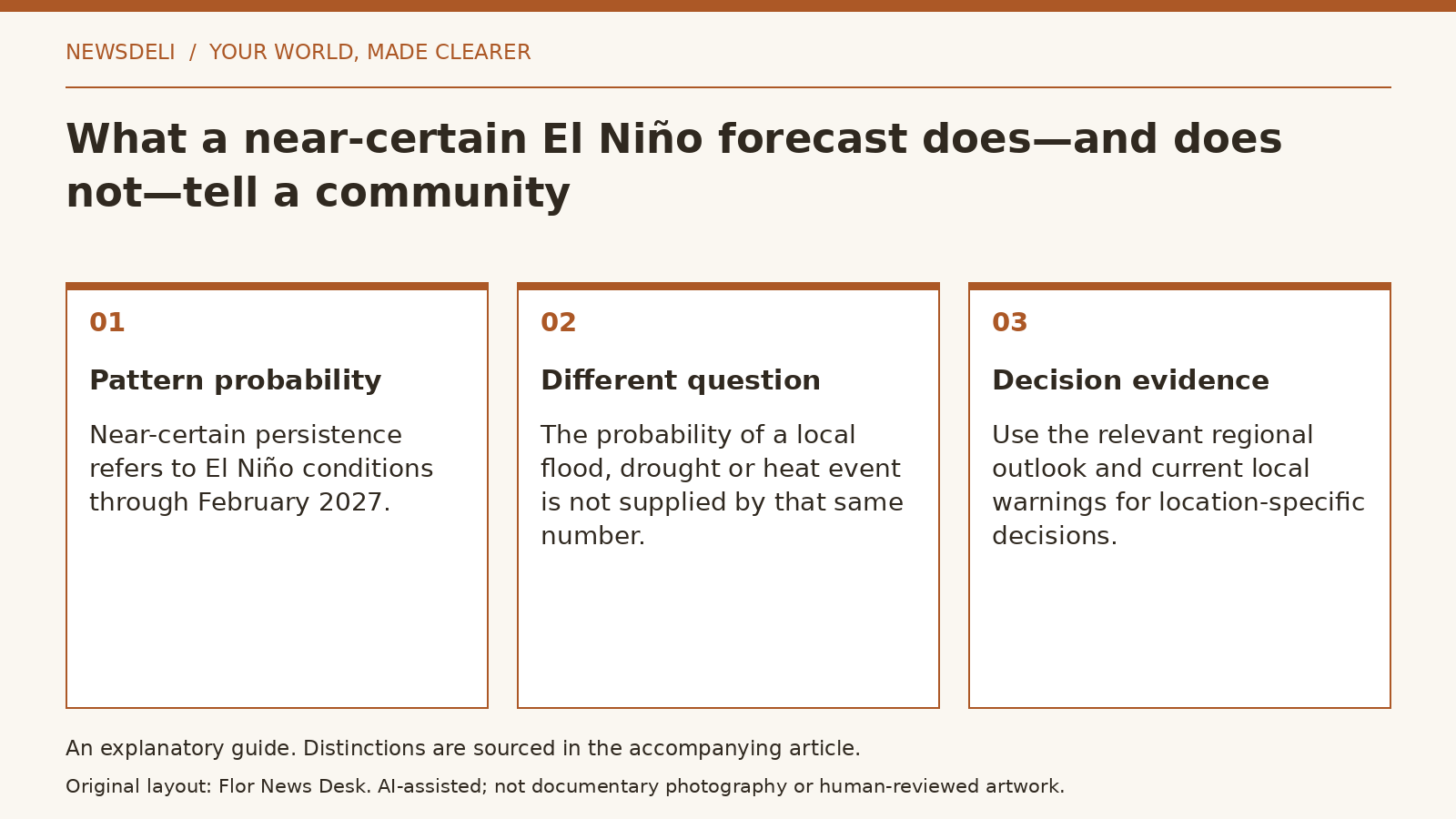
WMO’s September 3 outlook gives a near-100-percent probability that El Niño conditions will continue through February 2027 and says the event is expected to become very strong toward the end of 2026. That is a forecast about the climate pattern and its expected evolution. It should not be copied into a local headline as a near-certain probability of flooding or drought.
Name the event before quoting the number
Three questions need separate answers: whether El Niño persists, how strong it becomes, and what conditions develop in a particular region. A confident answer to the first question does not supply a numerical answer to all the others.
Imagine a hypothetical planner who learns that a broad risk factor is likely to remain present. That information may justify checking contingency plans. It still leaves practical questions about location, timing, severity and exposure. Calling every possible consequence equally certain would make the forecast less informative, not more urgent.
A large-scale pattern, not one weather map
WMO’s background explanation describes El Niño and La Niña as phases of a coupled ocean-atmosphere phenomenon in the tropical Pacific. The warm and cool phases are associated with wider climate influences, while neutral conditions are a distinct category. This helps explain why an outlook can be important across borders without describing identical weather everywhere.
The useful reading approach is to move from the broad pattern to the relevant regional outlook, keeping each document’s period and uncertainty visible. A seasonal outlook and a short-range warning answer different operational questions. Neither becomes more accurate when its qualifications are removed.
Preparation need not wait for certainty
There is also a difference between a forecast and a decision. A community can consider a precaution because the potential consequences would be serious, even when the local event remains uncertain. That does not require presenting the event as guaranteed. The choice should identify what evidence would trigger the precaution and what information could change it.
For an individual reader, current information from the relevant meteorological service is the appropriate source for local warnings. The September global outlook provides context for those services, not a substitute for them.
The strongest interpretation of the WMO announcement is therefore also the most specific: confidence in the persistence of El Niño is high. The consequences still require their own geographically and temporally defined assessment.