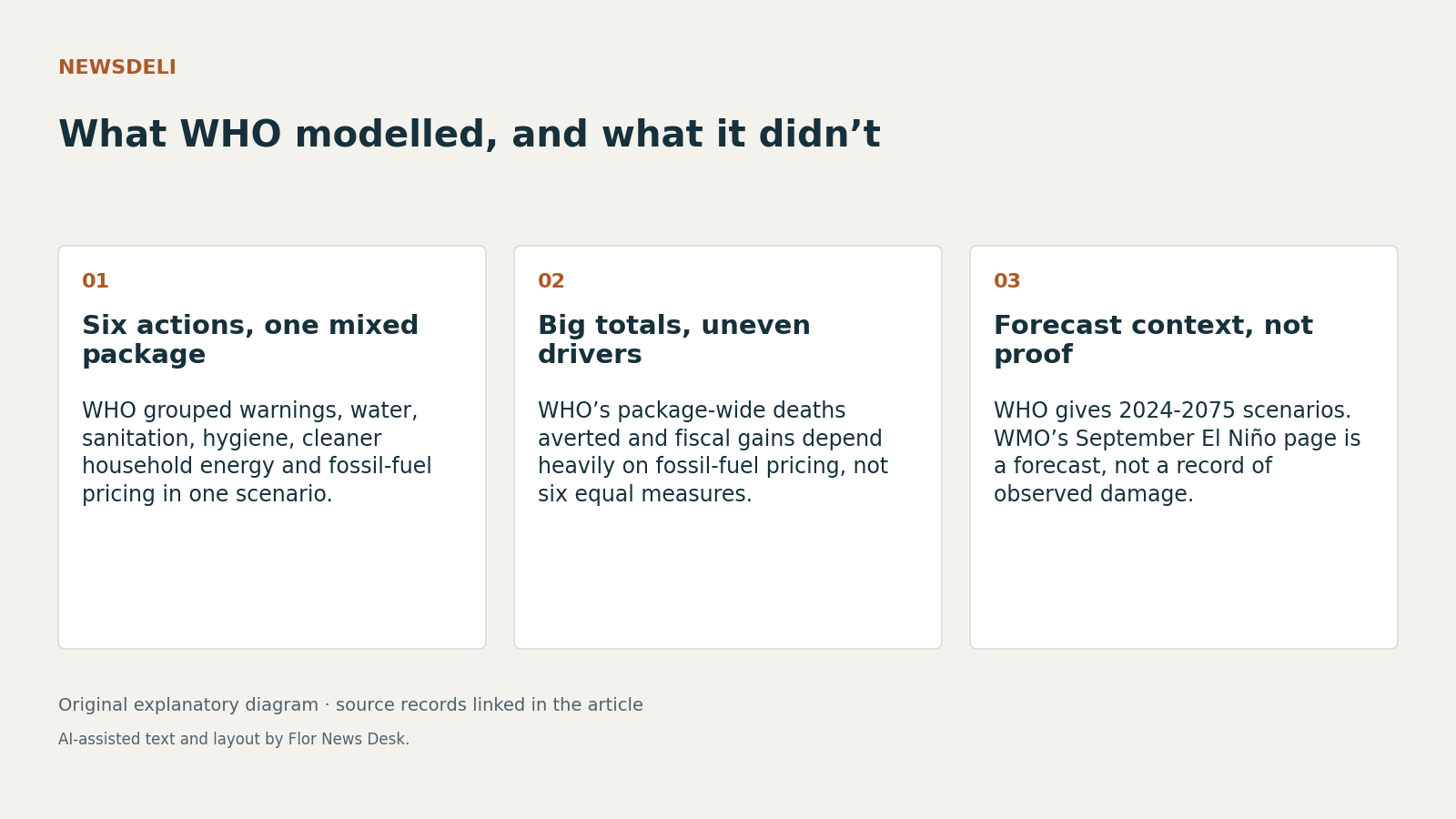
On 4 November 2026, the World Health Organization published an unusually concrete climate-health argument: scale up six specified actions worldwide, it said, and the result could be 1.6 million fewer deaths a year, 16.7 billion tonnes of carbon dioxide emissions avoided, US$3.9 trillion in annual economic welfare gains and US$5.4 trillion in fiscal benefits (WHO release). The important qualifier comes from the same record. These are modelled scenario results, not a record of what countries have already implemented or achieved.
The six actions matter because they are not one kind of policy. WHO groups together heat-health warning systems, climate-resilient drinking-water services, basic sanitation, hygiene and handwashing facilities, cleaner household fuels and technologies for cooking and heating, and efficient fossil fuel pricing policies (WHO release). That makes the package part public-health service expansion, part household energy transition and part economy-wide price reform. Readers should not treat it as six interchangeable versions of the same intervention.
WHO’s own numbers also show that the package headline is heavily driven by one item. The organization says efficient fossil fuel pricing policies account for 1.2 million of the 1.6 million deaths prevented, US$3 trillion of the US$3.9 trillion in annual welfare gains, and US$5.4 trillion in fiscal benefits, which matches the package-wide fiscal total (WHO release). The analytical point is straightforward: the report is not showing six equal levers that each deliver similar returns. It is showing a mixed package whose overall totals depend strongly on the assumptions behind one large policy measure.
The return-on-investment figures need the same caution. WHO says five of the actions average US$24 in benefits for every US$1 invested, and it highlights heat-health warning systems at US$835 per US$1 invested (WHO release). A high ratio can be important, but it does not automatically mean the measure is the biggest part of the package. A relatively low-cost warning system can post a striking return while still delivering smaller absolute gains than a broader policy change.
Method matters here because WHO says it compared a scale-up scenario with a no-scale-up scenario over 2024-2075, using statistical models informed by evidence syntheses and datasets (WHO release). WHO also flags important limits: aspirational scale-up assumptions, some interventions modelled without synergies, limited evidence bases and uncertainty in long-term projections. That makes the release best read as a prioritization exercise. As of 9 November 2026, this source set does not establish which governments have adopted these actions, appropriated money for them or measured outcomes from them.
The timing explains why WHO chose to publish now, but it does not validate the model. On 3 September 2026, the World Meteorological Organization said El Niño was established and expected to intensify, with an exceptionally high likelihood of persisting through February 2027 and raising risks of floods, drought and extreme heat (WMO update). By 9 November 2026, that page remains a forecast record, not proof of the event’s observed peak or measured damage.
So the cleanest way to read WHO’s release is as a quantified case for what governments could choose to fund before and after climate negotiations, not evidence that the money, implementation and results already exist. The next accountability question is narrower and harder: whether later budget and policy records actually line up with these six actions, rather than with the headline trillions alone.