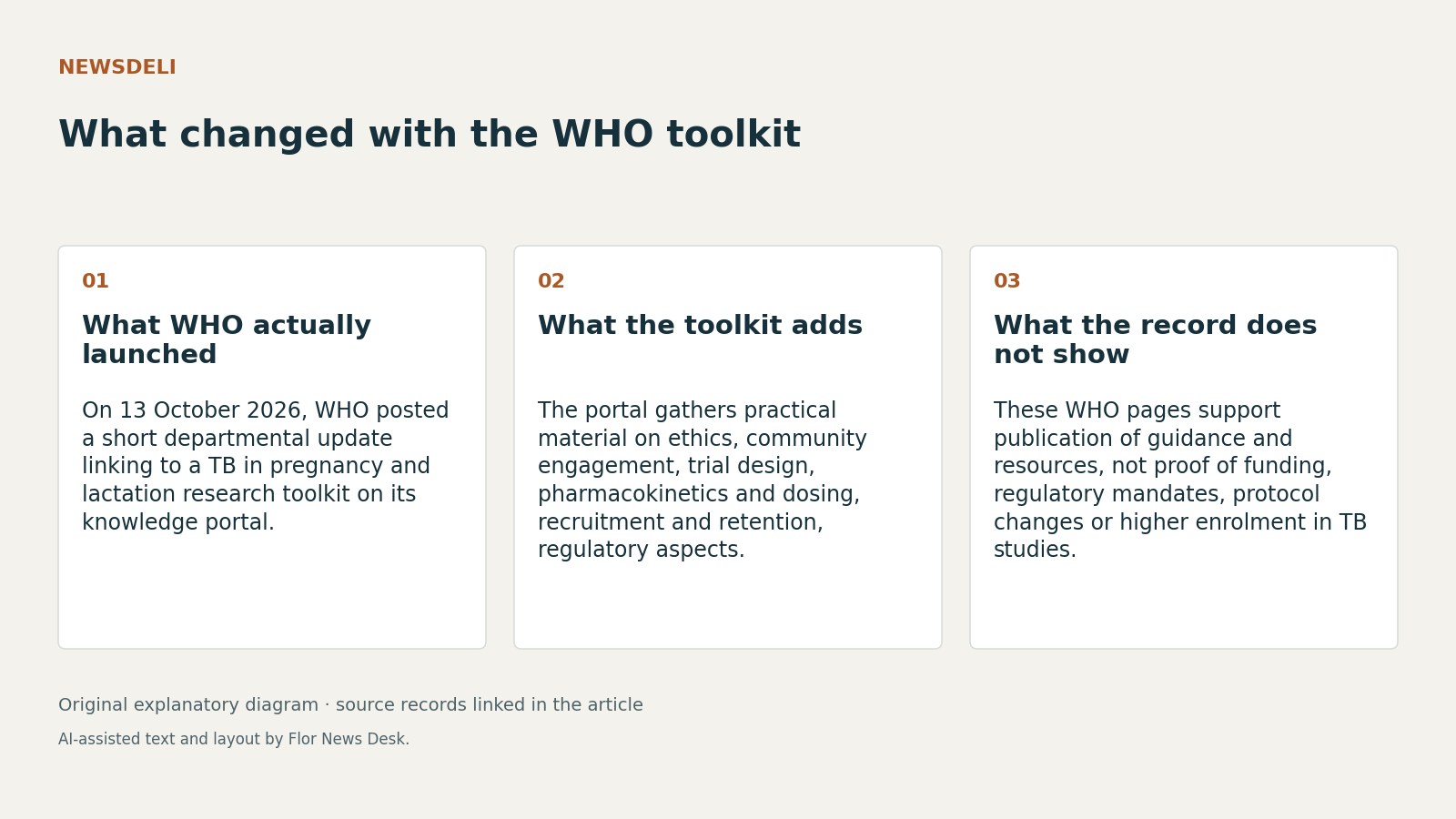
WHO’s 13 October 2026 launch of a tuberculosis research toolkit for pregnancy and lactation looks important for a specific reason: it turns earlier WHO consensus documents into a more usable working resource. The launch page itself is thin. It confirms the release in a short departmental update and links readers to the underlying portal, but it does not announce funding, new rules or measured results. WHO launch page WHO toolkit introduction
The portal is where the substance sits. WHO says the toolkit is meant to support TB researchers and trialists in the design, implementation, analysis and monitoring of studies that include pregnant and lactating women. Its section list shows the practical scope: ethical considerations, community engagement, preclinical research, trial design, pharmacokinetics and dosing, outcome measures, recruitment and retention, regulatory aspects, TB vaccines, and surveillance and registries. The introduction also says the material is supplemented by case studies and practical resources. WHO toolkit introduction
WHO frames the need as an evidence gap with real clinical consequences. On the portal, WHO says TB during pregnancy affects an estimated 336,900 pregnant and postpartum women each year, citing a 2026 *Lancet Global Health* paper. The same page says data on dosing and safety during pregnancy remain limited, and that historic exclusion from research has helped create those gaps. That annual estimate is WHO’s portal claim based on the cited paper; this source record does not independently verify the underlying study. WHO toolkit introduction
The toolkit also makes more sense when read alongside two WHO publications dated 19 August 2025. The consensus statement says the World Health Organization Global Programme on Tuberculosis & Lung Health led a consensus-building process with five thematic working groups, evidence reviews and a February 2025 meeting. The accompanying call to action says it specifies what different groups need to do to implement the agreed approaches, and names a broad audience that includes product developers, sponsors, funding agencies, regulatory authorities, institutional review boards and ethics committees, national programmes, civil society organizations, affected communities and health care providers.
That is why this launch is best read as operational, not transformative by itself. The 2025 documents describe agreed approaches and intended actions. The 2026 portal adds hands-on guidance that researchers, reviewers and other institutions could actually use. But these records do not show that those institutions have changed practice yet. They do not document new money, a regulator requirement, amended study protocols, extra registry fields or a measured rise in enrolment of pregnant or lactating women in TB studies. WHO consensus statement page WHO call to action page WHO toolkit introduction
One correction matters for the timeline. The portal introduction has no clear publication date, so it should not be treated as newly posted just because it was retrieved on 26 October 2026. It also contains an internal timing inconsistency: one passage says the consensus-building process was initiated “In 2025,” while the methodology section says it was conducted between October 2023 and February 2025, with working groups meeting throughout 2024. The safest dated milestones in this source record are therefore 19 August 2025 for the consensus statement and call to action, and 13 October 2026 for the launch page. On that evidence, WHO has moved from agreement to practical guidance, but not to documented system-wide change. WHO toolkit introduction WHO launch page