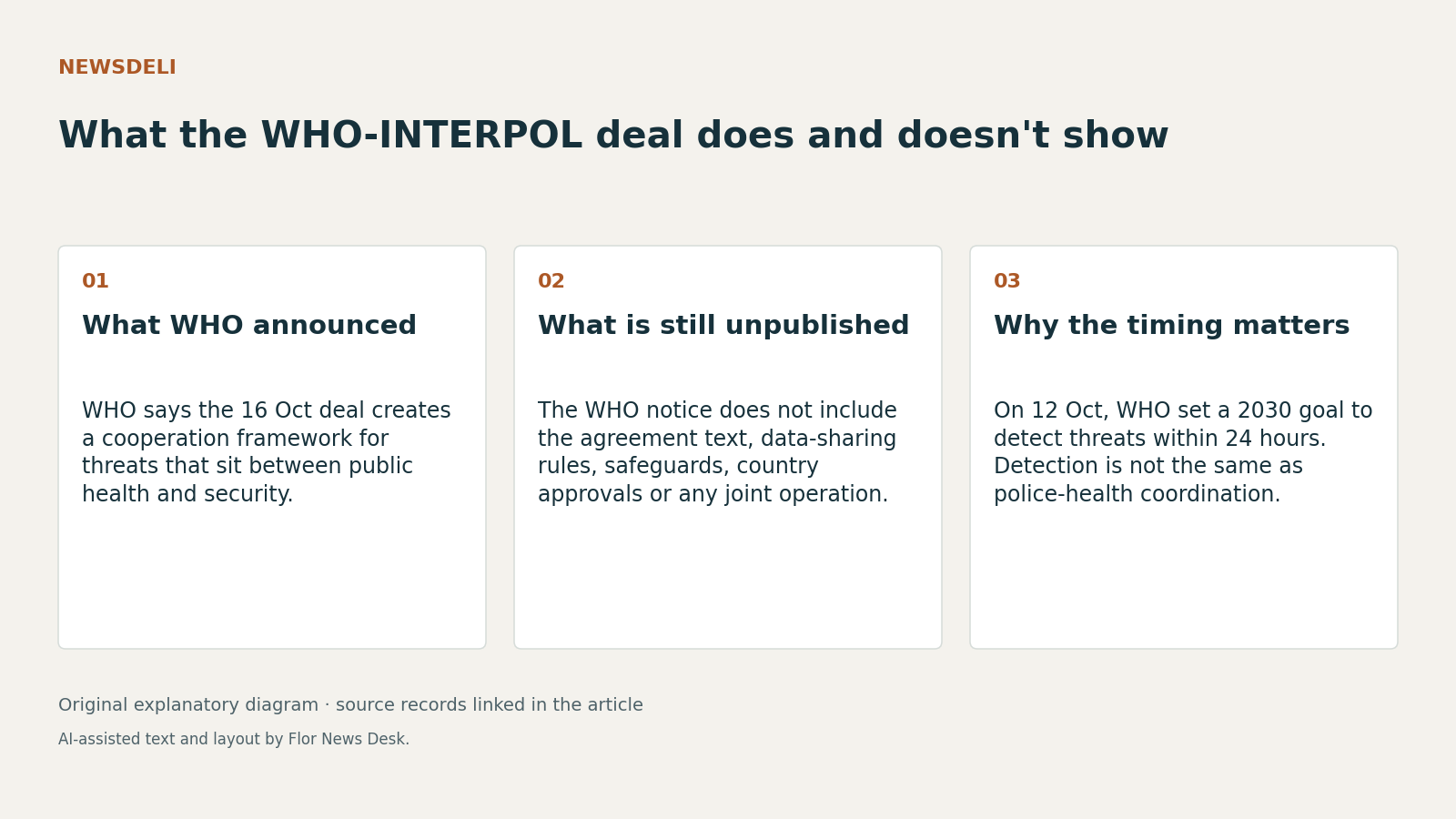
On 16 October 2026, WHO said it had signed a cooperation agreement with INTERPOL to create a framework for joint action where public health and security overlap. Four days earlier, WHO had also published a new five-year strategy for its Hub for Pandemic and Epidemic Intelligence, including a goal for every country to detect and understand emerging health threats within 24 hours by 2030. Read together, the two announcements point to a broader WHO effort: faster detection on one side, and some form of cross-border coordination when a health event may also involve crime or suspected deliberate harm on the other. But that link is an analytical reading of timing and subject matter, not a connection WHO spells out in either notice. WHO agreement announcement WHO Pandemic Hub strategy announcement
The agreement notice is broad. WHO says the cooperation is meant for exceptional situations needing both health and security action, including suspected misuse of chemical or radioactive materials and unusual biological events that may be natural, accidental or deliberate. WHO also says it covers preparation around major international events and mass gatherings, trafficking of persons for organ removal and the illegal trade in human organs, tissues and cells, illicit trade in goods affecting public health such as falsified medical products and counterfeit protective equipment, and support for implementing the WHO Framework Convention on Tobacco Control. That scope matters because it reaches far beyond classic outbreak surveillance into criminal markets and security-sensitive incidents. WHO agreement announcement
What the public record does not yet show is just as important. WHO’s announcement does not publish the agreement itself. It does not describe legal duties, national approvals, country opt-in rules, funding, timelines, privacy protections, human-rights safeguards, data-sharing procedures, evidentiary handling, or who leads in a mixed public-health and law-enforcement case. As of 31 October 2026, the WHO notice also does not establish that any joint operation has already taken place. So the public evidence supports a narrower conclusion than the headline might suggest: an institutional framework has been announced, but the operating rules are still not visible. WHO agreement announcement
That distinction matters when the second WHO announcement is brought in. On 12 October 2026, WHO said its Pandemic Hub had launched a five-year strategy aimed at helping every country detect and understand new threats within 24 hours by 2030. WHO also said the Hub’s open-source epidemic intelligence system uses artificial intelligence to scan thousands of public sources daily and is used by more than 125 Member States and 30 regional and international organizations. Those details describe a surveillance and analysis ambition. They do not prove that every country can already meet the 24-hour standard, and they do not explain how a suspicious signal would move from detection into an INTERPOL-linked response. WHO Pandemic Hub strategy announcement
The real unresolved issue, then, is not whether WHO and INTERPOL plan to cooperate. WHO says they do. It is whether the same agreement can sensibly govern very different situations without much more public detail. A mass-gathering health alert, a falsified medicine supply chain, and an unusual biological event that might be deliberate all raise different questions about authority, evidence and information sharing. The WHO summary does not say what triggers escalation from health monitoring to security coordination, whether member states must approve that step, or whether separate protocols exist for separate categories of case. WHO agreement announcement
For readers, the most useful next test is documentary, not rhetorical. If WHO or governments later publish the agreement text, annexes on information handling, national approval records, exercise plans or dedicated funding, that would show how much substance sits behind the announcement. Until then, the safest reading is limited but still significant: WHO has publicly marked law-enforcement cooperation as part of its health-security toolkit, while leaving the practical and legal mechanics unproven in the material now on the record. WHO agreement announcement