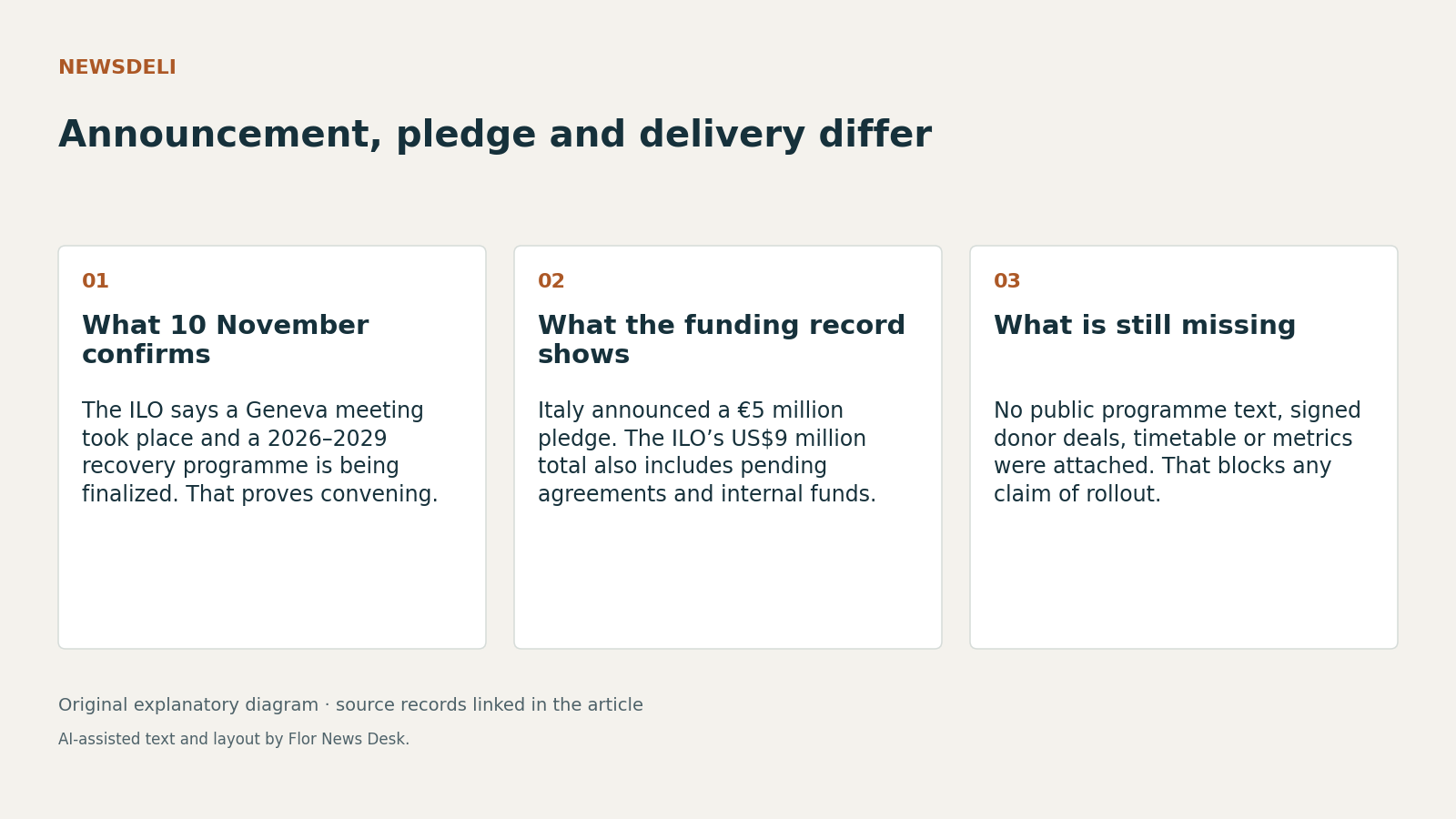
On 10 November 2026, the International Labour Organization said it held a high-level partners’ meeting in Geneva on employment-led recovery in the Occupied Palestinian Territory, co-convened with the State of Qatar and the Kingdom of the Netherlands. That establishes a real diplomatic and programme-design step. It does not, by itself, show that a recovery plan is already funded or operating. ILO meeting release
The same ILO record says governments, workers’ and employers’ organizations, UN agencies and development partners discussed the next phase of support under a Decent Work and Recovery Programme 2026–2029, which the ILO says it is finalizing with Palestinian tripartite partners. In plain language, the public evidence shows a framework and a coalition-building effort. It does not yet show an approved programme text, a launch schedule or confirmed delivery arrangements. ILO meeting release
The funding language is the main place where readers should slow down. The ILO says Italy announced a €5 million pledge, and that about US$9 million had been mobilized over the past year. But the same page says that total includes some contributions or funding commitments still awaiting finalized agreements, plus US$700,000 from ILO internal resources. So the published figure combines at least three different things: an announced pledge, pending commitments and internal allocation. It does not establish how much money has been contractually secured, transferred or spent. ILO meeting release
The urgency behind the appeal is easier to document than the recovery machinery itself. The ILO reports 252,000 jobs lost in Gaza between the third quarters of 2023 and 2025, unemployment there at 85.1 per cent, and labour income losses of US$2.77 billion. It also reports unemployment in the West Bank at 27.9 per cent in the second quarter of 2026. Those figures help explain why the ILO is framing recovery around work, wages and enterprises rather than only emergency relief. ILO meeting release
Timing matters too. The meeting took place during the period when the ILO’s Governing Body was due to meet in Geneva from 9 to 19 November 2026, according to an ILO notice published on 2 November. But that notice was written before the session began and still describes several agenda items, including the 16 November election of the next Director-General, as future events. As of 14 November 2026, it cannot be used as proof that those scheduled items have happened or that any decision has been taken on the Palestinian recovery programme. Governing Body notice
The ILO’s live schedule page is also a weak source for outcome claims. In the briefed record, it lists an election-result announcement and several Geneva sessions on inclusion and workplace topics, but it carries no visible publication date or update time and does not verify the Palestinian recovery meeting or any donor decision. A live agenda can show what is planned or listed. It cannot, on its own, prove attendance, approval, signatures or payment. Live schedule
What is still missing is the documentation that would turn mobilization into implementation: the full Decent Work and Recovery Programme 2026–2029, the ten project proposals the ILO says accompany it, signed contribution agreements, a delivery timetable, named implementing partners and a monitoring framework. Without those records, readers cannot tell which projects would start first, how success would be measured or when any announced support would become actual activity on the ground. ILO meeting release
The fairest reading of 10 November is therefore narrow but important. The ILO has publicly assembled a donor-facing recovery frame, attached a 2026–2029 label to it and disclosed at least one new pledge. The next milestones worth watching are more concrete: publication of the programme text, donor agreements that move from announced support to finalized commitments, and later notices showing disbursement or delivery partners. Until those appear in directly retrieved records, the public evidence supports momentum, not implementation. ILO meeting release