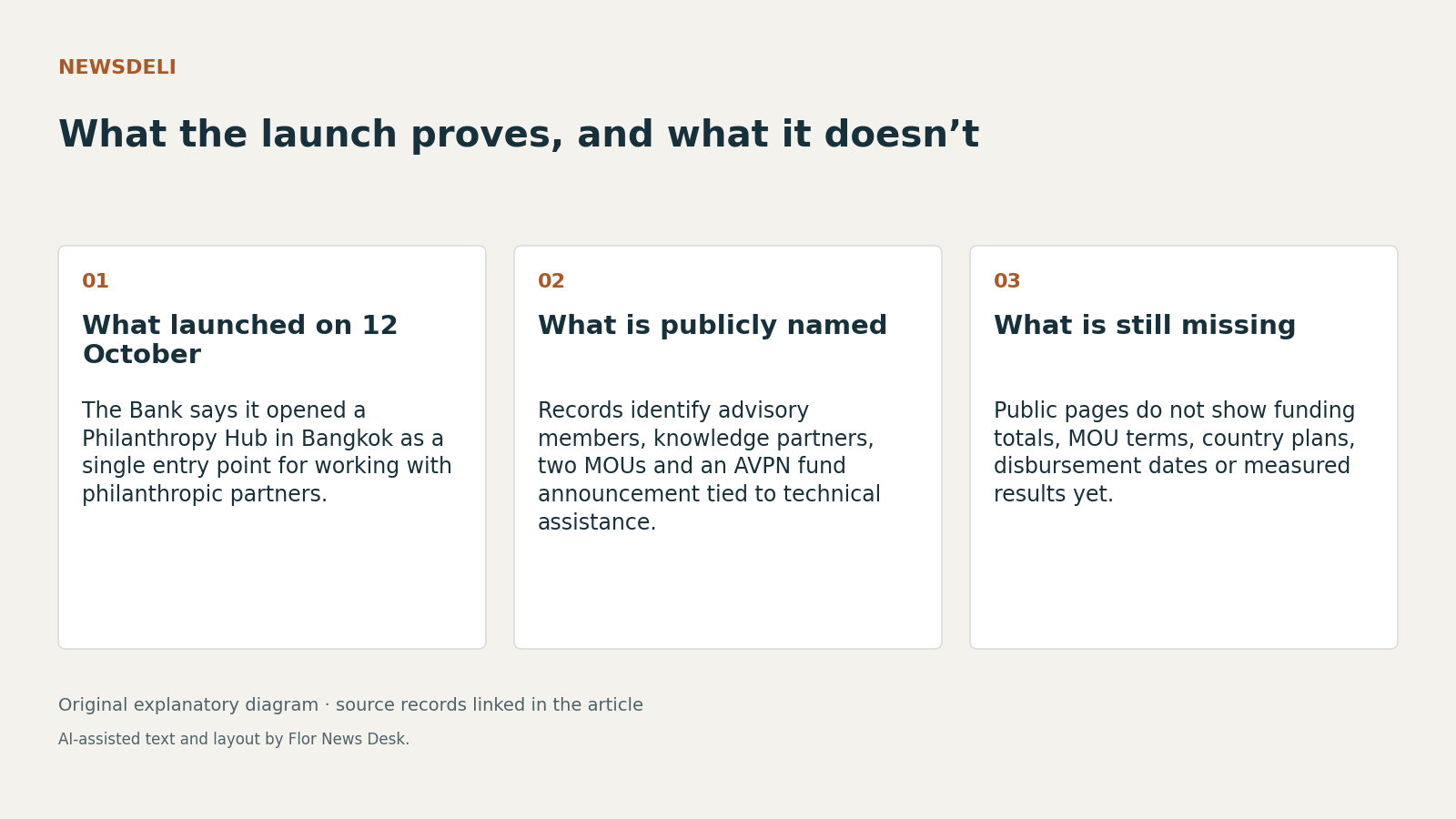
The World Bank Group says it launched a Philanthropy Hub in Bangkok on October 12, 2026, during the Annual Meetings, and the public record does support that a new institutional platform now exists. But the launch documents show something narrower than a new pool of development finance: they show a coordination mechanism, named partners and two signed memoranda, not a published ledger of capital already committed to countries. Press release
What the Hub appears to be, in the Bank’s own materials, is a formal front door for philanthropies that want to work with Bank programmes. The overview page says it links philanthropic organisations with governments, development institutions, businesses, networks, researchers and practitioners, and that it is organised around shared missions rather than one-off requests. It also says the Hub is meant to connect partners to country needs, evidence, specialists and financing options for longer-term partnerships. That is a meaningful institutional design choice: it suggests the Bank is trying to make philanthropy part of programme formation, not just an occasional add-on. Hub overview
The public record also identifies who is being brought into that structure. The “About the Hub” page lists a seven-member Inaugural Advisory Group: Naina Subberwal Batra of AVPN, Tom Hall of UBS Optimus Foundation Network, Kate Hampton of Children’s Investment Fund Foundation, Desmond Kuek of Temasek Trust, Peter Laugharn of Conrad N. Hilton Foundation, Matt Reed of Aga Khan Foundation and Arturo Franco of the World Bank Group. The same page says the group provides strategic guidance and helps identify barriers and opportunities, while Knowledge Partners supply research and specialist advice. About the Hub
The October 12 press release adds the most concrete launch-day steps. The World Bank Group said AVPN and Temasek Trust signed Memoranda of Understanding on the sidelines of the forum. It also said AVPN announced a dedicated fund to support Health Works through technical assistance. The release names Knowledge Partners including the Mo Ibrahim Foundation, Latimpacto, the Philanthropy Asia Alliance, the Centre for Asian Philanthropy and Society, Boston Consulting Group, Bridgespan, Dalberg, Coefficient Giving, the Marshall Institute at London School of Economics and Indiana University’s Lilly Family School of Philanthropy. Press release
What those records do not yet establish is just as important. None of the cited World Bank pages publishes a total for money pledged or received through the Hub, the size or terms of AVPN’s announced fund, the text or legal force of the memoranda, country-by-country implementation plans, disbursement schedules, or monitoring data. The Hub overview also lists a Multilateral Development Bank Network with the European Bank for Reconstruction and Development, European Investment Bank, International Fund for Agricultural Development, Inter-American Development Bank and Islamic Development Bank, but it does not spell out operational commitments by those institutions. As of 2026-10-16, that means the strongest verified claim is that a collaboration framework has been launched, not that development outcomes have been delivered. Hub overview About the Hub
A final caution comes from the event listing. A World Bank event page, tied to a September 8, 2026 URL, described the inaugural Philanthropy Forum in future tense and said it would mark the launch of the Hub, with sessions on collaboration, knowledge, networks and blended or stacked capital. That page is useful for understanding the intended agenda, but because it was written before the event, it cannot by itself prove every planned session or speaker appearance happened as listed. Event page
So the key distinction for readers is simple. The Hub is not imaginary; the World Bank Group has publicly launched it and named an advisory structure around it. But the evidence now in view is still mostly about architecture. To judge whether the Hub changes development finance in practice, later reporting will need signed agreements in full, funding amounts, country programme documents and early monitoring records.