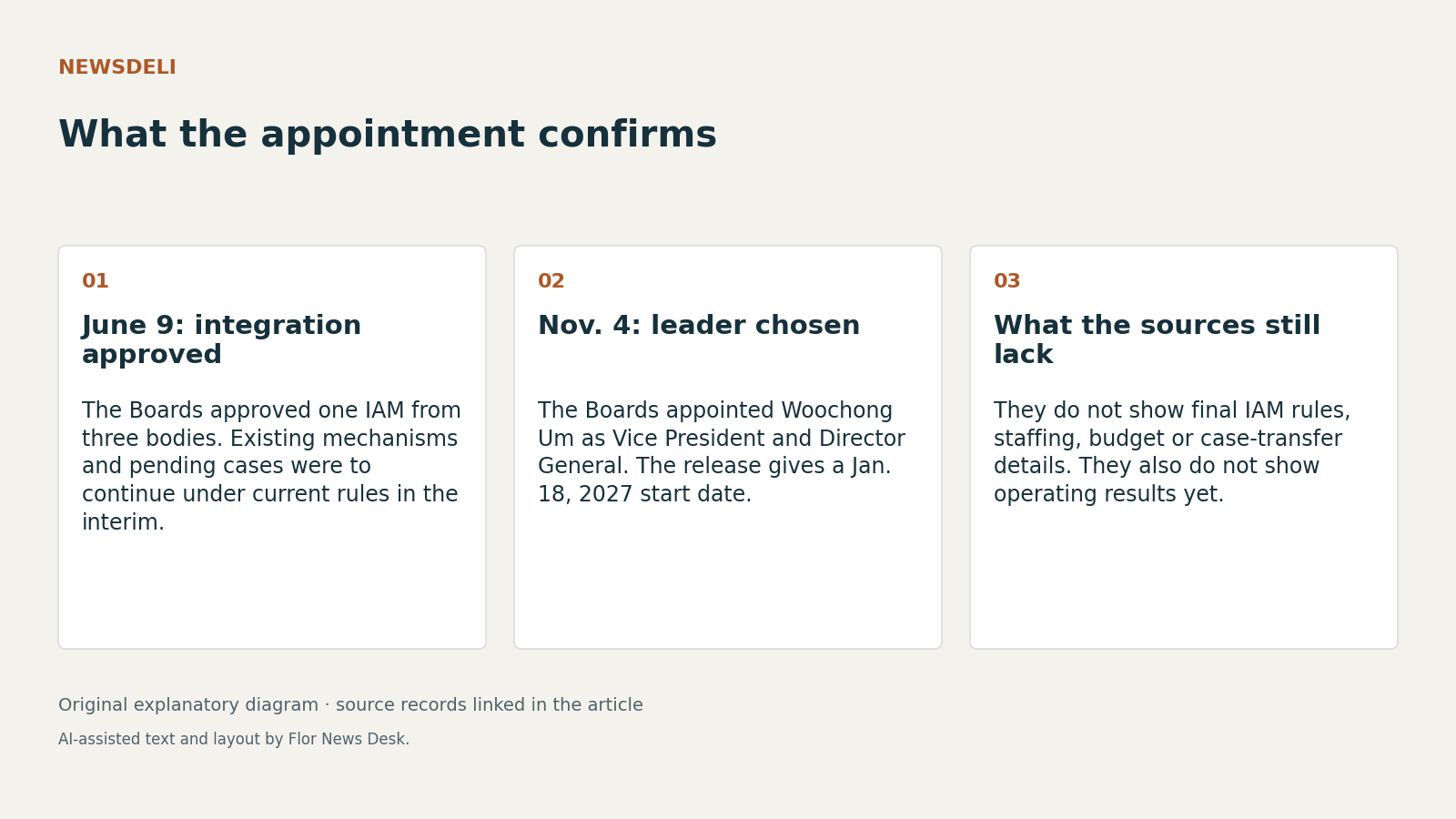
The World Bank Group’s November 4 appointment of Woochong Um settles one important question about its planned Independent Accountability Mechanism: the Boards have now chosen the person meant to run it. The institution said the Boards of IBRD, IDA, IFC and MIGA appointed Um as Vice President and Director General, reporting directly to the Boards, with a stated start date of January 18, 2027 (Nov. 4 press release). That is a real governance step. It is not, by itself, proof that the new mechanism is already operating under final rules.
The appointment follows a June 9 Board decision to combine three existing bodies into one Independent Accountability Mechanism: the World Bank Inspection Panel, the World Bank Dispute Resolution Service and the IFC/MIGA Compliance Advisor Ombudsman (June 9 press release). In that announcement, the institution said the new structure was meant to bring together compliance, dispute resolution and advisory functions, while staying independent of management and reporting to the Boards. Just as important, the same release said the three existing mechanisms would continue under their current policies in the interim and that active or pending cases would not be affected. So June 9 approved integration in principle, not immediate procedural replacement.
An August 3 recruitment notice helps explain what the Boards were filling. It described the Director General as a Board-appointed, Board-reporting post, overseen through the Committee on Development Effectiveness, with a nonrenewable five-year term and no later World Bank Group employment after that term (recruitment notice). That matters because it shows the institution was designing an office with a specific independence model, not merely renaming an existing executive role. But recruitment language is still only recruitment language. It cannot establish who would be chosen, when they would start, or how cases would move through the integrated system.
The public-facing record also shows why readers should be careful about claiming more than that. The World Bank Accountability Mechanism homepage still describes itself as an independent complaints forum using two parallel entities, the Inspection Panel and the Dispute Resolution Service, and says those bodies handle compliance review, advisory work and voluntary dispute resolution (Accountability Mechanism homepage). The same page’s news area includes a November 5 item about Um’s appointment. Read together, those details suggest a mixed public record: leadership for a broader World Bank Group mechanism has been announced, while at least one key webpage still presents the older World Bank-side structure. That is not evidence of failure or delay. It is evidence that the documentation visible here is incomplete.
The biggest gap is operational detail. The June 9 release said a new IAM policy framework would be developed under Board oversight, with stakeholder consultation and a non-regression principle (June 9 press release). But the sources provided do not include that policy text, a staffing plan, a budget, detailed case-transfer rules, or any record showing how future complaints will be routed once Um starts on January 18, 2027 (Nov. 4 press release). Because the start date is still in the future as of November 6, 2026, the available documents also cannot show measured results. Claims that the change will simplify processes or strengthen coherence remain institutional aims, not demonstrated outcomes.
That leaves a narrow but useful conclusion. NewsDeli readers can say the World Bank Group has moved through three distinct stages in public: Board approval of integration on June 9, a formal recruitment process announced on August 3, and a named Director General on November 4 (June 9 press release, recruitment notice, Nov. 4 press release). What readers cannot yet say from this record is how communities, borrowers or civil society will experience the new system in practice. Until the policy framework and operating documents are public, the appointment is best understood as a concrete Board action ahead of implementation, not evidence that implementation is complete.