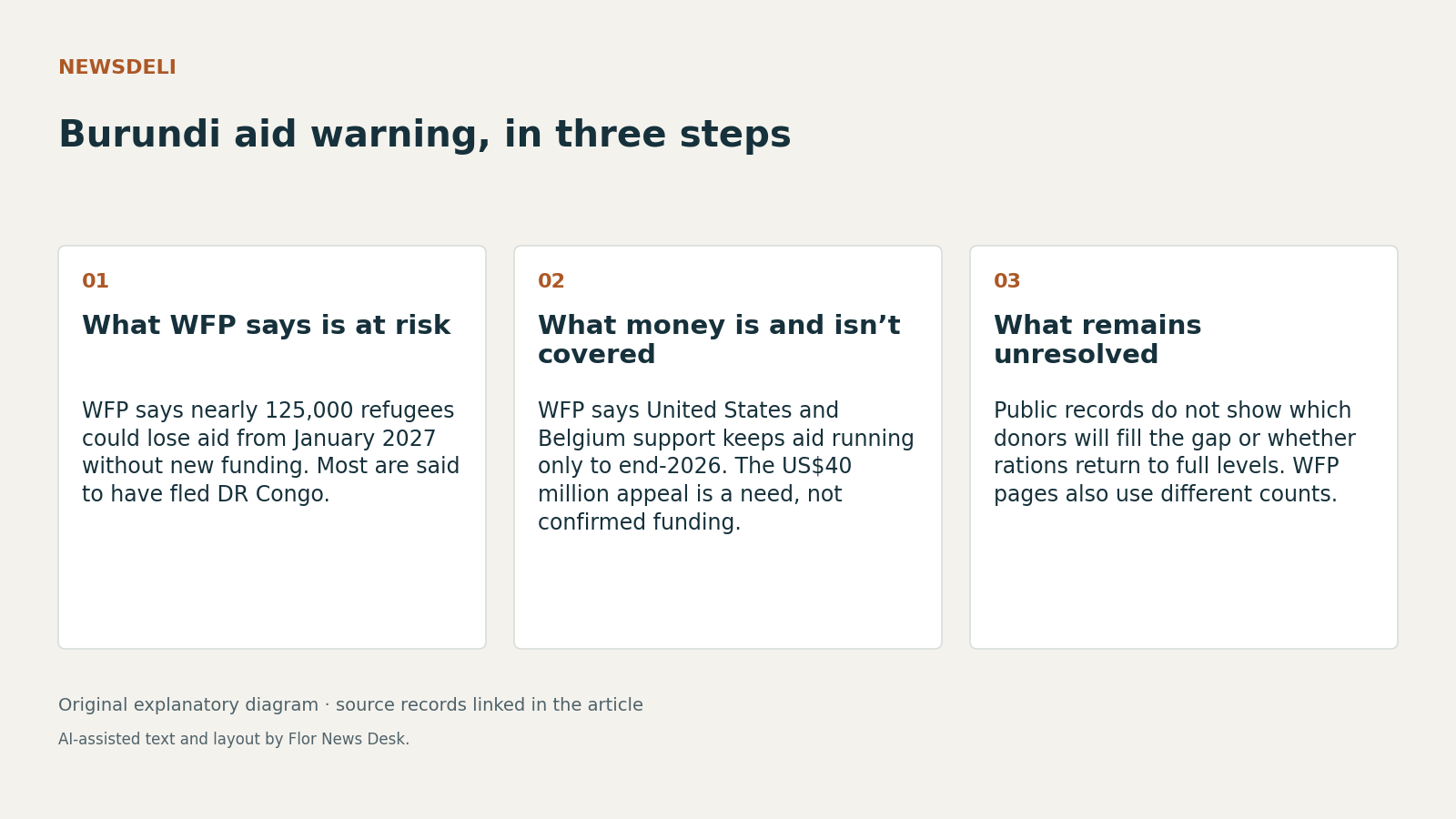
The immediate news from Burundi is not that refugee food aid has already stopped. It is that the World Food Programme set a clear public deadline on 3 November 2026: without more money, nearly 125,000 refugees in Burundi could lose food assistance from January 2027. WFP says most of the people affected fled conflict in the Democratic Republic of the Congo. The same notice matters because it separates a near-term interruption risk from the longer funding request behind it. WFP warning, 3 November 2026
WFP’s own statement draws a sharp line between money already received and money still missing. It says contributions from the United States and Belgium prevented an interruption that had been expected in October 2026 and will keep assistance running only through the end of December 2026. Separately, WFP says it needs US$40 million to avoid a January break and to raise support from 45 percent to 100 percent of minimum food needs through September 2027. It also says a further US$1 million is needed for school meals for 16,000 children from refugee and host communities through September 2027. Those are funding requirements, not evidence that donors have committed them. WFP warning, 3 November 2026
An undated WFP country page makes the picture more complicated rather than more precise. That page says WFP provides food and cash-based assistance to 120,000 refugees and asylum seekers in Burundi, and that funding shortfalls reduced daily refugee rations from 75 percent to 50 percent of the recommended daily calorie intake. It also says Burundi has received 70,000 refugees fleeing violence in eastern DRC since mid-February 2025. Because the page is undated and mixes figures from different periods, it does not reconcile its 120,000 figure with the 125,000 refugees cited on 3 November, or its 50 percent ration figure with the 45 percent figure in the newer warning. Readers should treat these as different WFP snapshots, not as a fully matched ledger. WFP Burundi country page
Older UN records show this was already an emergency-funded response long before the latest warning. On 5 January 2026, the UN said the Central Emergency Response Fund had allocated US$3.5 million for life-saving assistance for more than 70,000 refugees and asylum seekers in Burundi, and said the Government of Burundi had declared a state of emergency on 17 December. That release also mentioned an expectation that up to 166,000 refugees might reach neighboring countries over the next four months. By 4 November 2026, that forecast is only a historical projection from January, not proof of what later happened. UN emergency fund release, 5 January 2026
Another October record helps explain why WFP’s separate school-meals request matters. In a 16 October 2026 article, UNHCR said hundreds of Burundian refugees were returning home each week and that some families received cash assistance, construction materials, and support tied to education and health services in receiving areas. That article is not a measure of WFP deliveries, but it shows Burundi’s humanitarian system is not dealing with one population alone. In that context, WFP’s request for school meals for both refugee and host-community children looks like a service-protection ask, not just an add-on to general rations. UNHCR story, 16 October 2026 WFP warning, 3 November 2026
The same distinction matters for longer-term school feeding plans. WFP’s Burundi page says WFP and the Government of Burundi are working toward a national home-grown school feeding programme intended to reach all elementary schoolchildren by 2032. That is a separate ambition from the November 2026 appeal. The public record here supports a narrower conclusion: WFP has identified a funded runway to 31 December 2026, a financing gap from January 2027, and a target budget through September 2027. It does not yet show which donors, if any, will fill that gap, whether full rations will actually be restored, or how quickly future pledges would turn into food or cash distributions. WFP Burundi country page WFP warning, 3 November 2026