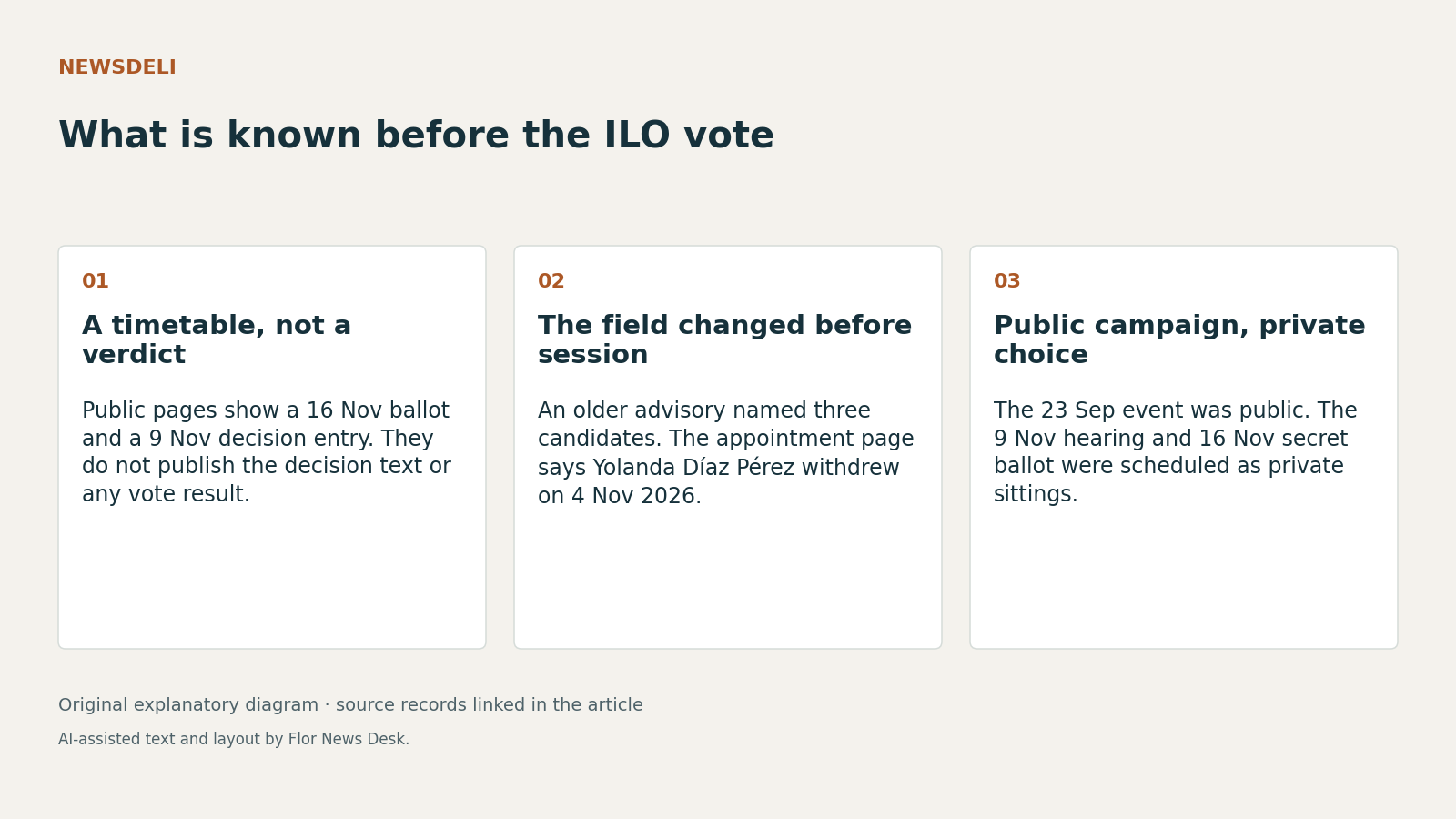
The International Labour Organization is scheduled to choose its next director-general on 16 November 2026, but the public record available here is more precise about procedure than outcome. The ILO’s 358th Governing Body page lists an agenda item for the “Election and appointment of the Director-General of the ILO” on 16 November, while the appointment page says the vote is to be held by secret ballot in a private sitting and the result then announced publicly. Those records establish a timetable, not a winner or a public account of internal support. 358th Session page Appointment page
That distinction matters because one part of the documentary trail is incomplete in the retrieved material. The ILO’s Institutional Section page lists a document on the election and appointment process, coded GB.358/INS/1(Rev.1), dated 4 November 2026, and a separate decision record dated 9 November 2026. But the page, as described in the source brief, is a document list rather than the text itself. So readers can say a decision entry exists, yet cannot responsibly say from this record alone what the Governing Body decided on 9 November or whether a private hearing definitely took place that day. Institutional Section
The best-supported public outline of the race comes from two ILO process pages read together. A 16 September 2026 media advisory named three candidates for a public interactive event on 23 September: Gilbert F. Houngbo of Togo, Yolanda Díaz Pérez of Spain, and Javier González-Olaechea Franco of Peru. The later appointment page repeats those names but adds a significant update: it says Díaz Pérez withdrew her candidature on 4 November 2026. On the retrieved public record, that means the field appears to have narrowed before the November session, even though the older advisory still reflects the earlier three-candidate stage. Media advisory Appointment page
The process also mixes public campaigning with private decision-making. According to the advisory, the September event was meant to let candidates present their vision and was to be broadcast live and recorded. The appointment page says each candidate also had to submit a CV, a vision statement and campaign-funding information by 29 October 2026. But the same page places both the 9 November hearing and the 16 November ballot in private sittings. The practical implication is straightforward: outsiders may see formal materials and a final result, but not the deliberation that links one to the other. Media advisory Appointment page
Why should global readers care beyond the internal mechanics? Because the same 358th session agenda includes separate items on ILO reform, follow-up work on the platform economy and the advisory opinion on Convention No. 87 in relation to the right to strike. That does not prove any candidate’s stance on those files, and these records do not reveal voting blocs inside the tripartite system. But it does show that the organization is choosing leadership while handling contentious institutional and labour-policy questions at the same session. Institutional Section
What to watch next is narrow but important. The appointment page says the new term would begin on 1 October 2027, so the 16 November ballot is about succession rather than an immediate handover. For now, the strongest verified conclusion is limited: the ILO has published a schedule, a candidate hub and a notice of one withdrawal, but the retrieved record does not yet establish the substance of the 9 November proceedings or the result of the 16 November vote. Appointment page 358th Session page