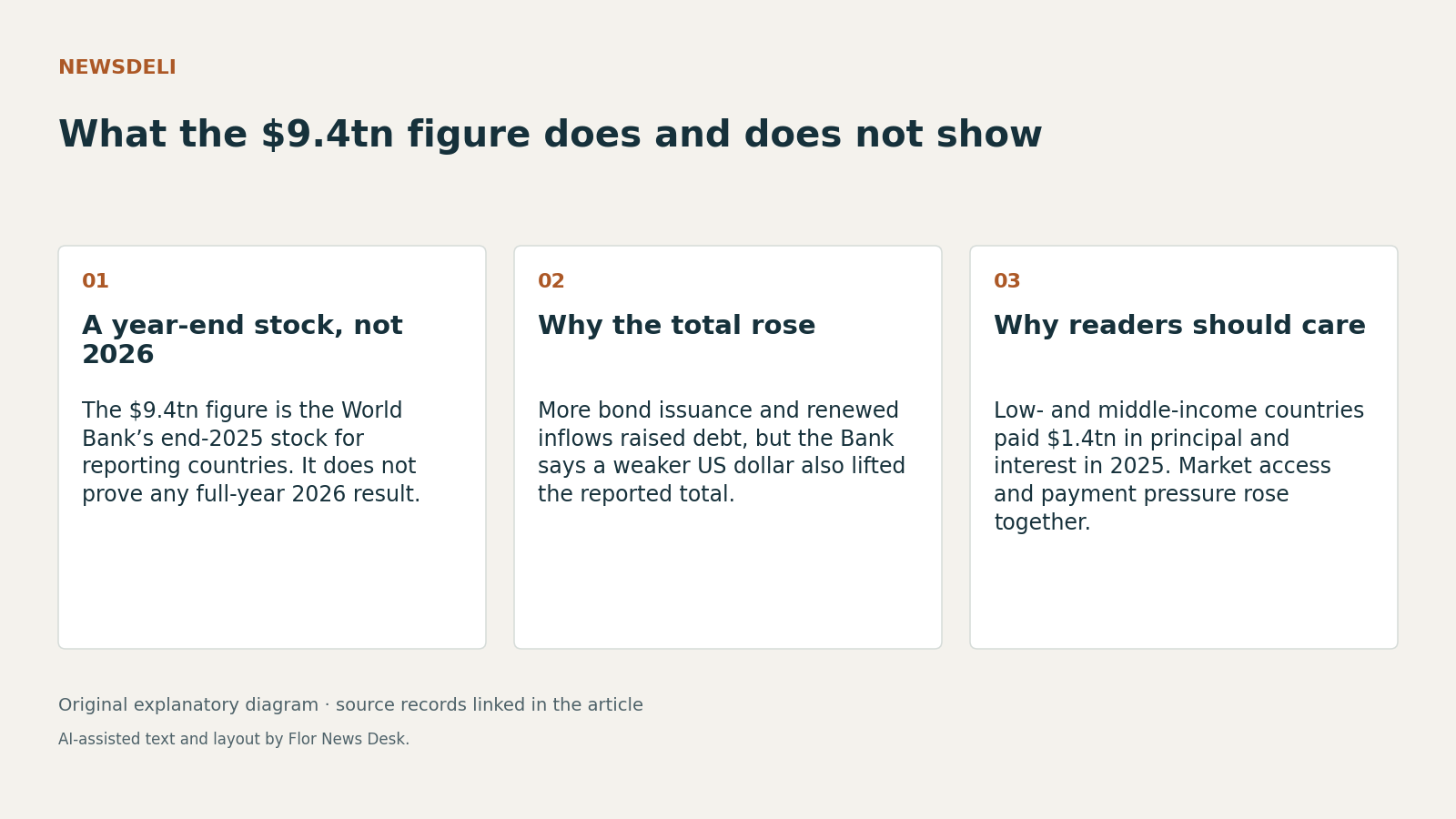
The World Bank’s headline number is striking: external debt of developing countries reached $9.4 trillion at the end of 2025, up 5.5% from a year earlier, according to the bank’s International Debt Report 2026, released on 5 November 2026 (World Bank press release). The first thing readers need to separate is stock from outcome. This figure is a year-end debt stock, not a measure of what happened through all of 2026.
The second distinction is scope. The World Bank’s International Debt Report page says the report is its annual publication on external debt statistics and analysis for low- and middle-income countries that report to the Debtor Reporting System, and that IDR 2026 analyzes debt stocks and flows as of end-2025. So the $9.4 trillion figure is broad, but it is not a claim about every type of debt everywhere, and it is not a country-by-country judgment about distress. It is a tally inside a defined reporting framework.
What changed in 2025, according to the World Bank, was not simply “more debt” in the abstract. The bank says bond issuance by public entities rose nearly 35% to $251 billion, which it links to reopened market access for many developing countries, while long-term debt flows shifted from a $118 billion net outflow in 2024 to a $45 billion net inflow in 2025 (press release). The analytical point is that renewed access to private capital markets can improve financing options at the same time as it increases future repayment obligations. Market access and debt pressure are not opposites.
The reported increase also was not purely new borrowing. The World Bank says more than a quarter of the $303 billion increase in public and publicly guaranteed debt reflected a weaker US dollar, which raised the reported dollar value of debt issued in other currencies (press release). That matters because a record dollar total can partly come from valuation effects rather than from an equal amount of fresh cash raised. In plain terms, the stock can rise faster than new financing.
The cost side is what makes the 2025 pattern more than a bookkeeping story. The World Bank says low- and middle-income countries paid $1.4 trillion in principal and interest in 2025, up 1.9% and marking a fifth straight annual increase. It also says payments to bondholders reached $363 billion (press release). Meanwhile, debt in countries eligible for International Development Association concessional financing rose 8.1% to $1.3 trillion. Taken together, those figures suggest that the return of bond financing did not reduce payment strain by itself; it coincided with larger debt-service bills.
Just as important is what these records do not establish. The landing page and press release do not, on their own, show which individual countries drove the aggregate increase, what borrowing terms each one faced, or whether any country’s 2026 position improved or worsened after end-2025 (International Debt Report page; press release). They are World Bank records, not independent verification, and the page describing the report does not set out the full methodology in the text available here.
So the clearest reading of the $9.4 trillion figure is narrower, and more useful, than the headline alone suggests. It shows that by the end of 2025 the World Bank was measuring a larger external debt stock across its reporting universe, with private-market borrowing and bond payments both playing bigger roles. It does not prove that every borrower shared equally in that rebound, that all of the increase came from new money, or that 2026 has resolved the underlying risks.