The main change in the UN’s 2026 E-Government Survey is not only who ranks first. It is that the United Nations Department of Economic and Social Affairs is recasting the policy debate from putting services online to preparing for AI-enabled administration. When UN DESA launched the survey on 19 November 2026, it said the edition tracks digital-government gains while examining a move toward more automated public administration. UN DESA launch EKAP report page
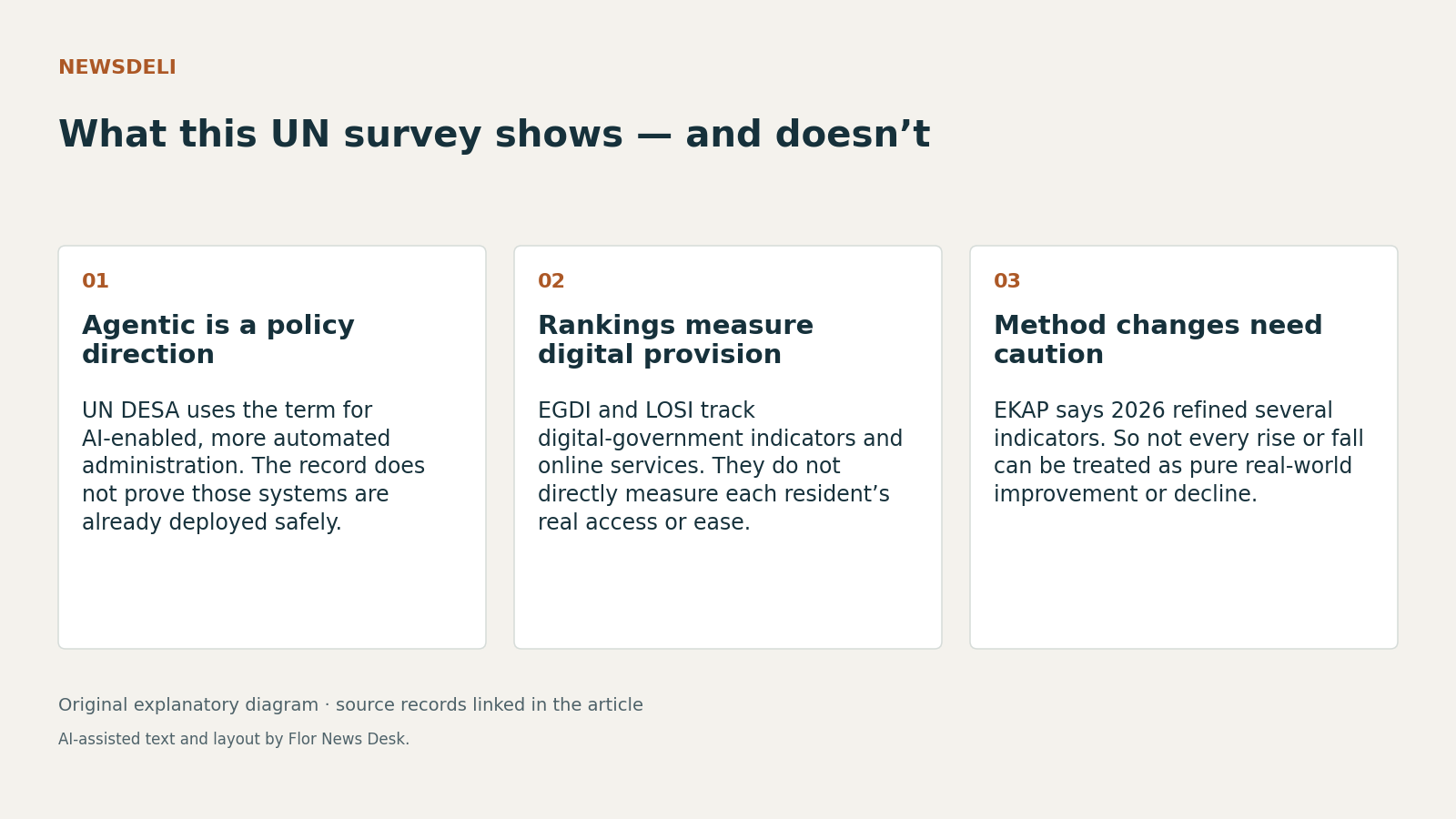
In the source record, though, “agentic government” is a framing term, not proof that states already operate autonomous public systems at scale. A UN DESA media advisory published on 16 November 2026 said the report would examine a shift toward automated and agentic systems, and the EKAP report page says such a shift depends on trusted data, resilient infrastructure, human oversight and accountability. In plain terms, the survey is pointing toward a model where software could handle more steps inside public services. The retrieved material does not establish which governments have actually deployed that model, under what legal rules, or with what audits. Media advisory EKAP report page
The measured results still matter. UN DESA says the 2026 survey covers 193 UN Member States and, for the first time, the State of Palestine, making 194 assessed entities in all. It says the Republic of Korea ranked first in the E-Government Development Index, followed by Denmark and Singapore. UN DESA also says 151 assessed countries are now in the high or very high groups, up from 138 in 2024, and that the global average EGDI rose from 0.6382 to 0.6675. UN DESA launch
Those improvements do not mean the digital divide has closed. UN DESA says about 1.95 billion people, or 24.31 percent of the world’s population, live in countries below the global EGDI average, while also warning that this country-level indicator is not a direct measure of an individual person’s exclusion. EKAP’s homepage helps decode the categories: it shows “high” beginning at 0.50 and “very high” at 0.75, and lists regional leaders as Denmark in Europe, Republic of Korea in Asia, United States of America in the Americas, Australia in Oceania and South Africa in Africa. UN DESA launch EKAP homepage
City rankings tell a similar story of progress with important limits. UN DESA says the number of cities in the very high Local Online Service Index group rose from 42 in 2024 to 68 in 2026, with Dubai, Madrid, Manama, Riyadh, São Paulo and Vienna sharing the top score. But the EKAP report page says broader local digital government has not always produced accessible, participatory and seamless end-to-end services. So a stronger city web presence is evidence of broader online provision, not automatic evidence that residents can complete difficult tasks simply or fairly. UN DESA launch EKAP report page
The biggest caution is about what the survey cannot settle on its own. EKAP says the 2026 edition introduced methodological refinements around life-event services, participation and engagement, digital infrastructure and e-government literacy while aiming to preserve comparability across editions. The material retrieved for this draft does not include the full technical appendix, raw score tables or a transcript of the 19 November launch, and the 16 November advisory was advance publicity rather than evidence of implementation. That means the survey can show direction and relative standing, but it does not yet show which governments have paid for AI oversight, changed procurement rules, or built enough local capacity to make more automated administration accountable in practice. EKAP report page Media advisory