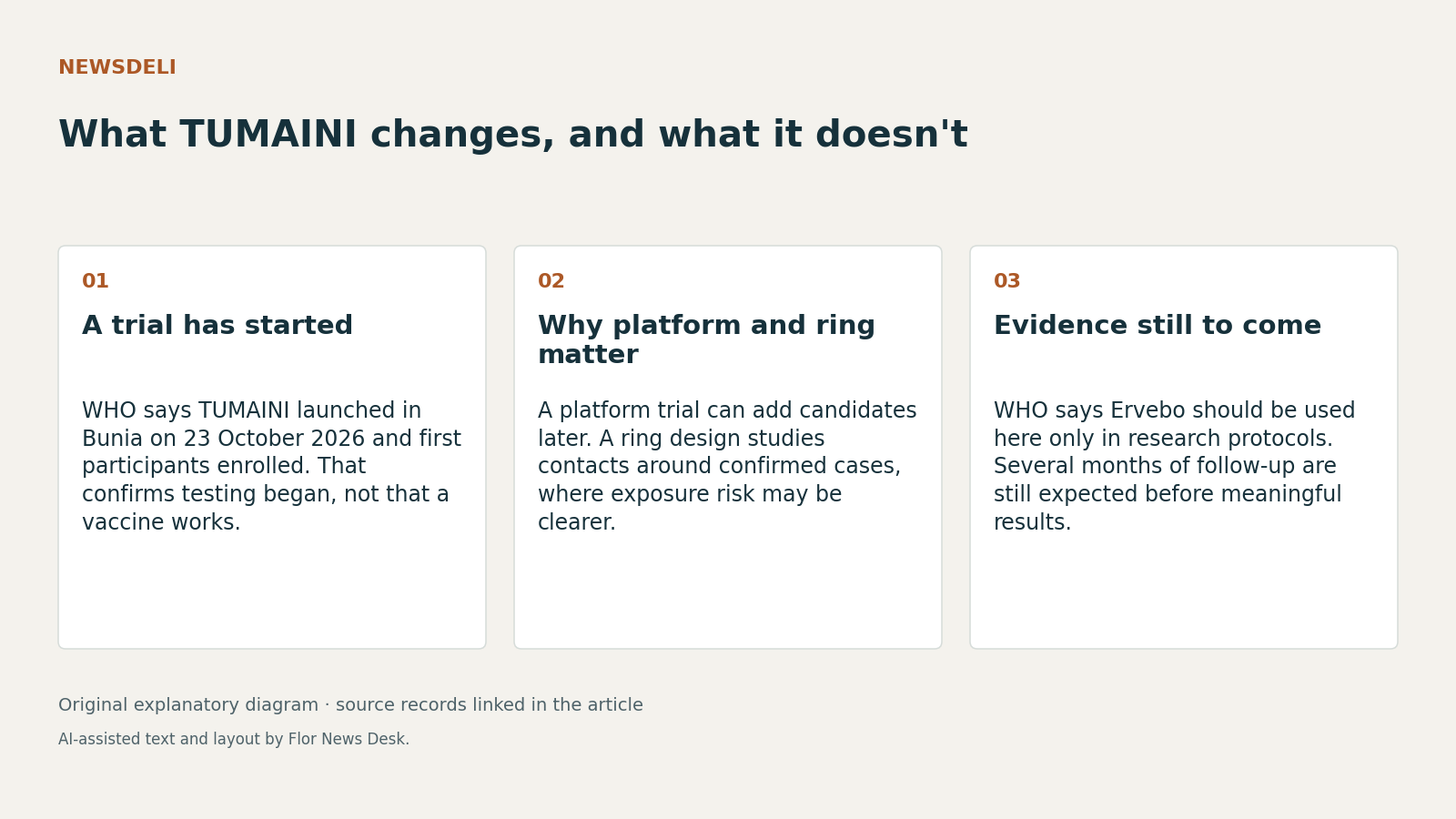
The important development in Bunia is not a vaccine result, but the start of a test. WHO said the TUMAINI vaccine trial was launched in Bunia, in Ituri province, on 23 October 2026 and that first participants were enrolled the same day. That comes during sustained transmission in the Democratic Republic of the Congo, with WHO reporting 9,704 confirmed Bundibugyo virus disease cases and 4,687 deaths as of 20 October 2026, and identifying Ituri as the epicentre. Starting a trial changes the evidence process; it does not answer the evidence question yet. WHO disease outbreak notice
What has started is a clinical study, not a general vaccination rollout. WHO called TUMAINI a pivotal Phase 2/3 trial and said it is supporting the work with technical, scientific and operational expertise. At a UN Geneva briefing on 27 October 2026, Dr. Meg Doherty said Congolese authorities are leading the study and the Institut National de Recherche Biomédicale is managing it. That matters because the immediate significance is institutional as well as medical: the response has moved from discussing candidate vaccines to running a formal trial during an active outbreak. WHO disease outbreak notice UN Geneva briefing transcript
The design helps explain what the trial may be able to show. Doherty described TUMAINI as a platform study using vaccination rings around contacts of confirmed cases. In plain language, a platform can begin with one candidate and add others later, while a ring approach focuses on people closest to a known case. That structure could allow faster comparison inside outbreak conditions. But the public WHO outbreak notice does not provide the protocol, sample size, comparator or endpoints, so readers should not assume details that are not yet in the source record. UN Geneva briefing transcript WHO disease outbreak notice
The clearest policy distinction right now concerns Ervebo. In a message discussing SAGE deliberations from 5 to 8 October 2026, Kate O'Brien, Director of the Department of Immunization, Vaccines and Biologicals at WHO, said SAGE reaffirmed its earlier view that Ervebo should be used in the Bundibugyo outbreak only within research protocols. The same message says TUMAINI is expected to generate evidence on whether candidates including Ervebo are efficacious against Bundibugyo virus disease. So Ervebo appearing in TUMAINI is not the same thing as WHO recommending routine use against this virus. WHO director message
The first operational step was still small. Doherty said four people were vaccinated at the 23 October 2026 launch in Bunia. She also said Ervebo is the first vaccine being evaluated, and that candidates from the University of Oxford with the Serum Institute of India and from Moderna could be added later. As of 31 October 2026, those additions are still prospective statements from a briefing, not completed expansions of the trial. UN Geneva briefing transcript
The timeline is another place where readers should resist over-reading an announcement. Doherty said the study is event-driven rather than tied to one fixed enrolment total, and that meaningful results would take several months. That means the launch does not establish near-term efficacy, broader effectiveness, regulatory action or outbreak control. Analysis follows directly from the source record here: a randomized trial can produce stronger evidence than ad hoc use, but only after enough follow-up and enough disease events occur inside the study. UN Geneva briefing transcript WHO director message
For now, the most defensible conclusion is narrower and still important. WHO's 23 October 2026 outbreak notice continued to present Bundibugyo virus disease as lacking an approved vaccine, while SAGE's position kept Ervebo inside research protocols. TUMAINI therefore marks the beginning of evidence generation, not the end of the vaccine debate. Many operational details now in public come from an automatically generated UN briefing transcript rather than a published protocol, so the next things to watch are formal trial documents, enrolment updates and any independent data release. WHO disease outbreak notice UN Geneva briefing transcript WHO director message